Inadequate
pp. 27-139 · Read in the full issue
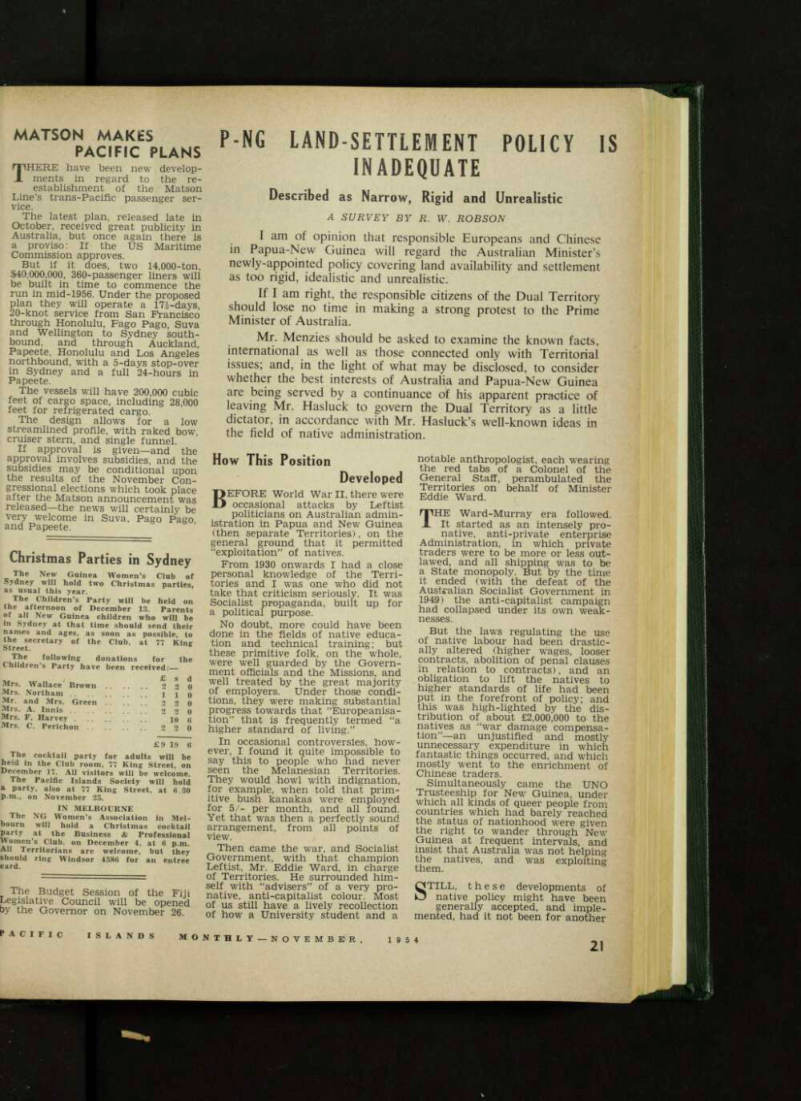
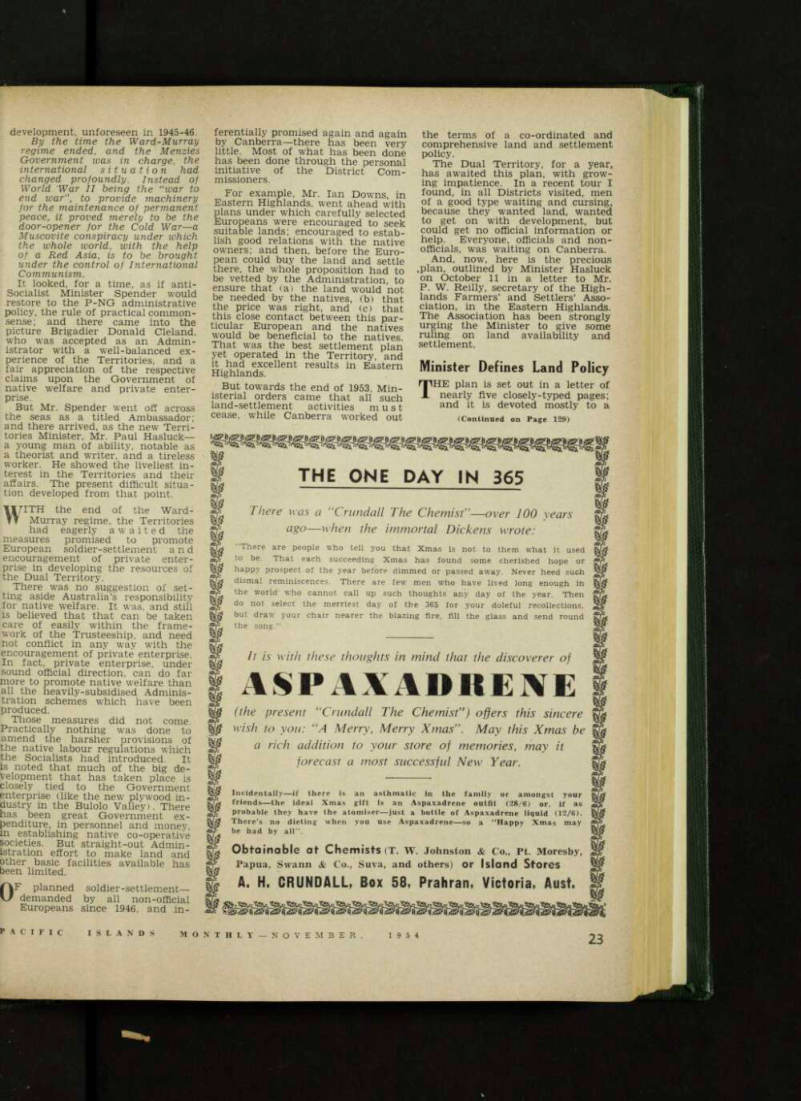
Png Land-Settlement Policy Is
Described as Narrow, Rigid and Unrealistic
A Survey By R. W. Robson
I am of opinion that responsible Europeans and Chinese in Papua-New Guinea will regard the Australian Minister’s newly-appointed policy covering land availability and settlement as too rigid, idealistic and unrealistic.
If I am right, the responsible citizens of the Dual Territory should lose no time in making a strong protest to the Prime Minister of Australia.
Mr. Menzies should be asked to examine the known facts, international as well as those connected only with Territorial issues; and, in the light of what may be disclosed, to consider whether the best interests of Australia and Papua-New Guinea are being served by a continuance of his apparent practice of leaving Mr. Hasluck to govern the Dual Territory as a little dictator, in accordance with Mr. Hasluck’s well-known ideas in the field of native administration.
How This Position
Developed
BEFORE World War 11, there were occasional attacks by Leftist politicians on Australian admin istration in Papua and New Guinea (then separate Territories), on the general ground that it permitted “exploitation” of natives.
From 1930 onwards I had a close personal knowledge of the Terri tories and I was one who did not take that criticism seriously. It was Socialist propaganda, built up for a political purpose.
No doubt, more could have been done in the fields of native educa tion and technical training: but these primitive folk, on the whole, were well guarded by the Govern ment officials and the Missions, and well treated by the great majority of employers. Under those condi tions, they were making substantial progress towards that “Europeanisa tion” that is frequently termed “a higher standard of living.”
In occasional controversies, how ever, I found it quite impossible to say this to people who had never seen the Melanesian Territories.
They would -howl with indignation, for example, when told that prim itive bush kanakas were employed for 5/- per month, and all found.
Yet that was then a perfectly sound arrangement, from all points of view.
Then came the war, and Socialist Government, with that champion Leftist, Mr. Eddie Ward, in charge of Territories. He surrounded him self with “advisers” of a very pro native, anti-capitalist colour. Most of us still have a lively recollection of how a University student and a
notable anthropologist, each wearing the red tabs of a Colonel of the General Staff, perambulated the Territories on behalf of Minister Eddie Ward, rpHE Ward-Murray era followed, X It started as an intensely pro native, anti-private enterprise Administration, in which private traders were to be more or less out lawed and all shipping was to be a State monopoly. But by the time ended (with the defeat of the Australian. Socialist Government in „ e campaign had collapsed under its own weak npssp': , . But the laws regulating the use °*. labour had been drastic ad Y a lLered (higher wages, looser contracts, abolition of penal clauses in relation to contracts), and an £!?S? atl0 ? "? l lft „ tho A^Y 0 ? to higher standards of life had been RP. in the forefront of policy; and highlighted by the dis tnbution of about £2,000,000 to the natives as war damage compensa
whfch
fantastic things occurred, and which mos tlv went to the enrichment nf Chinese traders. enrichment of Simultaneously came the UNO Trusteeship for New Guinea, under which all kinds of queer people from countries which had barely reached the status of nationhood were givln the right to wander through New Guinea at frequent intervals, and insist that Australia was not helping the natives, and was exploiting them,
QTILL, these developments of
O native policy might have been generally accepted, and imple mented, had it not been for another
development, unforeseen in 1945-46.
By the time the Ward-Murray regime ended, and the Menzies Government was in charge, the international situation had changed profoundly. Instead of World 'War II being the “war to end war”, to provide machinery for the maintenance of permanent peace, it proved merely to be the door-opener for the Cold War —a Muscovite conspiracy under which the whole world, with the help of a Red Asia, is to be brought under the control of International Communism.
It looked, for a time, as if anti- Socialist Minister Spender would restore to the P-NG administrative policy, the rule of practical common sense; and there came into the picture Brigadier Donald Cleland. who was accepted as an Admin istrator with a well-balanced ex perience of the Territories, and a fair appreciation of the respective claims upon the Government of native welfare and private enter prise.
But Mr. Spender went ofi across the seas as a titled Ambassador; and there arrived, as the new Terri tories Minister, Mr. Paul Hasluck— a young man of ability, notable as a theorist and writer, and a tireless worker. He showed the liveliest in terest in the Territories and their affairs. The present difficult situa tion developed from that point.
IITITH the end of the Ward -11 Murray regime, the Territories had eagerly awaited the measures promised to promote European soldier-settlement and encouragement of private enter prise in developing the resources of the Dual Territory.
There was no suggestion of set ting aside Australia’s responsibility for native welfare. It was, and still is believed that that can be taken care of easily within the frame work of the Trusteeship, and need not conflict in any way with the encouragement of private enterprise.
In fact, private enterprise, under sound official direction, can do far more to promote native welfare than all the heavily-subsidised Adminis tration schemes which have been produced.
Those measures did not come.
Practically nothing was done to amend the harsher provisions of the native labour regulations which the Socialists had introduced. It is noted that much of the big de velopment that has taken place is closely tied to the Government enterprise (like the new plywood in dustry in the Bulolo Valley). There has been great Government ex penditure, in personnel and money,
in establishing native co-operative
societies. But straight-out Admin istration effort to make land and other basic facilities available has been limited.
OF planned soldier-settlement— demanded by all non-official Europeans since 1946, and in
ferentially promised again and again by Canberra—there has been very little. Most of what has been done has been done through the personal initiative of the District Com missioners.
For example, Mr. lan Downs, in Eastern Highlands, went ahead with plans under which carefully selected Europeans were encouraged to seek suitable lands: encouraged to estab lish good relations with the native owners; and then, before the Euro pean could buy the land and settle there, the whole proposition had to be vetted by the Administration, to ensure that (a) the land would not be needed by the natives, (b) that the price was right, and (c) that this close contact between this par ticular European and the natives would be beneficial to the natives.
That was the best settlement plan yet operated in the Territory, and it had excellent results in Eastern Highlands.
But towards the end of 1953, Min isterial orders came that all such land-settlement activities must cease, while Canberra worked out
the terms of a co-ordinated and comprehensive land and settlement policy.
The Dual Territory, for a year, has awaited this plan, with grow ing impatience. In a recent tour I found, in all Districts visited, men of a good type waiting and cursing, because they wanted land, wanted to get on with development, but could get no official information or help. Everyone, officials and non officials, was waiting on Canberra.
And, now, here is the precious .plan, outlined by Minister Hasluck on October 11 in a letter to Mr.
P. W. Reilly, secretary of the High lands Farmers’ and Settlers’ Asso ciation, in the Eastern Highlands.
The Association has been strongly urging the Minister to give some ruling on land availability and settlement.
Minister Defines Land Policy
THE plan is set out in a letter of nearly five closely-typed pages; and it is devoted mostly to a
(Continued on Page 129)
defence, in relation to native wel fare, of the system which the Min ister now has finally decided upon, and proposes to implement. Here
is the introductory paragraph;
“There has been no change in land policy. That policy is to respect the native ownership of land, and to ensure that enough land is reserved to the natives to meet their present and prospective needs. Land can only be acquired from the natives by the Administration; and the Administration will not acquire land unless the natives themselves are willing to sell, and unless the Administration is satisfied that the land to be acquired is surplus to the present and prospective needs of the natives. Having acquired the land, the Administration will make it available on leasehold in accordance with the land laws of the Territory.”
The Minister then goes on to make a series of statements, of which the following is a summary: In future, the Lands Department is to handle all lands questions, including acquisition from the natives and leasing to the settler. It is recognised that the Department has not the required staff at present, and he hopes that land-seekers therefore will recognise the officials’ diffi culties.
The process of acquisition has been haphazard, different officers at different times applying their own rules to deter mine whether land was required by the natives. This is to cease—the Lands De partment will handle all such matters in accordance with Government policy.
The system of acquiring particular
areas of land at the initiative of the land seeker is condemned, because this tends to make European settlement widely dis persed, and out of range of services and facilities. The Lands Department will make land available only near existing services and facilities.
Department will not be encouraged to acquire new areas of land until it is satis fied that the land already acquired is insufficient for current demand and that sufficient use is being made of it.
It is considered necessary, before acquir more native land, “to know far more than the Administration appears to know about actual native ownership of land . . . Until policy on this point can be made more precise, and sound procedures can be developed to serve that policy, we feel obliged to proceed carefully.”
Some “minor acquisitions” may be per mitted in order to clear up transactions under way; but “the Lands Department will have to take the responsibility of en suring that the long-term achievement of policy would not be hampered or limited in any locality by further acquisition of land”.
The Minister says' that the following procedures have been laid down: (a) The further acquisition of land from the natives should be supervised by the Lands Department acting in consultation with the Departments of District Services, Health, Agriculture and Forests, regarding present and prospective needs, and the best economic use of any land acquired. (b) Land held or acquired by the Ad ministration should be examined by the Lands Department, in consultation with the other Departments concerned, to determine the best use to be made of it, and a land-use plan prepared.
(c) Land available for disposal in accordance with a land-use plan should be advertised as open to application, and; applications should be considered by a Land Board.
Points Against Minister’s Plan
THE Minister, with the courtesy
characteristic of him, sent a copy of his Reilly letter to the Editor of the PIM. On October 15',
just before departure for Fiji and
places east, I acknowledged the
Minister’s communication, and I said that I believed the reaction of most Territorians to his outline of policy and procedure would be un favourable, for these reasons: I.—Your approach to this basic problem of the administration of Papua-New Guinea by Australia is unrealistic and idealistic, and does not take sufficient cognisance of the facts that an enormous and growing mass of Asiatic and semi- Asiatic peoples is likely soon to spill over into the empty lands of the Western Pacific: that Papua-New Guinea is in the category of empty lands—they IVz million natives when, according t* Indonesian or Borneo or Philippines standards they could maintain 50 times that number—and the Asiatic countries, especially Japan, are well aware of it; and that in discussing lands policy and availability you treat Papua-New Guinea as if it were a thickly settled country, whereas, even taking mountains into account, it actually is one of the most thinly settled countries in this part of the world. • 2.—Most of your discussion in this out line of policy is dominated by the pro position that the needs of the natives are
in all circumstances a paramount con sideration. I respectfully but most strongly submit that this is not so. The protection of European settlement in Australia and countries eastward thereof is an equally important consideration.
The point is that if there is not in New Guinea a strong enough European settle ment and economy to tie Papua-New Guinea irrevocably to Australia, then Aus tralia inevitably must surrender Papua- New Guinea to the Asiatic races; and once established in Papua-New Guinea those Asiatic races are only one short step from Australia.
The welfare of the Papua-New Guinea natives is a most important consideration but I maintain that, in the overall view, it is not the paramount consideration; and any policy which subverts our ulti mate security and our plans of defence to the theory that all European claims for land in Papua-New Guinea must take a secondary place to native claims, is unsound and must lead ultimately to disaster. 3.—1 submit that it is impossible now, in view of what has happened in Asia in the past 10 years, and still is happen ing. to maintain the United Nations pro position that native welfare in Papua-New Guinea must be our paramount considera tion. The availability and use of land in Papua-New Guinea represent the core of the problem of what is to be done in Papua-New Guinea by Australia —and the security of Australia and all South Pacific Europeans is now of greater importance than any arguments put forward by the Trusteeship Council.
We must treat New Guinea now, not so much as a Trusteeship, but as the first bulwark of our defence against the grow ing menace in Asia. If New Guinea is to be thus regarded—and I base my whole argument on acceptance of the fact that it cannot be regarded in any other way—we must establish in New Guinea in the shortest possible time the strongest possible community of Europeans; and in that regard the first essential is the en couragement of land settlement by Euro peans.
There is no reason why native welfare and the rapid training of natives to a higher standard of life should not be adequately provided for within the frame work of an administrative policy based on the paramount need for European settlement; and I contend that such a policy is quite feasible within the terms of the Trusteeship Agreement and that no challenge to the authority of the United Nations is necessary. It is merely a matter of a realistic interpretation of the Trusteeship Agreement and a realistic acceptance of international conditions as they have developed since the United Nations Charter was accepted at San Francisco in 1945.
My contention is based on my belief that the survival of the European countries in the South Pacific is of more importance, in our view, than the con ceptions of the United Nations and the Trusteeship Council, no matter how praise worthy they may have been in 1945, when we believed that international relationships could and would be controlled by an international body. 4.—1 cannot imagine how even the very limited amount of European land settle ment in Papua-New Guinea which you now apparently envisage can be handled bv the Department of Lands—a procedure which you emphasise on every page of your letter to Mr. Reilly. In May, 1954. the total personnel of your Lands Depart ment (apart from draughtsmen, surveyors, mines and geologists) totalled nine, in cluding three typists. It is difficult now to get skilled personnel for your Papua- New Guinea Public Service. If land selection and settlement are to be entirely
the responsibility of the Department of Lands, years must pass before sufficient trained personnel is available to allow any perceptible increase in European settlement in the different Districts. s.—The procedure proposed, even if Lands officers were available for the 15 Districts, seems to me—in view of what I have seen personally in recent times in the different centres of administration — far too rigid. Different Districts clearly demand different methods—conditions vary widely—and obviously the man who should be in control of land settlement machinery should be the District Commissioner, sub ject only to the Administrator.
Any attempt to deprive the District Commissioner and the Administrator of this responsibility, and to channel all European land settlement plans through a Lands Board, tightly controlled by Trusteeship-based regulations and a Can berra Minister of definitely fixed ideas, is going to be strongly resisted by both official and non-official Europeans through out the Territories. With all respect, I agree in advance with the viewpoint which I know they will express.
I think I should have accepted their point of view and their arguments even if there had been no danger from Asia; but with that danger so plain, and de veloping so rapidly, I feel that it is the duty of all publicists who knew anything of the circumstances, to resist this policy that you have outlined by all the means available to them.
Appeal to Prime Minister
FOLLOWING the foregoing facts
and argument, here are what
appear to be the outstanding
points, as they affect the present
life and probable future of the
European residents of Papua and
New Guinea.
In Mr. Hasluck, the Australian
Territories probably have the best
educated, most eager and interested,
and most sincere Minister they ever
have known.
In Brigadier Cleland, the Terri
tories have an Administrator of great ability, with an outlook capable of holding the balance fairly as between the Missions and Trustee ship Council (who put too much em phasis on native welfare) and non official residents, who naturally measure all administrative problems from the private enterprise angle.
Brigadier Cleland has the gener ally loyal support and goodwill of what I think is the most competent and honest administrative personnel in the South Pacific Islands. These young Australians are doing a fine job; and, given a clear-cut policy that they can believe in, they will establish in P-NG an economic set up that will be a credit to Aus
tralia and some guarantee of security for the rest of the South Pacific countries.
ALL sections, official and non official, have suffered for about two years under a sense of frustration. The cause is the in ability of all classes to get on with the task of settlement and develop ment; and there is growing recog nition of the facts that this is due to Canberra’s failure to understand the real character of Australia’s obligation in P-NG, and to Can berra’s temperamental inability in any case to hand over complete re sponsibility to the Administrator and his competent and experienced
District Commissioners and Depart mental heads.
Evidence of this is provided, for example, in the Canberra decisions to (a) send each year to Australia 20 natives for secondary education, for four years, in Australian schools: and (b) the hamstringing of land acquisition and settlement through the rigid and unimaginative system just devised and announced by the Minister. These indicate that Can berra’s line of thinking on P-NG’s two fundamental problems (native education and land settlement) is put right out of focus by Canberra’s undue sensitiveness on the subject of native welfare.
Minister Hasluck’s intense—almost fanatical —preoccupation with native welfare is seen in various directions —in a book he wrote on Australian aborigines, for example; in notes he compiled for the 1954 Budget de bate; in the speech he made in the Budget debate on September 1, 1954; and especially in this recent letter to Mr. Reilly. It is most un fair to Australia—and especially to both official and non-official re sidents of P-NG —that anything of such importance to the whole South Pacific as the future control of New Guinea should be subjected to Mr.
Hasluck’s undue preoccupation with natives and a personal interest in P-NG administration so intense that he is unable to leave the task with out unnecessary interference to the experienced and competent officers \n the Territories.
THE Minister quotes—and can continue to quote—endless stat istics to prove marked “pro gress” in P-NG. But analysis shows that the “progress” is due mainly to (a) the distribution of enormous Australian subsidies there; (b) the expenditure by private companies on oil search; (c) the phenomenal profits accruing to old-established plantations from high copra, cocoa and coffee prices. If progress is to be measured in terms of develop ment based on new planting and new settlement and increased Euro pean production therefrom —which in our view is all that really matters —the picture is quite different.
These are the facts (irreconcilable under present conditions) to which the attention of the Australian Prime Minister should be directed.
Some people are certain to de scribe this article as anti-native, and an attempt to argue that Aus tralia’s responsibility for native wel fare should be ignored.
It is not. It is, however, a plea that Australia’s responsibility in re lation to these natives should be seen in better focus, and against the really terrifying picture of the Cold War.
Australia, as a defence measure, has an important obligation towards the P-NG natives. It is vital, as part of Australia’s bastion of de fence in New Guinea, that the natives be given some degree of
literacy, that their standard of liv ing he improved and that their goodwill and loyalty he cultivated.
That is an important part of our security plan; hut it is not para mount. And the job of implement ing it should he left to the trained and experienced men in the field, and not made the subject of far reaching, over-riding plans and de cisions by high official theorists in Canberra, who too often are guided by deeply implanted prejudices, or by advisers who have not that practical knowledge that can be gained only by long residence in
F-Ng.
(See Minister’s defence of policy, page 10, this issue.)