Partnership with BSIP Government?
p. 24 · Read in the full issue
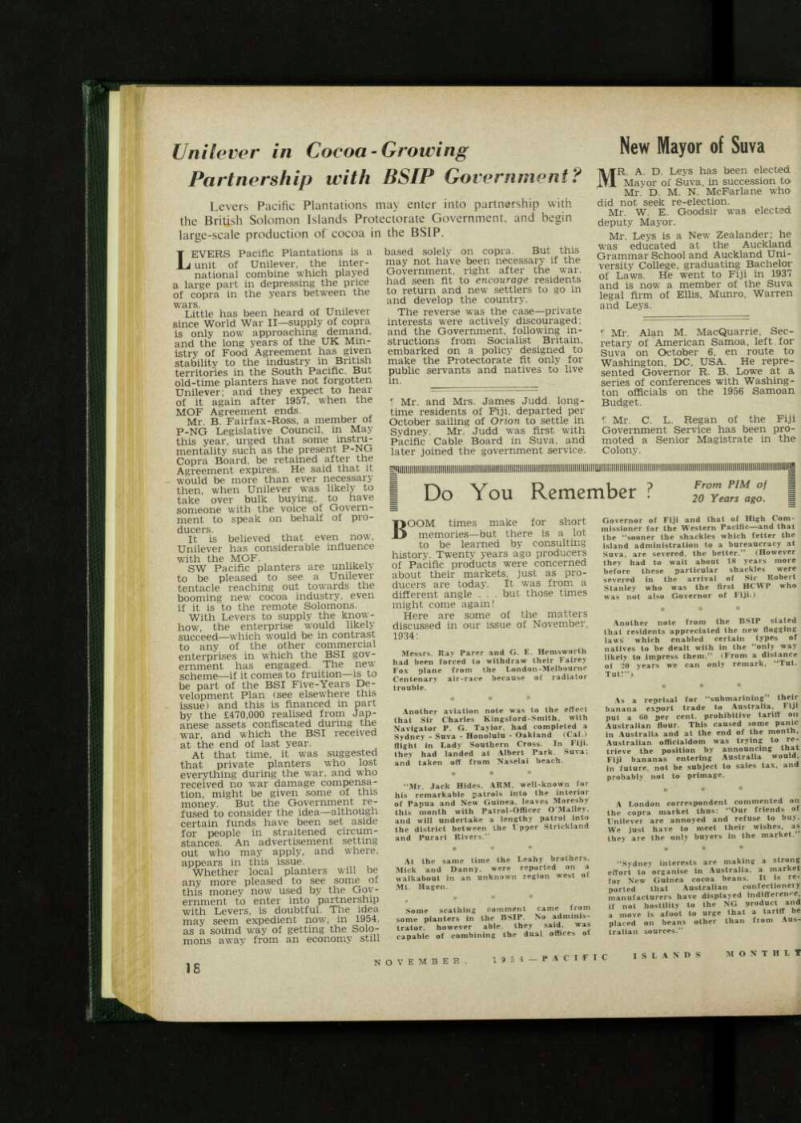
Unilever in Cocoa-Growing Partnership with BSIP Government?
Levers Pacific Plantations may enter into partnership with the British Solomon Islands Protectorate Government, and begin large-scale production of cocoa in the BSIP.
LEVERS Pacific Plantations is a unit of Unilever, the inter national combine which played a large part in depressing the price of copra in the years between the wars. , „ Little has been heard of Unilever since World War ll—supply of copra is only now approaching demand, and the long years of the UK Min istry of Food Agreement has given stability to the industry in British territories in the South Pacific. But old-time planters have not forgotten Unilever: and they expect to hear of it again after 1957, when the MOF Agreement ends.
Mr. B. Fairfax-Ross, a member of P-NG Legislative Council, in May this year, urged that some instru mentality such as the present P-NG Copra Board, be retained after the Agreement expires. He said that it would be more than ever necessary then, when Unilever was likely to take over bulk buying, to have someone with the voice of Govern ment to speak on behalf of pro ducers.
It is believed that even now, Unilever has considerable influence with the MOF.
SW Pacific planters are unlikely to be pleased to see a Unilever tentacle reaching out towards the booming new cocoa industry, even if it is to the remote Solomons.
With Levers to supply the know how, the enterprise would likely succeed —which would be in contrast to any of the pther commercial enterprises in which the BSI gov ernment has engaged. The new scheme —if it comes to fruition —is to be part of the BSI Five-Years De velopment Plan (see elsewhere this issue) and this is financed in part by the £470,000 realised from Jap anese assets confiscated during the war, and which the BSI received at the end of last year.
At that time, it was suggested that private planters who lost everything during the war, and who received no war damage compensa tion, might be given some of this money. But the Government re fused to consider the idea —although certain funds have been set aside for people in straitened circum stances. An advertisement setting out who may apply, and where, appears in this issue.
Whether local planters will be any more pleased to see some of this money now used by the Goy ernment to enter into partnership with Levers, is doubtful. The idea may seem expedient now, in 1954. as a sound way of getting the Solo mons away from an economy still
based solely on copra. But this may not have been necessary if the Government, right after the war, had seen fit to encourage residents to return and new settlers to go in and develop the country.
The reverse was the case—private interests were actively discouraged: and the Government, following in structions from Socialist Britain, embarked on a policy designed to make the Protectorate fit only for public servants and natives to live in. r Mr. and Mrs. James Judd, long time residents of Fiji, departed per October sailing of Orion to settle in Sydney. Mr. Judd was first with Pacific Cable Board in Suva, and later joined the government service.