Man and Cat Against the Sea!
pp. 22-149 · Read in the full issue
No Theories—It Was
Just A Case Of
Suva and Apia and Pago Pago still are rocking slightly under the newspaper earthquake started by Sydney Daily Telegraph , in its quest for world rights of the story of William Willis, “I-won’t talk” raft-drifter from Peru.
IT started when Willis, somewhere off Pago Pago, feebly radioed his arrival. Immediately, various folk in Suva and Apia, who repre sent newspaper organisations, began to receive long, urgent radiograms.
They found it hard to make Syd ney, London and New York under stand that Pago Pago, Tutuila, where Willis and his cat had arrived were far away and quite isolated.
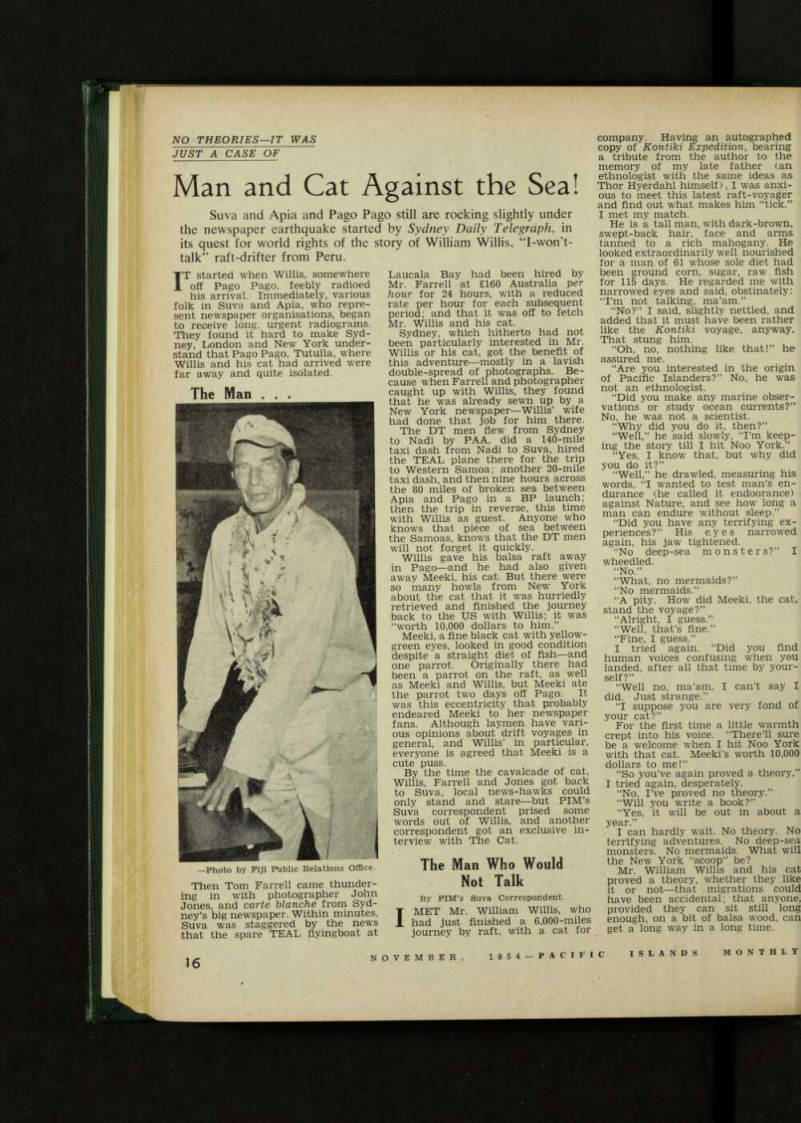
The Man . . .
Then Tom Farrell came thunder ing in with photographer John Jones, and carte blanche from Syd ney’s big newspaper. Within minutes, Suva was staggered by the news that the spare TEAL fiyingtaoat at
Laucala Bay had been hired by Mr. Farrell at £l6O Australia per hour for 24 hours, with a reduced rate per hour for each subsequent period: and that it was off to fetch Mr. Willis and his cat.
Sydney, which hitherto had not been particularly interested in Mr.
Willis or his cat, got the benefit of this adventure —mostly in a lavish double-spread of photographs. Be cause when Farrell and photographer caught up with Willis, they found that he was already sewn up by a New York newspaper—Willis’ wife had done that job for him there.
The DT men flew from Sydney to Nadi by PAA, did a 140-mile taxi dash from Nadi to Suva, hired the TEAL plane there for the trip to Western Samoa; another 20-mile taxi dash, and then nine hours across the 80 miles of broken sea between Apia and Pago in a BP launch; then the trip in reverse, this time with Willis as guest. Anyone who knows that piece of sea between the Samoas, knows that the DT men will not forget it quickly.
Willis gave his balsa raft away in Pago—and he had also given away Meeki, his cat. But there were so many howls from New York about the cat that it was hurriedly retrieved and finished the journey back to the US with Willis; it was “worth 10,000 dollars to him.”
Meeki, a fine black cat with yellow green eyes, looked in good condition despite a straight diet of fish —and one parrot. Originally there had been a parrot on the raft, as well as Meeki and Willis, but Meeki ate the parrot two days off Pago. It was this eccentricity that probably endeared Meeki to her newspaper fans. Although laymen have vari ous opinions about drift voyages in general, and Willis’ in particular, everyone is agreed that Meeki is a cute puss.
By the time the cavalcade of cat, Willis, Farrell and Jones got back to Suva, local news-hawks could only stand and stare —but PlM’s Suva correspondent prised some words out of Willis, and another correspondent got an exclusive in terview with The Cat.
The Man Who Would
Not Talk
By PlM’s Suva Correspondent.
IMET Mr. William Willis, who had just finished a 6,000-miles journey by raft, with a cat for
company. Having an autographed copy of Kontiki Expedition, bearing a tribute from the author to the memory of my late father (an ethnologist with the same ideas as Thor Hyerdahl himself), I was anxi ous to meet this latest raft-voyager and find out what makes him “tick.”
I met my match.
He is a tall man, with dark-brown, swept-back hair, face and arms tanned to a rich mahogany. He looked extraordinarily well nourished for a man of 61 whose sole diet had been ground corn, sugar, raw fish for 115 days. He regarded me with narrowed eyes and said, obstinately; “I’m not talking, ma’am.”
“No?” I said, slightly nettled, and added that it must have been rather like the Kontiki voyage, anyway.
That stung him.
“Oh, no, nothing like that!” he assured me.
“Are you interested in the origin of Pacific Islanders?” No, he was not an ethnologist.
“Did you make any marine obser vations or study ocean currents?”
No, he was not a scientist.
“Why did you do it, then?”
“Well,” he said slowly, “I’m keep ing the story till I hit Noo York.”
“Yes, I know that, but why did you do it?”
“Well,” he drawled, measuring his words, “I wanted to test man’s en durance (he called it endoorance) against Nature, and see how long a man can endure without sleep.”
“Did you have any terrifying ex periences?” His eyes narrowed again, his jaw tightened.
“No deep-sea monsters?” I wheedled.
“No.”
“What, no mermaids?”
“No mermaids.”
“A pity. How did Meeki, the cat, stand the voyage?”
“Alright, I guess.”
“Well, that’s fine.”
“Fine, I guess.”
I tried again. “Did you find human voices confusing when you landed, after all that time by your self?”
“Well no, ma’am, I can’t say I did. Just strange.”
“I suppose you are very fond of your cat?”
For the first time a little warmth crept into his voice. “There’ll sure be a welcome when I hit Noo York with that cat. Meeki’s worth 10,000 dollars to me!”
“So you’ve again proved a theory,”
I tried again, desperately.
“No, I’ve proved no theory.”
“Will you write a book?”
“Yes, it will be out in about a year.”
I can hardly wait. No theory. No terrifying adventures. No deep-sea monsters. No mermaids. What will the New York “scoop” be?
Mr. William Willis and his cat proved a theory, whether they like it or not —that migrations could have been accidental; that anyone, provided they can sit still long enough, on a bit of balsa wood, can get a long way in a long time.
—Photo by Fiji Public Relations Office.
An Exclusive Interview
With Meeki
APAKUKI TUITAVUA is one of my Fijian friends. Rugby fans will remember him as the popular captain of Fiji’s 1952 and 1954 tour ing teams. He is also a government meat inspector, and at present is in charge of the Animal Quarantine Station at Vatuwaga, about four miles from Suva.
I am always in sympathy with underdogs (and cats), especially when they are being hounded and badgered by unintelligent humans, so when William Willis arrived in Fiji from Samoa during his flight back to New York, I decided to see his cat first.
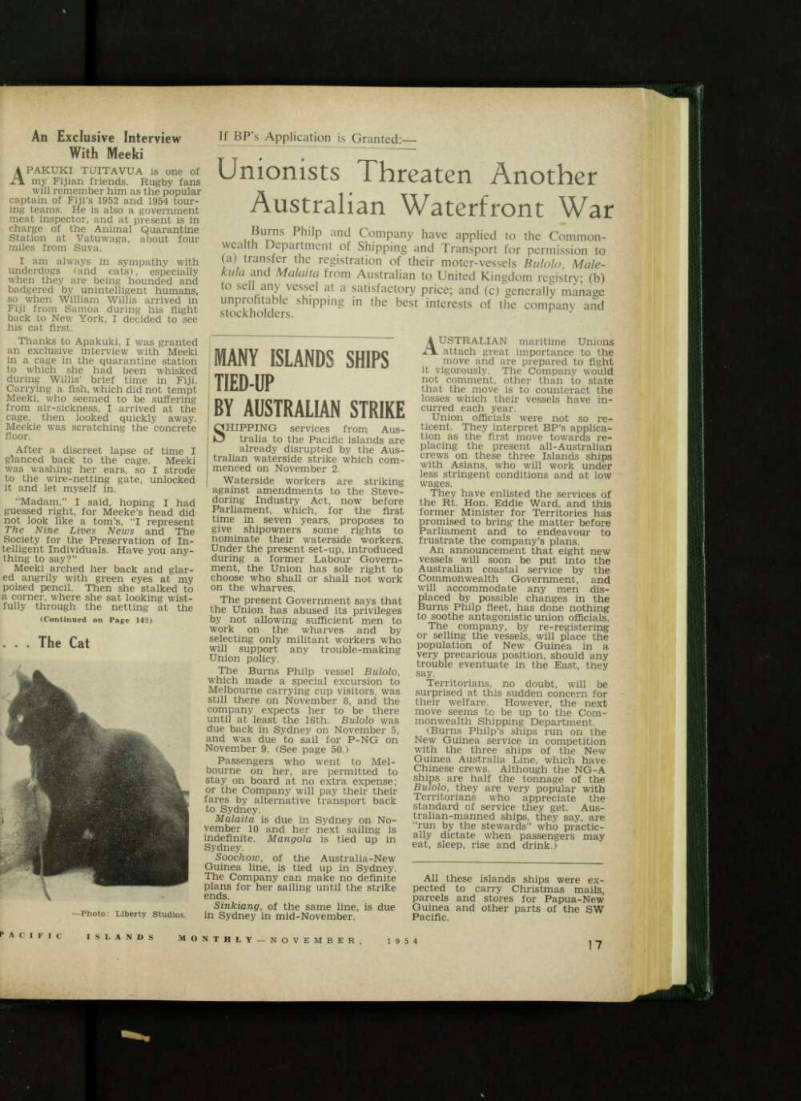
Thanks to Apakuki, I was granted an exclusive interview with Meeki in a cage in the quarantine station to which she had been whisked during Willis’ brief time in Fiji.
Carrying a fish, which did not tempt Meeki, who seemed to be suffering from air-sickness, I arrived at the cage, then looked quickly away.
Meekie was scratching the concrete floor.
After a discreet lapse of time I glanced back to the cage. Meeki was washing her ears, so I strode to the wire-netting gate, unlocked it and let myself in.
“Madam,” I said, hoping I had guessed right, for Meeke’s head did not look like a tom’s, “I represent The Nine Lives News and The Society for the Preservation of In telligent Individuals. Have you any thing to say?”
Meeki arched her back and glar ed angrily with green eyes at my poised pencil. Then she stalked to a corner, where she sat looking wist fully through the netting at the
(Continued on Page 142)
brown earth outside while comment ing cattily about humans; “For a hundred and fifteen days, from Peru to Pago Pago, I dreamt about earth —and then what happened? Locked up in Fiji, with a concrete floor!
Haven’t you humans got any con sideration for travelling cats?” —
Jack Thornton.
What It Was All About
WHEN wiry 61-year-old New Yorker William Willis released the tow line of a Peruvian naval tug on June 22, ten miles off Callao, the news was flashed to the world that Seven Little Brothers was on the way. But by the time he released the tow line of Manu’a Tele off Pago Pago wharf soon after midnight on October 21, 5,900 miles and 115 days later, the name of the 34-ft, seven-log balsa raft had be come established as Seven Little Sisters. The Port Captain at Callao advised PIM that the raft was named 7 Hermanitas — and the dictionary says that Hermanitas may be little brothers or little sisters.
This —or the Kon-Tiki venture— could not be described as a true drift voyage. Willis”s raft carried a substantial sail area, which drove him at a surprising speed. Kon- Tiki made only 42.6 miles per day; Willis averaged 51.3 miles per day with his smaller raft. Willis appar ently passed very close to the south of the Marquesas, which he did not sight, close past uninhabited Flint, which was the only land he sighted before the Manua Islands, and close north of Suwarrow.
Though he carried the latest type of Marconi Salvita lifeboat trans mitter he used it only on June 30 when he reported all well to Callao naval base; and again when, unable to make a landing on the Tutuila coast and carried on to the north west.
Through the alertness of Mr.
Doug Cunnold, officer-in-charge of Rarotonga Radio, these signals were picked up from the little hand
turned-generator set. He promptly
contacted Tutuila Radio through commercial radio channels, and Manua Tele, about to sail for her annual refit in Suva, was despatched.
When located, Willis was nearer Upolu than Tutuila and the tow back against the Trades to Pago Pago took 13 hours.
Two months out of Peru, his cans of fresh water rusted and to eke out supplies he thereafter drank 3 glasses of sea water per day.
Like the Kon-Tiki men, Willis found the ocean alive with dolphins which provided him with a steady fresh diet, supplementing his corn meal.
Willis’ raft was well equipped with nativational gear, although he seems to have been extraordinarily ignorant of its use. He did not find
out how to wind his chronometer before sailing, and, though it was faulty, used a watch instead. Nor did he know' how to put distilled water in his radio receiver battery (the emergency transmitter did not use a battery.) There was nothing amazing in the voyage as a feat of navigation. But, if only accidentally, he has demon strated again that some people could have reached Polynesia from east as
well as from west.