Record Budget
p. 17 · Read in the full issue
P-NG LegCo Discusses: How to Spend the £10.5 Millions Record Budget
P. Moresby, Nov. 6.
THERE were only three new faces amongst the non-official mem bers of the Papuan-New Guinea Legislative Council which met in Port Moresby for days at the be ginning of November.
They were Mr. G. Whittaker, elected member for New Guinea Mainland; Mr. Robert Bunting, a businessman with interests in Samarai. Lae and the New Guinea Highlands who replaces Mr. J.
Sedgers, who did not seek re appointment; and John Vuia, native representative who replaces Aisoli Salin. Vuia is president of the Rabaul native village council.
The full list of non-official nom inated members of this, the second post-war Legislative Council of P NG, is:
Mission Representatives
The Very Reverend James Dwyer The Reverend D. E. Ure The Reverend F. G. Lewis
The Native Members
Simogun Peta Merari Dickson John Vuia
Other Non-Official Members
Mr. B. Fairfax-Ross Mrs. Doris Booth Mr. Robert Bunting The elected European members are: Mr. E. A. James (Papua) Mr. G. Whittaker (NG Mainland) Mr. D. Barrett (NG Islands) The most important work of the Council’s first meeting and the work which took the longest to achieve, was the passing of this year’s record budget of £10,000,000. Apart from passing a few minor Bills, including one which provides £lOO penalty for any non-natives found in certain native villages between 9 p.m. and 6 a.m., there was nothing of great significance in the routine work.
The colour, as usual was added by the adjournment speeches of the elected and nominated members, which provided a varied collection of suggestions, most of them good, but which will, as usual, probably get little attention from Canberra.
One of the most insistent pleas made at the present meeting was pne to change the title of Admin istrator to High Commissioner, to bring this office into line with the titles of various other, and smaller, Pacific Territories.
This was moved by Mr. James (Papua) and supported by Mr.
Barrett (Islands), Mr. Whittaker
(new member for the Mainland) and a number of nominated mem bers, including Mrs. Doris Booth, who remarked that she hoped that on this occasion “Canberra would
hear the voice of Papua-New
DoS?;
Rather along the same lines was another suggestion, also made bv the elected and nominated members, led by _a Mission representative, Father Dwyer, that the Administrator’s salary (£3,500) was “parsimonious in the extreme.’
The meeting will probably bring a few shocks to the Minister for
esoecfallyt'he plea bv 1 ~a£*SS?’
bCT sfmogun
AusteSs to be livenm£re tend in the Territory land The newlv-elected member Mr Whittaker, had a lot to sly on many subjects during the meeting, and w e hfc e h d to be continually waging during these Councils. B As Mr James nointed out pnriv in the week: “I have often heard it said that all the elected members do is criticise. Well, what can we do but criticise? What else can we do to help develop Papua-New Guinea?”
Mr. James made the very pertinent point that the unofficial members were never invited to help plan the works programme and the gen- Sent P ' anS f ° l ' Terrltory develop-
It’s likely that the next meeting will last at least 10 days. It will probably begin on March 14, 1955.
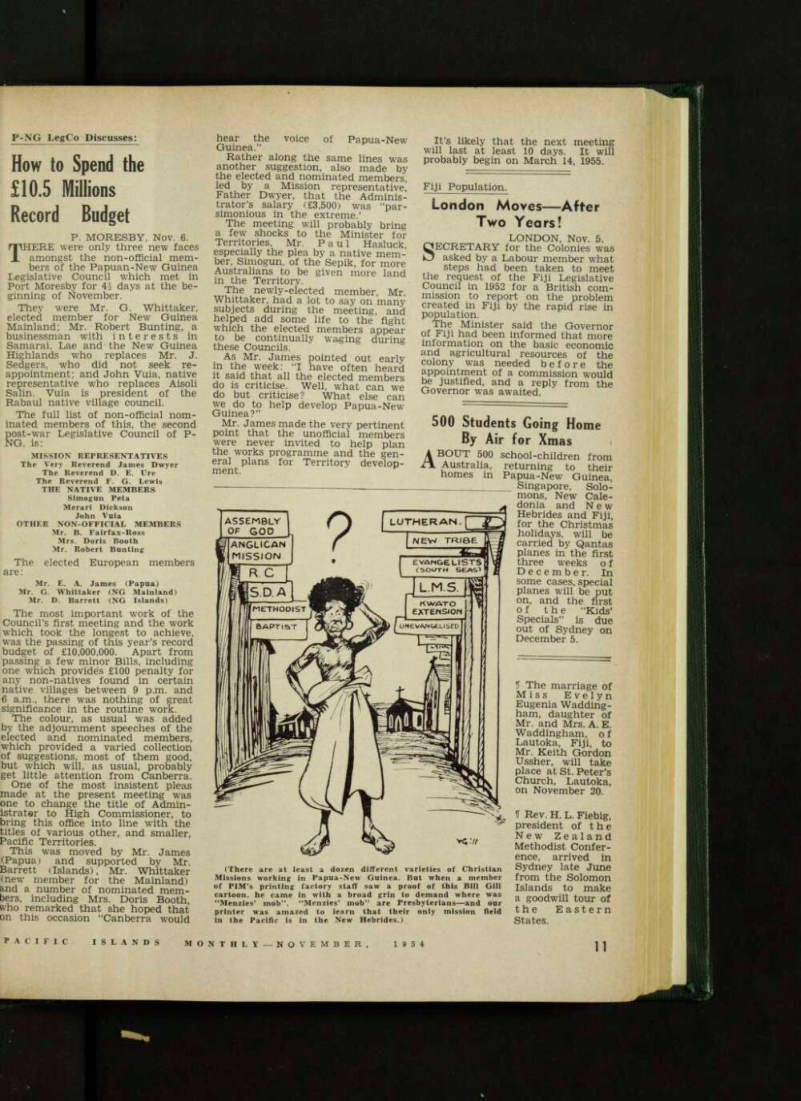
(There are at least a dozen different varieties of Christian Missions working in Papua-New Guinea. But when a member of PIM’s printing factory staff saw a proof of this Bill Gill cartoon, he came in with a broad grin to demand where was “Menzies’ mob”. "Menzies’ mob” are Presbyterians—and our printer was amazed to learn that their only mission field in the Pacific is in the New Hebrides.)