News of the Small-Ships
pp. 99-113 · Read in the full issue
It Happened In This Month:
1-The 230-ton Danish brig Saint *homas was wrecked under un gual circumstances in Fiji on Sep ember 1, 1869. With Captain Thag ard in command, the vessel war nder charter to Wolf den & Co. of lydney and was fully laden with otton, cotton seed, and coconut oil. rhen she cleared Levuka on a fine lear afternoon. In the light south asterly breeze she took a first “leg” cross towards Wakaya, then came bout and ran back towards Ovalau.
Phen approaching the Ovalau coast le wind fell away light, the Saint 'homas failing to come about, and Bfore anything could be done she as on the reef opposite Naslnu — ided by a strong set.
With all sail still set, she soon eeled over, but boats were lowered nd all hands and the passengers, Dt away. Mails, luggage, and most f the cargo were saved, but the essel was rotten and soon broke p. What remained of her, includ ig spars, rigging, ground tackle, ;c„ was sold some time later on le reef for £142/10/ —the cargo ringing £124. She was formerly a anish warship.
New Lighthouse:—Work Is
roceeding at Niau atoll in the uamotu on the foundations of a ?hthouse which the Public Works
Department of French Oceania is building there. It is expected that the light will be in operation by the end of the year.
Savoie Disposes:—Hard On
the news of the loss of Jacques del Mar on Lord Howe Island recently, comes news that Captain Emile Savoie has sold Colorado del Mar (ex Hokitika) to Etablissements Ballande at Santo. Captain Savoie purchased this vessel in Auckland last January at the same time as he purchased the Jacques del Mar in Wellington. Only the Maria del Mar (ex Margaret-W) of the vessels mentioned last month, remains under Savoie ownership.
Albert Bonneaud In
TROUBLE;—The attractive 240-ton inter-island trader Albert Bonneaud, owned by Comptoirs Francaise des Nouvelles Hebrides, came to grief early July when a heavy blow swept the New Hebrides and caused the vessel to drag onto the beach at Malequla, damaging her rudder but apparently not causing any serious hull damage. She was able to get off and in mid-August was still undergoing rudder repairs at Santo.
TINA II: —Some time ago we in correctly stated that Captain Beim, of Santo, had purchased the Fair
mile C-Gull. Actually, it was Tina 11, which was lost on Dentre casteau Reef, Banks Group, in a February blow, almost immediately after her arrival from Australia.
The Noumea Fairmile Philante II has since taken a salvage party to the scene and everything of value was successfully recovered, the hull only being a total loss.
Attached For Debts:—The
well-known French Oceania inter island vessel Florence Robinson, of 95 tons gross, was attached for debt in Papeete on July 30 and was to be auctioned with all equipment on
September 3. The vessel was owned by Messrs John and Sam Mervin .and the claimant, for the 1,595,262
francs owing, was Madame Helene Chapman.
Radio Pandemonium-
People associated with Smallships’ radio facilities in the Pacific fondly hoped, prior to the Atlantic City in ternational radio conference of 1947 that decisions w<puld be made there to end the existing pandemonium.
In actual fact, the situation fr a Smallships’ safety point of v to-day is even worse as the decisi then made are gradually put i operation. The frequency of 2 kc/s is nominally a world-w distress channel for voice-equip] vessels, but not a single Island co station is maintaining a continu watch on that frequency—or,
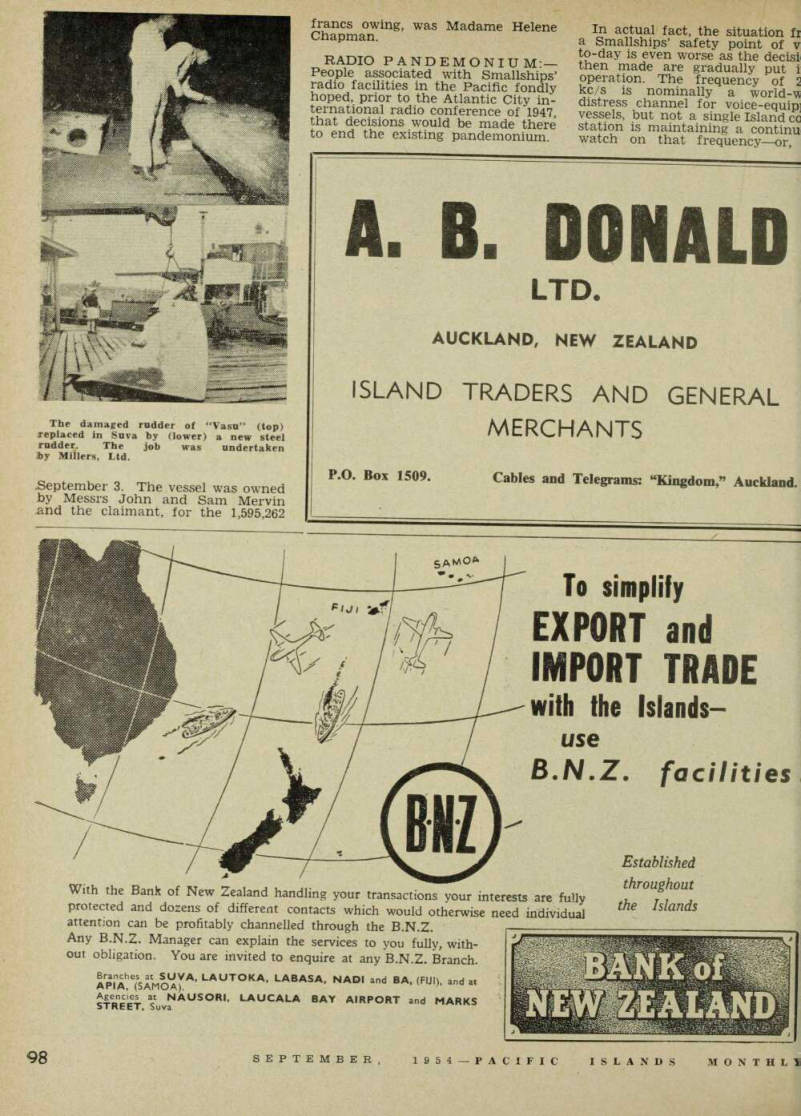
The damaged rodder of “Vasu” (top) replaced in Suva by (lower) a new steel rodder. The job was undertaken toy Millers, Ltd.
at matter, on any other stand dised frequency on which a small lip could raise assistance in an aergency.
The frequency of 6280 kc/s, ough not constantly guarded, was itil recently used by shipping in number of Island groups, includ g New Guinea and also on the istralian coast. The 2182 kc/s fre iency, while satisfactory for short nge working, is too low a frequ ,cy for the long-distance working lied for in the Islands at day ne, so was not acceptable to all [ministrations.
Now we find that an even greater riety of frequencies is being ought into use. Suva is about to andon 6280 in favour of some new jquencies. Noumea has just shifted yet other frequencies. French seania uses others again. A vessel ramping” in the South Pacific to ,y would have to carry half a zen transmitter crystals and have jransmitter capable of a frequency nge of from 2182 kc/s (Cook ands and Tonga) to around 8300 /s or higher.
Technical difficulties are involved, t, much worse, the safety factor ,s been substantially reduced. It
is difficult indeed to see why two frequencies—2lB2 kc/s and one in the 6-8 mc/s region—could not he agreed upon by all Island adminis trations, with other optional alternative working frequencies it desired, and at least a continuous speaker watch maintained on the two agreed frequencies by a few 24hour stations like Port Moresby, Noumea, Suva, Rarotonga and Papeete,
New Fairmile Models:—We
have received a copy of a new and glossy catalogue from the Fairmile Construction Company of Cobham, UK. These designers and builders of small-ships are as well known in the Pacific as they are nearer home, The prospective purchaser of any thing from a tug to a pleasure launch will find the catalogue which is illustrated with photos of the craft available—of interest. The company will also have vessels speci ally designed and built, if required— or modifications made to the models illustrated. KELAUA SOLD:—The Kelaua, one of the last two ships owned by the Commonwealth Government in
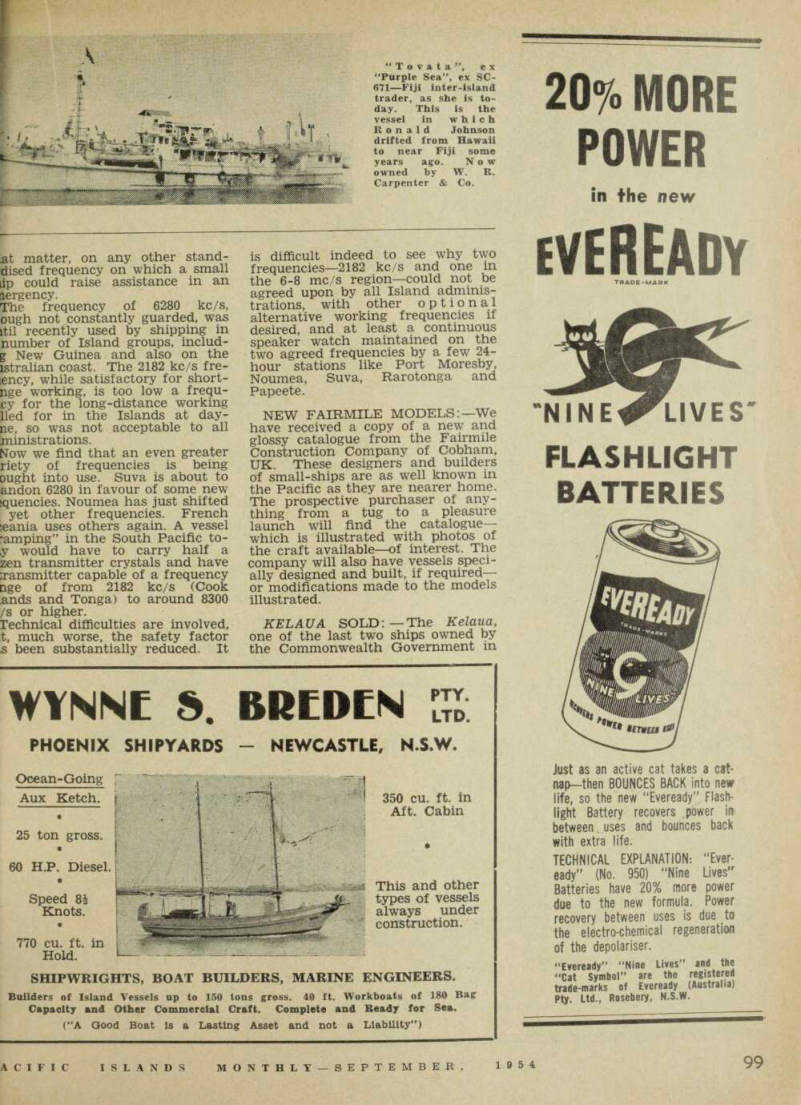
"Tovata ”, ex ‘‘Purple Sea”, ex SC 671—Fiji inter-island trader, as she is to day. This is the vessel in which Ronald Johnson drifted from Hawaii to near Fiji some years ago. Now owned by W. B.
Carpenter & Co.
e\v Guinea, has been sold to the fcred Heart Mission (New Britain) roperty Trust, Vunapope. She will place the under-powered Waimana frying heavy timber to Rabaul id diesel oil from Lae to run the [ission’s workshop and saw-mill g machinery.
Future plans for the Waimana e unknown. Originally a square zged three-masted sailing ship ,lthough when used by the RAAF iring the war, schooner rigged), ’aimana is auxiliary powered by jo Grey Marine engines and no nger uses sails. It is well known tat an American film company,
Twentieth Century Fox, recently offered to buy the ship at a very handsome figure for the sole purpose of sailing and wrecking her, but at that time she was still on active duty. Residents of the Territory are now wondering whether they will «e e r-bowed Waimana .once at of nseudo Wood Hollvwood Dirates ’ bl d ' thirsty, Hollywood pirates.
RIRA ENDS LIFE:—The oncefamous topsail schooner, Rira, which chased Count Felix von Luckner round the Pacific in 1917, broke its moorings during a recent storm and
piled up on Westmere Reef Auck land Harbour. For the last few years Rira has been just a hulk rotting in the harbour, In November 1916 von Turkov broke the ßritish blockade Atlantic with his 1 600-ton chnner Readier W (Sea Eagle) ° and SSS havoc amon S Allie d shipping.
In 1917, he entered the Pacific
Left: The new slipway being built in Rabaul Harbour by J. L. Chipper & Co. [?]en complete it will take ships of up to 300 tons. Right: the “KelauA” and the [?]aimana” at the smallships wharf, Rabaul.
and in August that year Seeadler was wrecked on a coral reef in the Society Islands; von Luckner set out in a lifeboat to find another vessel. They were captured and the Count, with one of his officers, was interned on Motuihi Island, Auck land. Escaping in the camp com mandant’s motor boat after start ing a fire in the camp, they soon captured the schooner Moa.
Rira, equipped with rifles and grenades set off in pursuit and eventually recaptured the elusive German. He was handed over to the authorities on the NZ ship Iris.
Coral Star Sinks:—G. V.
Miller & Co.’s converted LTC Coral Star turned over and sank in more than 1,000 fathoms of water approxi mately 35 miles south of Nouna Island (near Manus, NG) on the night of July 19. Although a heavy swell was running, the weather was fine.
Coral Star has a European captain and engineer and a native crew. It appears that when S-E of Manus Island, at 11 p.m., she developed a slight list to port. The list rapidly increased to 30 degrees, causing the 100 tons of cargo, including mobile equipment, bulldozers and workshop machinery, to break free and rush to the port side, opening up the whole length of deck. Twenty minutes after the list was first noticed, the vessel turned over and sank immediately.
Crew and passengers, including two Europeans, manned the boats and sailed, under make-shift sail,
the 65 miles to Adriel Is. They arrived there on Wednesday, July 21 A preliminary enquiry has been held at Rabaul. t RO S ALI E\ Societe des Hes Loyaute s Rosalie cleared Auckland on return to Noumea August 11, after an extensive refit which in cluded replacement of a large num ber of bottom planks and the greater part of the totara wooden sheathing on the starboard side of
the hull as well as elsewh Rosalie, one of the standard a posite American designed 11 powered lighters built in Auckl during World War 11, had accommodation considerably proved by the addition of a s deck house at Noumea after she purchased by her present own The bridge is on top of this ad deck house which accommodates master.
[Rosalie returned almost empty, Ithough a good deal could have Ben picked up in Auckland. iSTITCH IN TlME:—Arriving in uva from Apia in July, the master f Tasman Steamships’ Vasu re arted that the vessel’s rudder ppeared to be jamming in a sea ay. Investigations were taken in and by Millers Ltd.’s boatyard and i was found that the heavy wooden lock was seriously sprung and it as fortunate that the rudder had ot been lost, as would probably ave happened in heavy weather.
The rudder, as originally supplied > the Italian-built 300-tonner, as a piece of timber 12 h inches
lick. It was decided to replace it ith a fabricated steel rudder, the ib being smartly completed and asu sailing August 1 for Tarawa, .bout the only small vessel at pre *nt “tramping” in the South 'acific, Vasu is expected to sail for tie New Hebrides on her return to uva.
HIGH AND DRY;—Californian . Libby, arriving back in a village n the eastern frontier of Turkey ate July after climbing part way p Mt. Ararat, claimed that he has ound the remains of the original sland trader —Noah’s Ark. Bad leather forced him to descend but te planned to make another at empt to reach the top of the aountain which the Bible seems to dace as the stranding-point of the irk following the Flood. Allied air nen during the war reported sight ng “something” that could be the irk’s remains.
Second Thought: —U Nit Ed
states Government has now decided o pay $BOO,OOO compensation to the Japanese fishermen injured by 'adio-active ash from the March itomic tests at Bikini. This is con
siderably higher than the sum first offered.
But Too Much Paint.—Joe
Kurusiga, foundation member of one of Fiji’s now thriving Credit Unions, at Kalokolevu, has, with funds so raised, been able to purchase his own fishing punt—instead of paying hire on one. The new punt has been named Kalokolevu Credit Union!
French Oceania Radio
SCHEDS:—Latest news available in regard to R/T facilities in French Oceania, other than at Papeete, is as follows: Taiohae, Marquesas, FJC maintains watch on 2620 kc/s, replying on the same frequency or
alternatively on 2845 or 1755 kc/s from 0400-0530 and 1630-1800 GMT daily except Sunday (GMT).
LINE ISLANDS:—Communica tions in the Fanning-Washington- Christmas-Palmyra area are carried on, inter-island, on 3500 kc/s, voice and morse. Vessels equipped with that frequency may make contact initially by calling and listening be tween 1800-1900 GMT or at 0200 GMT. Alternatively, as Fanning is on the telegraph-cable route, a schedule may be arranged before departure from last port, when bound for the Line Islands,
Old-Timer Reports: Mr.
J. L. Russell, of Gladstone, Queens
Upper, “Rosalie” returned to her birth [?]ace for refit, including extensive re [?]anking of bottom; and lower, Fiji [?]edical Department’s busy “Vuniwai”.
nd, renewing his sub., mentions tat he served years ago in the On [long & Co. barquentine Alexa. He ilieved she was destroyed by fire \ the Gilberts about 1930, and inhered whether the company is ill in existence.
Bv chance, when his letter arrived, e New Zealand Government vessel aui Pomare was in port at Auck nd. and her master, Captain mlton, who served as Second Seer in Alexa for about 2h years, nfirms that she was destroyed by ■e, through spontaneous com istion, while she was loading copra Butaritari, around 1930. She was lilt in Holland, was 285-tons steel ssel, with a very poor reputation to speed. Best passage, he be >ves, was 150 days from Sydney to itaritari. Another time, with Mr.
C. Macdonald (who died in Auck nd at the beginning of August) mate, and Captain Boulton as cond mate, she made a 71-day issage from ’Frisco to Auckland.
On Chong, a Hongkong firm with i important office in Sydney, first med the steamer Brunner and the rque Loongana —the latter eventu ly breaking her back when beached Butaritari. Then came the Alexa, e steamer St. George and the acquarie.
The company was bought out ound 1937 by R. W. Carpenter & of Sydney, the John Bolton, a lall wooden motor vessel, then Lite new, being taken over in the lal.
TOVATA: —W. R. Carpenter & Co.’s Tovata, better remembered as the famous sub-chaser SC-671 in which Ronald Johnson drifted from Hawaii to Fiji, was in trouble in July. Negotiating the narrow Vatoa passage, the 112-tonner punched a hole in her planking in the way of the engine room when she bounced on a coral head. Slipped in Suva, the planking around the pro peller shafts was also found to be badly wormed. Repairs were put in hand and the vessel was expected to resume normal operations early August.
Expensive Snooze:—When He
fell asleep at the wheel on July 24, off Dawadawa, Milne Bay, Mr.
Lancelot Wilkinson, of Bubuletta, woke to find his 36-foot diesel launch Guguhini in the surf and on a sand bank. Before anything could be done, big seas from the fresh south-easter had swamped the craft and hurled the owner and his nine Papuan crewmen over board. Two of the crew were drowned in trying to get ashore and Mr.
Wilkinson, in August, was in the Samarai hospital with broken ribs and lacerations.
RECORD DRIFT;—What appears to be an all-time record drift by a bottle—if no hoax was involved — was reported from Auckland in July. There Mr. Percy Myall re ceived back a portion of a cigarette packet on which he had scrawled his name and address and tossed
overboard in a lemonade bottle from the Monowai two days out of Auckland, bound Sydney in Oc tober, 1936.
Thp . ttl „ 7QC .
H annisbu?e beach Norfolk P FnI “
. JNorloiK >
If™?’ f h llo ’_ r ?jL lB , P to round the Horn
™uth welt H Afrirn thP^?P
waids south west Africa thence
north-west until picked up by the V2P Stream, and so across the Atlantic again to England. The s°.ttle may, of course, have been drifting about the English coast for years before it was actually picked up by school-master St, Pierre, who sent the card to his brother in Auckland for personal delivery.
Weather In French:—A Re
cent Notice to Mariners reports that
Sector broadcasting station on
3355/6035 kc/s now gives the forecast for that area in 0115 GMT, re peated at 0200 GMT—in the French language.
WARNING:— Another Notice is of interest to small-ships’ masters who have been wise enough to equip their vessels with one of the surplus Gibson Girl automatic-dis tress hand-cranked emergency transmitters and other similar automatic distress transmitters.
These should never be tested at tached to an aerial—or even with the aerial wire left very close to the set, as there have recently been cases where false distress signals were sent which caused consider able concern and bother.
Should one of these accidently be wound while attached to an aerial, steps should immediately be taken to inform the nearest coast station of the accidental trans mission before the Search and Rescue Organisation goes into action.
The local radio inspector will always test these sets for masters upon re quest.
Chore Completed:—The Sur
vey vessel HMNZS Lachlan, Com mander G. S. Ritchie, RN, con tinuing her survey of Samoan coastal waters, this year sounded
the main shipping track from 1 100-fathom line northward sei miles to Apolima Strait. Last y< she surveyed from the Strait Apia Passage.
In shore work was also can out with sounding launch betwt Malua light and Fasitoouta. aerial survey of the area, also un<
t y, would aid in the final work of sparing new charts. Due for a uor refit next winter, Lachlan iy not return until the follow t year. The practice has been do survey work in Fiji-Samoa ,ters for short periods during the dter while weather prevents work the big New Zealand coastal rvey job.
SUVA PORT:—It is expected that ; recent heavy congestion of •go on the Suva waterfront will relieved by the new receiving jds which came into use in July, though the port area is to be [fted entirely within a year or 0 (at considerable cost), these ;ds, erected to the rear of the sting sheds, have been built as interim measure.
NEAR MISS:—In a book just Wished, The Moon Puzzle, N. O. rgquist, of Copenhagen, con des that the moon was formed m a piece of the earth gouged t of what is now the Pacific ean by a passing planet. The ;ory, which seems to have some entitle support, is that the planet uck somewhere close to what is w Tonga, in a glancing blow to rds the south-east past what is sv Cape Horn. The result was a al wave which literally washed ay continents and gave the •th its present axial tilt which es us our seasons. Till then the jgraphical and magnetic poles ncided. The crash caused an im diate and permanent separation those poles. rhe pieces of earth which was nged off from Tonga to Cape rn was hurled into space to be ne nicely balanced between the ivitational pulls of the surround ; celestial bodies. So the Tongans iy, after all, be related to the ,n in the moon—or something.
DAY OUT:—The French patrol Dp Tiare, Commandant Servent in nmand, in Suva for drydocking July, took a party of school lldren round the coast, under otage of Captain Harness, Suva rbour master-pilot, to attend an rersary celebrations at Queen itoria School, Matavatucou. There mmandant Servent was received :h traditional Fijian ceremonial, 1 school boys were ferried out to ik over Tiare, and a good time s had by all.
Tiare departed Suva July 24 to itinue her usual winter cruise to illis and Futuna, Tahiti, and Dbably other non-French groups her run back to Noumea. She t a petty officer in hospital re peating from a serious operation.
F’ROG SURVEY:—Because the d was unavailable for examination the bottom of Adi Keva, follow l her recent stranding, and be ase the men required to carry b the survey are members of the va spear-fishermen’s club, no
time was lost in carrying out a frog-man survey using aqua-lungs.
This was the first occasion that this type of equipment had ever been used commercially in Suva.
The frog-men were Assistant Mechanical Engineer Corbett of the PWD ship-yard, and Mr. Colin White, of Miller’s Boatyard. The survey showed that no damage had been done in the stranding.
Cws Reshuffle: —Coi O N Y
Wholesale Society of Tarawa re cently had a reshuffle of skippers in its smallships fleet. Captain Stan Brown, lately of Maureen, resigned in Suva in July on arrival there with that vessel for survey. He is reported to be interested in the new Fiji Navy unit. Captain Vic Ward
has transferred from Tuvalu to Tungaru. Captain Gerry Douglas now commands Tuvalu. Captain Hay, well known in Suva, was ex pected to take command of Maureen on completion of refit. That vessel has not been slipped for two years and her hull is reported to be in bad shape with much copper miss ing. Of double-skinned construc tion, it is anticipated that replace ™ent of planks will be a protracted Job-
Unwanted Lct;—Vacuum
Oil Company has been unable to sell its Suva-based LCT VO-1, idle since the opening of the Vacuum oil terminal near Nadi put her out of business as a transporter of drummed oil from Suva to Lautoka
adi. The price asked was earlier ported to be very reasonable, but f considerable amount of work ould have been required on the issel to comply with surveys due. acuum are reported now to be ripping the LOT of useful equip ent. Like other LCT’s, she is iwered with three 225 hp GM otors.
Caron Ia Calling:— If You’Ve
ten hearing an attractive Ameri ,n voice calling KQM in Honolulu id signing WE-9951, that’s Mrs. lanne Booth Johnson, radio orator, secretary, shareholder and xector of the Portland salvage ganisation based aboard the big 6-ton motor yacht Caronia, cur ntly at Canton Island. Equipped Lth a 100-watt radio telephone, rect telephone calls can be made om Canton to Honolulu and rough there to the States by ironia. For ship-to-ship working rs. Johnson uses 2638 kc/s.
NOT BlTlNG:—Captain “Dusty” iller, of Joyita, recently trans rred his fishing locale from Can n to the more profitable American imoa area. Joyita is probably the ily wandering free-lance fishing ssel operating south of the Line, tart from Japanese-owned craft.
Noumea Addition—Maid Of
nto, British-built wooden trawler, lich arrived in Noumea early June r Agence Reuter, has been re imed Lorraine. She is reported, twever, to have experienced seri
ous engine trouble en route from Malta and may have to be re engined before going into com mission in the New Caledonia coastal trade. Lorraine is at present powered with a Crossley diesel. She is a vessel of 203 gross tons, 186 tons below decks, 110 nett, and measures 91.4 ft x 22 ft x 7.8 ft.
Lloyds give previous owners as Med iterranean Shipbreaking and Sal vage Co Ltd>> 0 f Malta. She will replace Reuter’s Jeanne d’Arc, lost b stranding last year,
Not Discouraged:—Mr. Lew
Graham, back in Auckland after the loss of Nukalau in the Tasman Sea, indicated in August that he is de finitely still in the shipping busi ness. He was then investigating the 563 GT Swedish-built vessel Falken (ex Lillemor, ex Brevik ) for sale at Stockholm. A steel vessel (“no more wooden ships, thanks!”) Falken was built in 1946 at Moss, Norway. She measures 150 ft x 30.7 ft x 10.6 ft with a nett tonnage of 334 and is Powered with an Atlas diesel, Mr. Cecil Harrison, other active partner with Mr. Graham in Pacific shipping ventures, was in Syndey in August standing by a HDML launch which was to be de livered to a Lord Howe buyer for fishing charters as soon as fitting out was completed there.
Lehi Continues, Crewless:
—Though De Vere Frank Baker, Mormon elder, of Petaluma, Cal., and his crew, had quit the raft Lehi
on the high seas a few days after setting out on an attempt to drift provisionless from San Francisco to Hawaii early July, the raft itself appeared to be continuing the voyage.
On August 6, just a month after she was towed out of the Golden Gate, a fishing vessel reported pass ing Lehi, still very much afloat, 250
miles south of Los Angeles and about 450 miles from her starting point. Owner Baker was reported trying to raise the funds to have the $17,000 raft (which contains radio gear, cameras, and other equipment left in the rush to abandon ship) towed home. He says he is deter mined to make the drift, if necessary by building another raft.
Lehi, named after a Jewish priest mentioned in the Book of Nephi in the Book of Mormon, was financed by Dr. Arthur Fearon, professor of philpsophy at San Francisco Uni versity. The voyage has a religious significance too involved to discuss Jiere.
LST’S FOR SALE:—The Ministry of Transport and Civil Aviation, London, was advertising a couple of well-known LST’s in mid- August. One was HMAS Lae, LST No. 3035, built in 1945, by Denny, of Dumbarton, engined with Rankin & Blackmore motors; and the other was HMAS Labuan, LST No. 3501, built and engined by Canadian Vickers in 1945. Both are well known in the New Guinea area.
They have a gross registered ton nage of 4,157, nett 2,430, and a ser vice speed of 13 knots. At that speed they burn 8,000 lbs of fuel oil per hour. These Mk.3-type LST’s are currently lying in Syd ney Harbour.
FIJI NAVAL BASE:—Work is in progress at the Bay of Islands, in Suva Harbour, on the erection of
headquarters for the new Fiji Royal Naval Volunteer Reserve.
The Fiji Military Forces con struction unit is at present erecting a drill hall 101 ft x 61 ft, with a two-storied lecture wing where rat ings will sling their hammocks at week-end training periods.
When completed, another two storied block will be built to house
office, storerooms, workshops accommodation for petty-ofl instructors and a permanent t crew.
A third building, the ward ro will then be erected, with officers’ cabins on the top floor, jetty will be built and a 72-ft tv diesel-powered SDML acquired New Zealand.
rhis launch will be given the same ime as the new shore station —not t decided. Some whalers and nghies will complete the fleet.
Rising from an opening strength 10 officers and 100 men, it is Mined eventually to have 30 leers and 300 men within a few ars. A limited training programme to commence immediately, on a rritorial basis, with night and sek-end training only.
Lieut. S. Brown, recently master Gilberts CWS vessels, has been pointed executive officer under ►mmander G. R. Woods, VRD, 10 will command the Reserve.
Slipways Building In P-Ng:
A photograph on page 101 shows e site of the new slipway in ibaul which will be built by T. L. upper & Co. [n Moresby, Andrews & Roberts, at-builders and shipwrights, will □rtly commence building a slip ,y of small boats on the reclaimed •eshore at Konedobu. They plan 10 to bring from Australia about dozen small, powered craft which
they will hire out for pleasure pur poses.
[?]one-hander Jean Gau’s “Atom” and, [?]ow, George Karl and Jim Robinson’s [?]ariner” recently mentioned.