tropicalities
pp. 79-80 · Read in the full issue
Magazine Section
Tlnited Nations in
frlusic-Making
SPANISH guitars are being manu factured by an Australian firm from German materials, and are for sale to New Guinea natives.
A south Brisbane firm, Dandy Drum Co., has already sent 100 guitars to Rabaul and has orders for another 100. To give the in struments a better tone, spruce, im ported from Germany, is being used in the fronts or “bellies.”
Profitable? On a comparative basis perhaps not. But it is certainly en terprising.
The two Cliftons NEWSMEN arriving back in New Zealand after accompanying a Parliamentary ccunmission of inquiry to the Cooks in August, re ported an unfortunate coincidence.
The mission, headed by Territories Minister Clifton Webb, was in vestigating complaints regarding taxation, amongst other things.
At Rarotonga, the main township was plastered with posters; “It’s that man again! Clifton Webb in— " For Heaven’s Sake!’” Then there was a follow-up line explaining that the big film was about a “fallen angel who’d refused to pay his in come tax!” They’re still wondering whether it was just a coincidence.
Palms Don’t Make
This Island
WHEN a Qantas aircraft touched down at Canton Island before dawn one morning in early August, a passenger hurried off into the surrounding darkness—a man with a mission.
He was R. H. Allen, of Auckland, son of the late Captain E. F. Allen, who in pre-war days had shipping and plantation interests in that area. R.H. was looking for a par ticular coconut palm, about the only one on Canton—if it still survives.
Early in 1914, Mr. Allen and his father planted 460 palms on Can ton. Five years later they returned to find only two survivors. We have a photo taken in 1938 showing at least those two —so Mr. Allen may have been lucky, though he had in formation that one was cut down during the recent war.
Geographical Shift for
Tonga
TONGANS crowded into Nukualofa on August 18, to see the 900 tourists from the Orient liner Orion, which spent the day there.
But Australian newspapers de scribed Nukualofa as “the centre in the Fiji Group!”
If He Wants it He Can Have it REVELI, a 24-year-old Solomon Islands native seaman, working on BP’s Muliama, received a spate of Australian newspaper publicity a month or so ago when he won £6,000 in the NSW State lottery. (It was stated that at the current BSI bride-price, this was sufficient to buy 150 wives).
The newspapers reported Reveli as returning home promptly to look-over the most beautiful girls (if any) on his island. Then the BSIP Government stepped in and put £5,000 of his money in trust until his seaman’s contract expires in 12 months’ time.
Frustrated, but still grinning, Reveli returned to Sydney with a bankbook worth £l,OOO and went on a big buying spree. He was last seen spending £25 a day on dresses, hats, beads, compacts, etc.
His stroke of luck will make Reveli one of the most eligible bachelors in the Solomon Islands.
American Who Believes
in Pidgin
FOLLOWING is some background on Dr. Robert Hall, the Ameri can linguist from Cornell Uni versity, who has intrigued New Guinea residents by championing much-discussed (and much-abused) Pidgin, and had written a book about it before he had ever seen a Pidgin speaking native.
The information herewith was published in the quarterly bulletin of the Anthropological Society of Hawaii: Dr. Robert Hall stopped briefly la Honolulu in February, accompanied by his family. Hall is author of "Leay« Your Language Alone”, one of the few
popular works on modern linguistic theory and techniques.
His study of Melanesian Pidgin is well known. He has also written on Haitian and other creole languages, and has made a study of Takitaki, a language of South America. In addition he is a specialist in Romance languages.
Dr. Hali is working under the arrange ments of a Guggenheim Foundation award which will enable him to continue his study of Melanesian Pidgin. He plans to go to New Guinea, New Britain, the Solomons, and perhaps to New Caledonia and the interior of Australia. On the way back to Cornell, the Halls hope to spend some time in Honolulu, where the doctor will turn his linguistic ear to Hawaii’s Pidgin.
Mrs. Hali, a graduate in social work, has been made a visiting professor on the faculty of the University of Adelaide in South Australia. The Halls will, there fore, call Adelaide their headquarters, and the three children will enrol in school there for the term of their father’s field work.
The Heart of the
Matter
THERE was a recent reference in PIM to that alleged kingly dish of the Pacific, millionaire’s salad, made from the heart of the coconut tree.
I had heard of this item in civil isation, years prior to settling in Polynesia, and looked forward keenly to the time when I might sample it. In the Cl, palms are not fre quently cut down, unless a hut is being built, and timber required for the upper frame (doconut-wood rots
if damp).
But at last, the opportunity came; there was the recumbent nu, and my boys extracted the cylindrical lumb of ambrosia with somewhat bored expressions, and it was sliced and plated for me.
What did it taste like? Nothing Polynesian, believe me! It reminded me of a forbidden (and not at all Roman-orgy) eatable of my in fancy. My mother had an old fashioned English prejudice against the “chewy” butts of our home grown garden lettuces, which she imagined to contain laudanum— well, her mother had said they did.
I, in contradiction of this peril, loved the butts and ate every one I could get hold of.
Memory went back 20 years when I tasted the alleged Millionaire’s Salad of Polynesia. Again I was masticating forbidden lettuce-butts!
It’s time someone told the truth about the item, and here it is. Now let the “Blue Lagoon” school of Hollywood thought turn and rend
Me!—Edwin Gold.
Who Grew the Guavas?
A READER of the Australian Post is still wondering how a plantation of guavas came to be near Aitape, northern NG, where he served during the war.
Diggers who were in that region will remember that until they
reached Aitape, fresh fruit had been very scarce—nothing but paw-paws, green coconuts and a peculiar aciduous fruit they knew as five fingers.
Not so at Aitape, however. For there right next to the camp, was a well laid-out, although overgrown orchard of laden red and yellow guava trees.
Troops consumed the fruit with delight when they were first sighted but they soon began to pall.
What puzzled the troops then was the identity of the person or persons who planted the orchard in such a remote place. Natives showed no enthusiasm for the fruit and the nearest market could onlv have been Australia.
Perhaps some resident of the Aitape district knows the answer— although the fact that they were there probably proves only that someone liked guava-jelly. They grow like weeds in the tropics, and in Fiji are regarded as a pest.
Fresh Flowers for
R.L.S.
IT is time someone sang the praises of Sieni. . . . Here goes: She is a pretty, sweet-natured part-Samoan girl, aged seven; and she lives in the village across the road from Vailima, the reconstructed home of Robert Louis Stevenson, now the residence of the New Zea land High Commissioner in Apia, Western Samoa. It is a long, steep climb from the village to the great writer’s tomb on Mount Vaea, and the journey to the top and back again takes about two hours—even for a sprite like Sieni—and it is usually hot going. But this little girl has taken it upon herself to keep fresh flowers on RLS’s tomb, so—often with her five-years-old brother, Tolai, but sometimes alone —she makes the ascent twice weekly, with blazing red bunches of hibiscus in her hand. (PIM pub lished a photo of Sieni some months ago).
When I first met her on the track I thought that one of the half-caste guides, who have a habit of pester ing visitors, might have sent Sieni on her journey.
But I was wrong. She has been looking after RLS’s resting-place for more than a year, and it is entirely a voluntary chore, under taken because she feels that the grave is a bit lonely, and she has heard that the writer loved her people.
My own reaction when I first arrived at the tomb, lathered in sweat, was the thought: “Well, it was okay for him to want to be buried under a wide and starry sky, but I wish he had thought of a place a bit more convenient than this. And then I felt ashamed, for Sieni arrived with a new bunch of flowers for the memory of a man whose language she may never be able to appreciate.—JACK THORN
Ton.
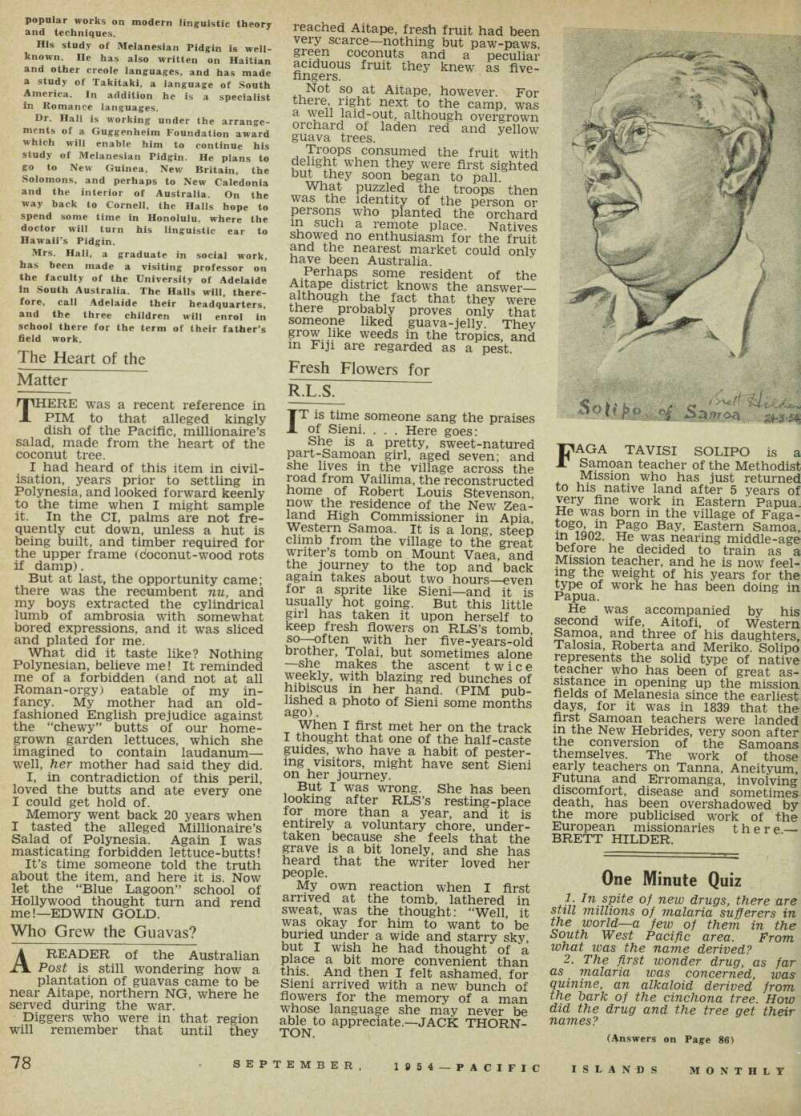
Faga Tavisi Solipo Is A
Samoan teacher of the Methodist Mission who has just returned to his native land after 5 years of very fine work in Eastern Papua.
He was born in the village of Faga togo, in Pago Bay, Eastern Samoa, m 1902. He was nearing middle-age before he decided to train as a Mission teacher, and he is now feel ing the weight of his years for the type of work he has been doing in Papua.
He was accompanied by his second wife, Aitofi, of Western Samoa, and three of his daughters, Talosia, Roberta and Meriko. Solipo represents the solid type of native teacher who has been of great as sistance in opening up the mission fields of Melanesia since the earliest days, for it was in 1839 that the first Samoan teachers were landed in the New Hebrides, very soon after the conversion of the Samoans themselves. The work of those early teachers on Tanna, Aneityum, Futuna and Erromanga, involving discomfort, disease and sometimes death, has been overshadowed by the more publicised work of the European missionaries there.—