The Editors’ Mailbag
pp. 20-139 · Read in the full issue
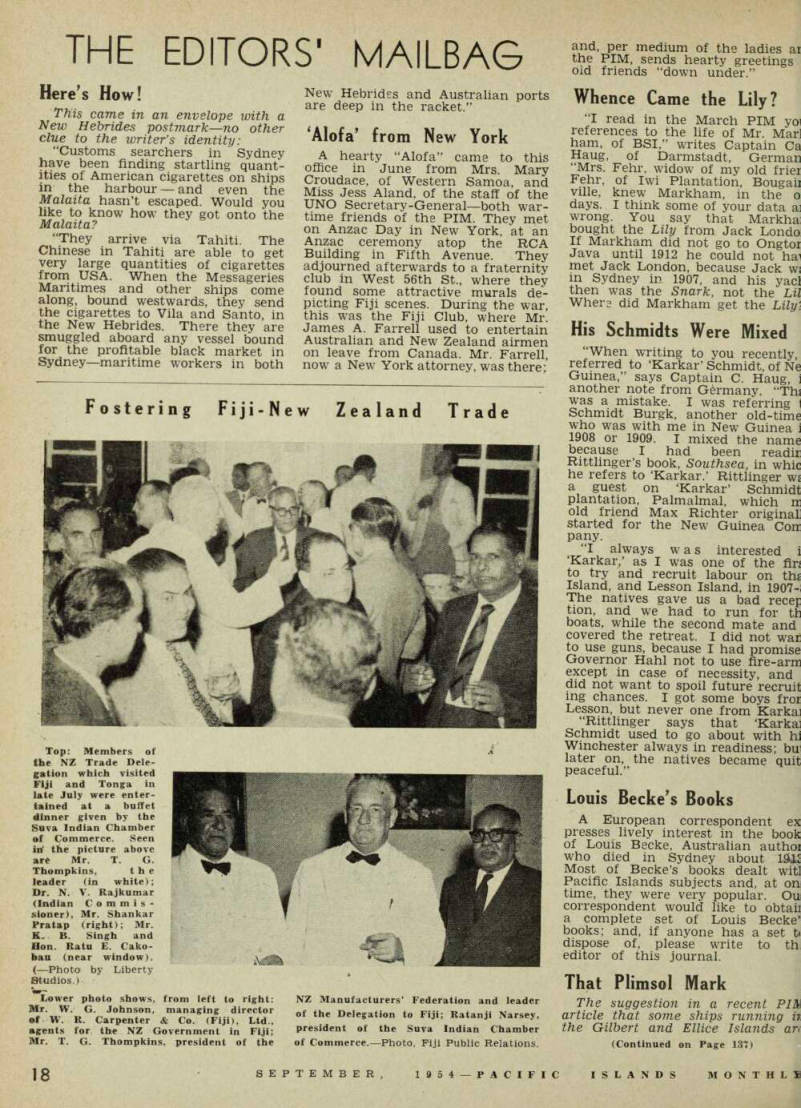
Here's How!
This came in an envelope with a New Hebrides postmark—no other clue to the writer’s identity: “Customs searchers in Sydney have been finding startling quant ities of American cigarettes on ships in the harbour and even the Malaita hasn’t escaped. Would you like to know how they got onto the Malaita?
“They arrive via Tahiti. The Chinese in Tahiti are able to get very large quantities of cigarettes from USA. When the Messageries Maritimes and other ships come along, bound westwards, they send the cigarettes to Vila and Santo, in the New Hebrides. There they are smuggled aboard any vessel bound for the profitable black market in Sydney—maritime workers in both
New Hebrides and Australian ports are deep in the racket.” <*!£>£ v v i AiOta from New York a heartv “Alofa” ramp trv tbic office in June from Mrs Mary Croudace ’ of Western Samoa, and Mlss Jess Aland - of the staff of the UNO Secretary-General—both war time friends of the PIM. They met on An zac Day in New York, at an Anzac ceremony atop the RCA Building in Fifth Avenue. They adjourned afterwards to a fraternity club in West 56th St., where they found some attractive murals de picting Fiji scenes. During the war this was the Fiji Club, where Mr’
James A. Farrell used to entertain Australian and New Zealand airmen on leave from Canada. Mr Farrell now a New York attorney, was there’’
and, per medium of the ladies ar the PIM, sends hearty greetings old friends “down under.”
Whence Came the Lily?
“I read in the March PIM yoi references to the life of Mr. Marl ham, of BSI,” writes Captain Ca Haug, of Darmstadt, German “Mrs. Fehr, widow of my old frier Fehr, of Iwi Plantation, Bougaii ville, knew Markham, in the o days. I think some of your data a: wrong. You say that Markha: bought the Lily from Jack Londo: If Markham did not go to Ongtor Java until 1912 he could not ha) met Jack London, because Jack wj m Sydney in 1907, and his yacl then was the Snark, not the Lil Where did Markham get the Lily\
His Schmidts Were Mixed
“When writing to you recently, referred to ‘Karkar’ Schmidt, of Ne Guinea,” says Captain C. Haug, j another note from Germany. “Thi was a mistake. I was referring 1 Schmidt Burgk, another old-time who was with me in New Guinea i 1908 or 1909. I mixed the name because I had been readir Rittlinger’s book, Southsea, in whic he refers to ‘Karkar.’ Rittlinger wf a guest on ‘Karkar’ Schmidt plantation, Palmalmal, which m old friend Max Richter original started for the New Guinea Coir pany.
“I always was interested i ‘Karkar,’ as I was one of the fin to try and recruit labour on the Island, and Lesson Island, in 1907-; The natives gave us a bad recep tion, and we had to run for th boats, while the second mate and covered the retreat. I did not war to use guns, because I had promise Governor Hahl not to use fire-arm except in case of necessity, and did not want to spoil future recruit ing chances. I got some boys fror Lesson, but never one from Karkai “Rittlinger says that ‘Karka: Schmidt used to go about with hi Winchester always in readiness; bu ! later on, the natives became quit peaceful.”
Louis Becke's Books
A European correspondent ex presses lively interest in the book of Louis Becke, Australian authoi who died in Sydney about l&L; Most of Becke’s books dealt witl Pacific Islands subjects and, at on time, they were very popular. Oui correspondent would like to obtaii a complete set of Louis Becke’ bpoks; and, if anyone has a set b dispose of, please write to th editor of this journal.
That Plimsol Mark
The suggestion in a recent PIM article that some ships running it the Gilbert and Ellice Islands arc
(Continued on Page 137)
\ sufficiently provided with life nng equipment, has brought this nment from Commune Bonum; Some years ago I took a new vernment ship to the Gilberts, ring my stay (a few months) I s astounded to notice other Gov iment ships coming into or leav ; port carrying passengers well excess of their boat accommoda ti. These vessels were not com nded by British foreign-going sters, who, if such circumstances i attended by loss of life, can be de criminally liable, lowever, I got used to being sur ged and thought no more of the tter, until I found that I, too, 5 expected to do the same. My iwer was “No”. . . i few weeks later, the ship was t to Suva, well ahead of her e for refit; and, on arrival, the yernment very, very regretfully pensed with my services—no sons were given for so doing, am not hurt or annoyed over matter; but I am still amusedly prised that those things can con le so many years after the death Samuel Plimsol.
ien Walter Carpenter
is Young
7e liked this letter, in which iran merchant Walter Maidment Daru, Western Papua, tells of ) he first met the late Sir Walter penter, the South Pacific’s wrest financier: was a young commercial /eller (in leather) when, one ning, Arthur Carpenter knocked our door, and asked for me. alter would like you to go up to irsday Island and join him in shelling business,” said he. \nd where on God’s green earth fhursday Island?” said I. \way up north, off Cape York,”
I he. scratched my head, for a lute, and then had a look at an s. “Well, Arthur, you know how se getting around in boats,” said ‘l’ll take it on.”
Some up to-night and see the sr,” said he. rhe pater” was one of the finest i I ever met—old Captain John ton Carpenter, father of Walter the Carpenter tribe. He ex ned to me the conditions up and TI; and after I had had a : at the Duke and Duchess of it (I think), then visiting Aus ia, I sailed in the Yawatta m, with Captain Carpenter to me off. oon I was in charge of a crew British New Guinea men puans you call them now) and king for Walter Carpenter ng “Chips” we called him then, did not then think so much of financial ability. He would call
me mtc, h is office and put up what I thought was some crazy propositl( ? n - , T “Look, Chips,” I would say, “don’t jeopardise what you now own. You know how you have worked for what you have—don’t gamble with IVt nf°fhp nffirp 6 ’ and 1 would get out of the office.
I was closely associated with him, for years. I built all his dinghies for him, and his diving boots; I did his auctioneering I even carried young “Ranji” around Thursday Island. I lived with Mr. and Mrs. Carpenter, and I thoroughly enjoyed those years with them. Well, he climbed high—and
now he has passed on—l was deeply shocked when I heard the news. Australia has lost a man whom it will be hard to replace
The Answer
What is this Wnrin seeking in New Guinea anyhow? (asked the PIM a few months ago). it was thought that the claim was aimed at the Morobe goldfield— but that does not seem to be the case what do these American-German- Swedish interests hope to get’
An answer came back in ari en velope posted in Rabaul, containing a sheet of paper, blank except for one word, “Uranium!”