Australian Tariff Board To
p. 19 · Read in the full issue
Relief for Rubber Producers?
Meet In Moresby
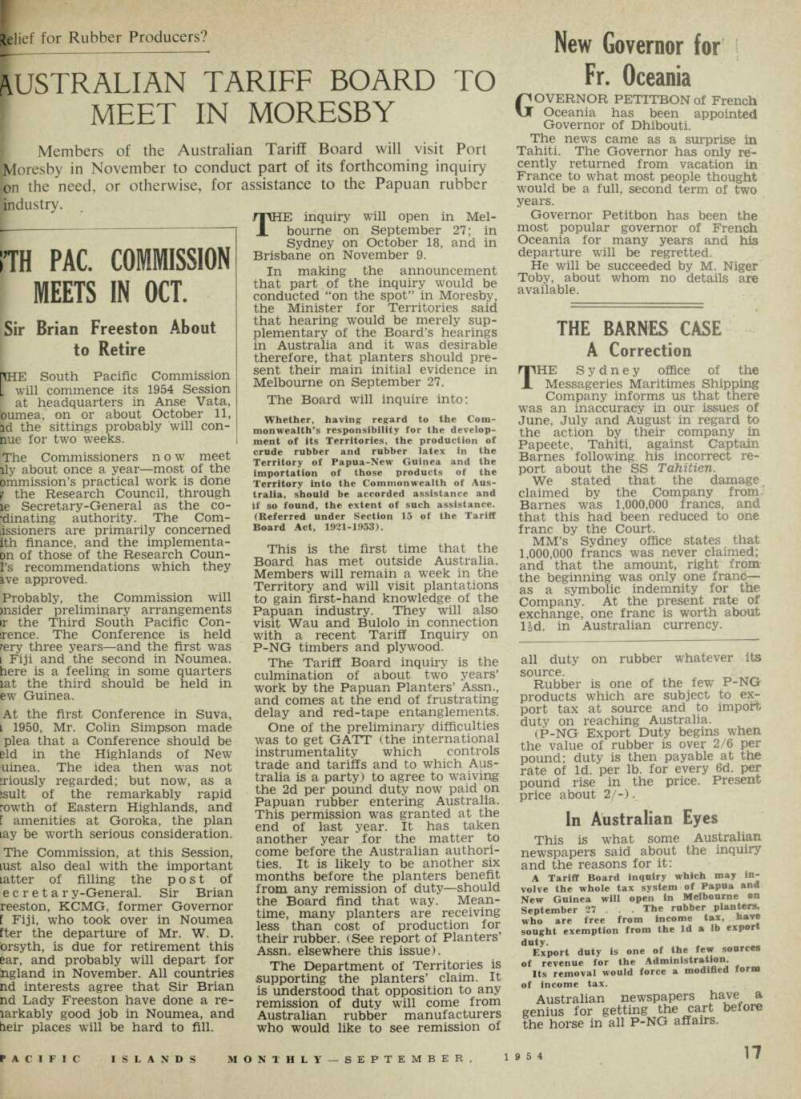
Members of the Australian Tariff Board will visit Port Moresby in November to conduct part of its forthcoming inquiry on the need, or otherwise, for assistance to the Papuan rubber industry.
rE inquiry will open in Mel bourne on September 27; in Sydney on October 18, and in Brisbane on November 9.
In making the announcement that part of the inquiry would be conducted “on the spot” in Moresby, the Minister for Territories said that hearing would be merely sup plementary of the Board’s hearings in Australia and it was desirable therefore, that planters should pre sent their main initial evidence in Melbourne on September 27.
The Board will inquire into: Whether, having regard to the Com monwealth’s responsibility for the develop ment of its Territories, the production of crude rubber and rubber latex in the Territory of Papua-New Guinea and the importation of those products of the Territory into the Commonwealth of Aus tralia, should be accorded assistance and if so found, the extent of such assistance. (Referred under Section 15 of the Tariff Board Act, 1921-1953).
This is the first time that the Board has met outside Australia.
Members will remain a week in the Territory and will visit plantations to gain first-hand knowledge of the Papuan industry. They will also visit Wau and Bulolo in connection with a recent Tariff Inquiry on P-NG timbers and plywood.
The Tariff Board inquiry is the culmination of about two years’ work by the Papuan Planters’ Assn., and comes at the end of frustrating delay and red-tape entanglements.
One of the preliminary difficulties was to get GATT (the international instrumentality which controls trade and tariffs and to which Aus tralia is a party) to agree to waiving the 2d per pound duty now paid on Papuan rubber entering Australia.
This permission was granted at the end of last year. It has taken another year for the matter to come before the Australian authori ties. It is likely to be another six months before the planters benefit from any remission of duty—should the Board find that way. Mean time, many planters are receiving less than cost of production for their rubber. (See report of Planters’
Assn, elsewhere this issue).
The Department of Territories is supporting the planters’ claim. It is understood that opposition to any remission of duty will come from Australian rubber manufacturers who would like to see remission of
all duty on rubber whatever its source.
Rubber is one of the few P-NG products which are subject to ex port tax at source and to import duty on reaching Australia. (P-NG Export Duty begins when the value of rubber is over 2/6 per pound; duty is then payable at the rate of Id. per lb. for every 6d. per pound rise in the price. Present price about 2/-).
In Australian Eyes
This is what some Australian newspapers said about the inquiry and the reasons for it: A Tariff Board inquiry which may in volve the whole tax system of Papua and New Guinea will open in Melbourne on September 27 . . . The rubber planters, who are free from income tax, have sought exemption from the Id a lb export doty.
Export duty is one of the few sources of revenue for the Administration.
Its removal would force a modified form of income tax.
Australian newspapers have a genius for getting the cart before the horse in all P-NG affairs.