News of the Small-Ships
pp. 101-110 · Read in the full issue
Lit Happened In August:—
fust 50 years ago, on August 15, ;he new Glasgow-owned 2,285-ton iteel barque Saragossa, bound from Newcastle, NSW, to San Francisco pith a cargo of 3,200 tons of coal, inished her days on the south oast of Mangaia Island, Cook Iroup. iCommanded by a Captain Duncan, t man of over 70, and with Messrs.
IcCulloch and Campbell as first aid second officers, the vessel was lose hauled on the starboard tack, pith a fresh south-easterly blowing.
IThe breakers were sighted too ate, the vessel coming about but rounding aft at a point two miles ast of Tamarua. She soon adopted [heavy list to seaward, t Attempts to float a line ashore ailed and eventually a seaman warn to the edge of the surf with [ light line. It was taken by a langaian who, with great courage, warn through the heavy surf. This ian, Vaevaeongo, already held the toyal Humane Society’s medal for ascue work on a previous occasion.
A breeches-buoy was rigged, but ifficulty was experienced in using E; the sailmaker Jones was killed i a fall from the mast to the deck s the messenger-line tightened.
The remaining 26 men eventually ot ashore, many of them in a runken condition after broaching le ship’s liquor supplies following lie stranding. lOn August 20, the wreck was uctioned by the magistrate at neroa, on instructions of the [aster and sold for £ll/10/-. The irgo brought a further £l/2/6 and le lifeboat £6/15/-. The buyer in ich case was Mr. S. K. Bulkeley,
manager for Cook Islands Trading Company at the island.
The survivors were taken to Auckland by Union Co’s Taviuni, and in the subsequent inquiry the Master was found guilty of neglig ence. (Next Page)
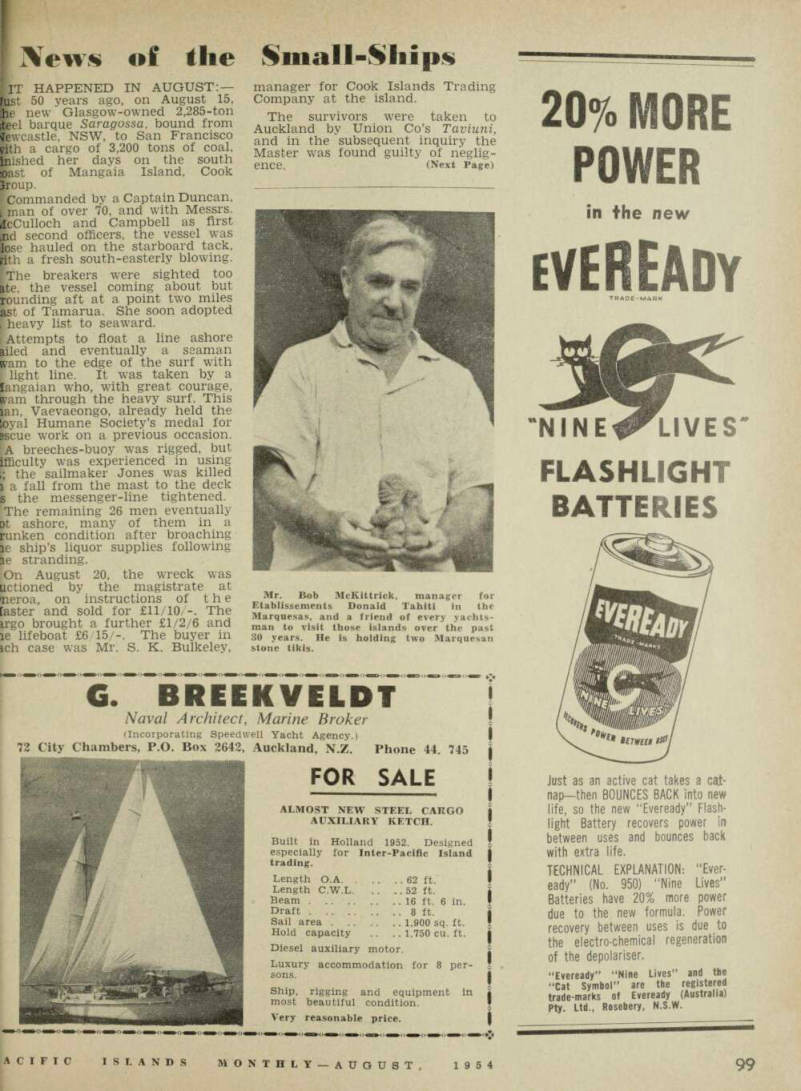
Mr. Bob McKittrick, manager for Etablissements Donald Tahiti in the Marquesas, and a friend of every yachts man to visit those islands over the past 30 years. He is holding two Marquesan stone tikis.
F Trading In Solomons:
\urengana, which reached BSIP rom UK via Panama, calling at lukuhiva, Suwarrow and Apia in a uick run across the Pacific some
time ago, is now owned by Captain Scott-Elliott and Mr. R. Pearson.
This Baltic ketch was formerly named Gunborg. Lloyds Register shows her as built at Borga in
1948, and of Finnish registry, measuring 94.4 ft x 24.3 ft x 8 ft, and of 129 GT, 76 nett.
She was acquired by her present owners early last year and was con verted for her present trade in the Solomons. A large aluminium-alloy house containing two cabins and saloon was fitted aft, and another consisting of washroom, toilet and
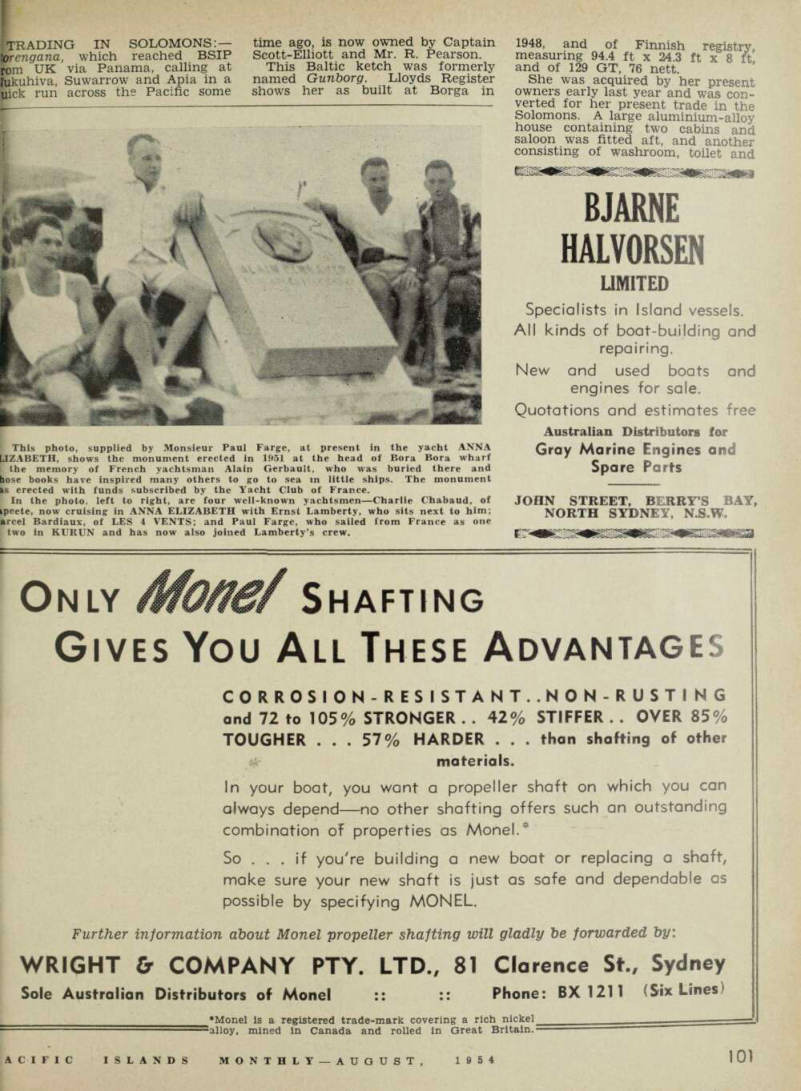
This photo, supplied by Monsieur Paul Farge, at present in the yacht ANNA LIZABETH, shows the monument erected in 1951 at the head of Bora Bora wharf the memory of French yachtsman Alain Gerbault, who was buried there and hose books have inspired many others to go to sea in little ships. The monument as erected with funds subscribed by the Yacht Club of France.
In the photo, left to right, arc four well-known yachtsmen—Charlie Chabaud, of [?]peete, now cruising in ANNA ELIZABETH with Ernst Lamberty, who sits next to him; [?]arcel Bardiaux, of LES 4 VENTS; and Paul Farge, who sailed from France as one two in KURUN and has now also joined Lamberty’s crew.
galley fitted ’midships. The wooden hull was also copper-sheathed.
There is accommodation for crew forward. Ketch rigged, the sturdily built craft carries a big squaresail and rafee.
It is understood that the owners have acquired operational rights in, or are managing, coconut planta tions which were operated pre- World War II by Levers.
Navy To Rescue:—Morris
Hedstrom & Co.’s Fiji trader Adi Keva —the former Noumea vessel Le Phoque —was again in trouble late June. The New Zealand naval frigates Kiwi and Tui and the Burns Philp trader Yanawai were called to her aid. It seems that the 190tonner went aground on a reef in the Tomberua Passage off the Rewa River mouth when fully laden with copra. This was partly discharged to the Yanawai and partly to Kiwi, both frigates then joining forces to tow the vessel off the reef. She then proceeded safely to Suva. After ex amination she was reported un damaged.
Radiation Victims:—The Us
Government has paid £5,000 com pensation to be shared between the owners of the tuna boat Fukuryo Maru and the crew of 23 injured by radio active dust from the March hydrogen bomb test at Bikini.
Sixteen other boat owners and their crews will receive lesser compensa tion.
The crew of the Fukuryo Maru, according to a medical report from Tokyo, will require medical treat
ment for the rest of their lives. 7n be in hos Pital for from 10 to 20 years. tt™ a ™
Vuna Reef Light Coming:—
Work is proceeding on the construction of a lighthouse on Vuna Reef, off the southern tip of Taveuni, Fiji, it will be gasoperated—the gas stored in bottles. . * fJ 01 -.working on the exposed leef, the 32-ton concrete and steel
base structure was built by Fi Public Works Department on wa’ ashore, then launched and, sub ported by pontoons, towed two milt to its site. There the watertigl base was flooded and the structui lowered to the bottom. Installatic of the top portion with the light now under way.
Motor For Pitcairn-— Tli
British Government, through tt Colonial Development and Welfai
Fund, has given the Pitcairn people Ei marine engine for one of then whale-boats. This will assist them in their fishing and trading opera tions and their lengthy voyages to Henderson, Ducie and Oeno islands where they gather timber which is icarce on Pitcairn, for curios and Eirewood.
I Events At Canton: —Be-
latedly comes news of a fire in the ashing camp of Madeiras, Izumi md Chee at Canton Island early ;his year. “MIC”, as the Hawaiian jompany is known, is one of two ishing organisations based on Can- Kin of which little is heard.
I MlC’s camp is located in the lorth side of the lagoon pass. Fish ng is done mainly by netting in she lagoon, employing Gilbertese :rom settlements on other nearby Phoenix islands. MlC’s overseer is Hr. Bob Sutherland, formerly em jloyed in GEIC shipping and well mown in Suva. Fish is airfreighted, it the special rate of 15 cents per jound, by Pan American Airways ;o Honolulu, where it is marketed irofitably. 1 It appears that fire broke out in he living quarters of the camp at light and the entire installation, which included ice-box, two gen erators, nets, motor truck, and other ;quipment, was destroyed.
The other Canton fishing organ sation, operated by Skipper “Dusty”
Hiller, of the small vessel Joyita, ippears to have ceased operations ■ecently. It was reported from Honolulu some time ago that Cap ain Miller had trouble with some )f his Gilbertese. He later flew south to Fiji and was rumoured to ie planning to transfer registry from Honolulu to Suva, and his scene of operations from Canton ;o, possibly, Samoa and its appar ently prolific tuna fishery.
Early June we heard from an )ther source that Joyita was at Pago Pago.
Mr. Miller, like Mr. Sutherland, s also known in Suva. Both men served together in the GEIC vessel
Last month we published a photo of SIREN, ready to be relaunched at Raro tonga. This is how she looked when Mr.
D. C. Brown and his men salvaged her from the reef in 1952.
yiaureen and were in her when she Kras lost a few years ago at Uanumea. They were originally partners in Miller’s Canton fishery.
I NEW BOSS:—During July the >EIC Administration was advertis ng overseas for a manager and an fesistant manager for the Colony Wholesale Society which operates nost of the shipping in the Gilbert tnd Ellice Islands trade. A mini num salary of £A1,700 was being iffered for the manager, and £A1,050 or an assistant manager. , CWS vessels, like all Western >acific High Commission vessels, re unregistered and not subject to ny survey. Their operations are conomical without certificated men r strict surveys, though the vessels re generally fairly well main ained. .NEW USE: —Under construction i Papeete is a 70-foot welded steel essel, the materials of which came rom oil tanks established by the FS Navy at Bora Bora during the rar. The vessel will have tanks )r the carriage of live fish and will an mainly to Makatea, where here is a big market with the hosphate Company’s labour.
Several people have an interest i the vessel, including M. Henri Imau, head of the Public Works Apartment’s workshop, who is do
ing the building in his spare time.
Transport of the craft and its launching in the harbour will in volve some problems.
STC MlSHAP:—Steamships Trad ing Company almost lost their auxiliary ketch Wotan on June 21 when she went aground in a heavy blow while bound from Samarai to Sariba Island. She was under sail with a load of copra. Assistance was successfully rendered in haul ing Wotan off by Mr. E. E. Smith’s Cape Vogel and Mr. Harry John ston’s crash-boat Belsana. Little damage was done.
Lehi Experiment Over;—
The Lehi drift voyage was short lived. Described as a five-sided wooden raft, and similar in shape to a flat-iron, the Lehi was towed off-shore from San Francisco, July 4, and set adrift—destination Hono lulu. The raft, 32-feet long and 16feet abeam at the widest part aft, has a low house, about 8-feet square and 4-feet high. Aft was a binnacle and wheel, with an auxiliary motor for emergency use. The men were to live, Bombard-fashion, entirely from what the sky and sea could offer. (Over)
HIFOFUA, Tongan Government ketch, reported for sale.
On July 14, leader Devere Baker reported that little progress was being made and asked to be towed further off-shore to pick up a more favourable current. A launch was despatched, but the fol lowing day a report came from Lerii that she was opening up in heavy seas.
Earlier, radioman Don Smith had made appeals to the shore that he be taken off the raft, the others could continue if they wished.
Two vessels and a private air craft were unable to locate Lehi, so three coastguard ships and two of their aircraft made a search.
One of the vessels located the raft and took off all hands. They re ported catching only one shark and one salmon since sailing.
Christmas Visit:—Us Fish
and Wildlife’s John R. Manning, miring a fishery research cruise to the Line Island in May-June, made a call at Christmas Island to ser vice instruments maintained there by Pacific Ocean Fishery Investi gation with the assistance of the local British District Officer and Gilbertese staff. An automatic sea temperature recording thermograph is m operation there. Regular samples of sea water are taken.
Samples of wood left in the water some time ago by Dr. Edmondson, of Bishop Museum, to study the effects of boring organisms were also recovered. A collection of her mit crabs was made at this and
other Line Islands for the Universtiy of Hawaii, and other fish were taken at each island for despatch to Dr. Halstead, of California, who is making a study of poisonous fish problems in the Islands.
RADIO SEXTANT:—During July * . re Ported that the US Bureau of Ships has developed a radio sextant” which operates on the
principle of receiving, through dor cover, radio “noises” from the sr and certain other stars. A high, directional, dish-type radio antenr is employed, together, presumabli with a small cathode-ray displaj tube of the radar-receiver type, ar probably a gyroscopic levellir systepi. A radio receiver must als be incorporated.
I Interesting, in that it places the marine navigator in the same posi tion as the air navigator who can fly above the cloud cover. It would appear unlikely that the “sextant” is portable, let alone of the hand type. It is probably only applic able to use in larger ships, but gives promise of future developments in navigation.
R Betio Harbour:—Mr. D. V.
Buck, consulting engineer, recently visited the Gilberts to advise the Administration on the development of Betio harbour, Colony Wholesale Society’s shipping headquarters
port.
I Another Veteran Gone:—
Captain Emile Savoie’s January purchase, Jacques del Mar, ex-eight sarlier names, seems to have ended tier varied career on a reef near the north passage at Lord Howe Island, where she went ahsore in a heavy olow on July 20.
The 500-ton, twin screw, 29-year >ld vessel was lying off the island awaiting cargo-handling at day tight when the blow struck at 5.30 a.m. She was anchored at the ;ime, with one motor running. The jther was started, but even with 50th motors pulling and anchor iown she was forced high on a •eef and will probably not be salvageable. The crew were taken >ff at 8 am by shore boats. It was jxpected that most of the cargo would be saved.
At one stage of her career, as ;he Marion Sleigh, this vessel was jperating between Sydney and Dar win—before going to New Zealand md being renamed Port Whangarei n the early 1930’5. Then, when the war extended to the Pacific, the ittle ship was renamed KG-28, with many other New Zealand toasters, joined the American anallships fleet in the Western Pacific islands.
As Holmhurn, she was sold by the ■lolm Shipping Co. in Wellington o Captain Savoie, of Noumea, this rear, operating between that port md Sydney with calls at Norfolk md Lord Howe at times. Captain Savoie has purchased in recent rears from NZ the following vessels: Wapiti, renamed El Retiro, and wrecked under other ownership in slay, 1953; Hauturu, renamed Istrella del Mar, and now owned n Brisbane: Margaret-W , renamed Maria del Mar; Hokitika, renamed Colorado del Mar.
Later - Tenders have been called n Sydney for purchase of Jagues del Mar as she lay on reef off Lord iowe.
Seven Little Brothers:
See “Pacific Radio Amateurs” ection this issue.
YANKEE’S TOUR: —Cap t a i n rving Johnson, of the brigantine YANKEE, thinks New Guinea is a laturalist’s paradise. He and most »f his crew of 30 paying members :re looking for lecture material.
Yankee has been in Lae on the current tour and expects to visit Madang and sail up the Sepik River.
Most of the ship’s company will fly in to the Highlands, and to Maprik from Wewak.
Yankee will call at Dutch NG, Borneo, Siam, Indo-China, Singapore, Java, Bali, Cocos Island, Mombassa, Zanzibar and other places before returning to America. the MV Kulu, which had the distinction of being the first ship to be raised by the new cofferdam in Rabaul harbour. With the aid of
the cofferdam, the ship’s stern was raised while she was still floating: the propellers and rudder being ex-’ posed for repair of the “A” brackets, BP’S have now given Mr. Mike Morgan the job of changing the MV Katika’s brackets which have been condemned. Mr. Morgan built the cofferdam for 300-tonners.
Kulu was one of the last of the P-NG Govt. Shipping Services ENGINE, NO SHIP;—A salvage party which went to Jammer Bay in June to save what they could of the wrecked MV Channel Star
found that only the engine ; mained on the beach where t vessel had grounded. The ship h completely disintegrated un d heavy seas that were washing o T her when she grounded in May The salvage party, Messrs. R Auld and Bob Paterson, of Aii Traders, who run their own bo the MV Airco, bought the Cham Star where she lay, less the ge
that had already been salvaged, f £lOO. Within a few weeks they we to Jammer Bay but saw that ti Channel Star had apparently di appeared. They could not lai owing to a heavy swell, so pr ceeded further along the coast Sumsum, where they landed ai trekked the 30 miles back Jammer Bay.
They found only the engine « the beach, and even that was ne; to being washed back into the se They dragged it further ashore ai intend to pick it up later, take to Rabaul for overhaul, and inst it in the Airco.
REEF SHOOTING; —Mangaia: are planning to use a flat-bottome engine-driven boat for lighten], across the reef at Mangaia, Co< Is., and for ocean fishing as we The boat is now being built New Zealand.
The financial possibilities appe; to be good. Lighterage is no monopolised by a fleet of whaler operated by Polynesian muscll power, often under hazardous cor ditions. The charge is £4 per toe The incredible shortage of fit ensures a ready market for ar that are caught.
Nothing has ever been done wii any success to deepen the entrant to the reef channel, and the nerv\ racking shooting of the reef lip still being done by all incomii. and outgoing boats. Europeans car not see any great obstacle prevent ing the demolition of the reef to < depth of 20 feet, but the Adminii tration’s advisers insist that it impracticable.
Only the engine remained . . .