Can Pidgin Be Used For Instruction
pp. 97-100 · Read in the full issue
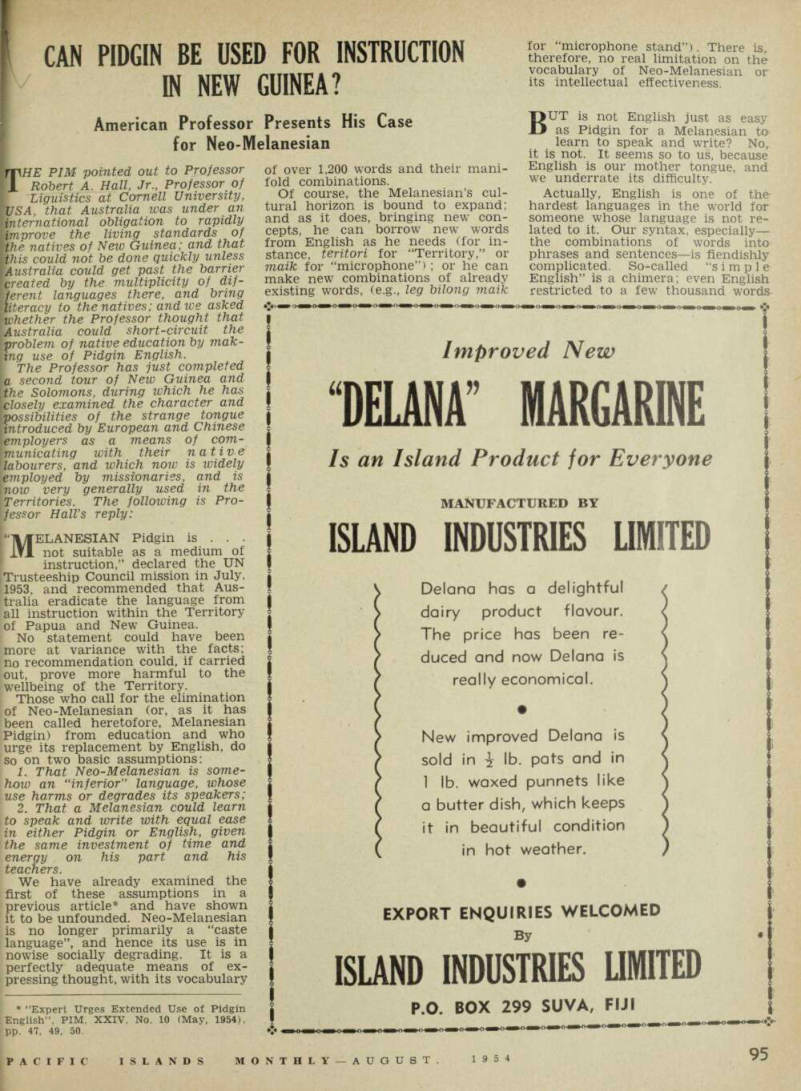

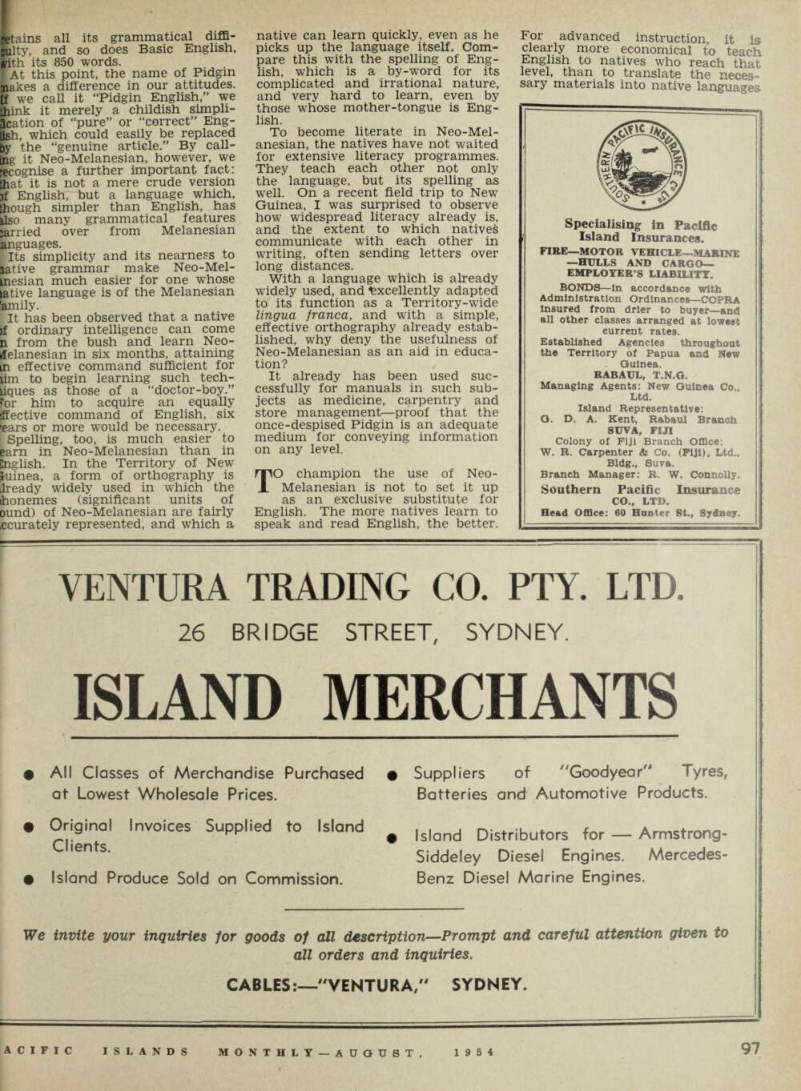

In New Guinea?
American Professor Presents His Case for Neo-Melanesian
THE PIM pointed out to Professor Robert A. Hall, Jr., Professor of Liguistics at Cornell University, f USA, that Australia was under an international obligation to rapidly improve the living standards of r the natives of New Guinea; and that .this could not be done quickly unless tAustralia could get past the barrier Icreated by the multiplicity of dif ferent languages there, and bring literacy to the natives; and we asked \whether the Professor thought that l Australia could short-circuit the problem of native education by mak ing use of Pidgin English. . The Professor has just completed a second tour of New Guinea and the Solomons, during which he has \closely examined the character and possibilities of the strange tongue Introduced by European and Chinese employers as a means of com municating with their native labourers, and which now is widely employed by missionaries, and is now very generally used in the Territories. The following is Pro fessor Hall’s reply;
“T|/|ELANESIAN Pidgin is . . .
ifl not suitable as a medium of instruction,” declared the UN Trusteeship Council mission in July, 1953, and recommended that Aus tralia eradicate the language from all instruction within the Territory of Papua and New Guinea.
No statement could have been more at variance with the facts; no recommendation could, if carried out, prove more harmful to the wellbeing of the Territory.
Those who call for the elimination of Neo-Melanesian (or, as it has been called heretofore, Melanesian Pidgin) from education and who urge its replacement by English, do so on two basic assumptions: 1. That Neo-Melanesian is some how an “inferior ” language, whose use harms or degrades its speakers; 2. That a Melanesian could learn to speak and write with equal ease in either Pidgin or English, given the same investment of time and energy on his part and his teachers.
We have already examined the first of these assumptions in a previous article* and have shown it to be unfounded. Neo-Melanesian is no longer primarily a “caste language”, and hence its use is in nowise socially degrading. It is a perfectly adequate means of ex pressing thought, with its vocabulary
of over 1,200 words and their mani fold combinations.
Of course, the Melanesian’s cul tural horizon is bound to expand: and as it does, bringing new con cepts, he can borrow new words from English as he needs (for in stance, teritori for “Territory,” or maik for “microphone”); or he can make new combinations of already existing words, (e.g., leg bilong maik
for “microphone stand”). There is, therefore, no real limitation on the vocabulary of Neo-Melanesian or its intellectual effectiveness.
BUT is not English just as easy as Pidgin for a Melanesian to learn to speak and write? No, it is not. It seems so to us, because English is our mother tongue, and we underrate its difficulty.
Actually, English is one of the hardest languages in the world for someone whose language is not re lated to it. Our syntax, especially— the combinations of words into phrases and sentences—is fiendishly complicated. So-called “simple English” is a chimera; even English restricted to a few thousand words
* "Expert Urges Extended Use of Pidgin English”, PIM, XXIV, No. 10 (May, 1954), pp. 47, 49, 50.
fetains all its grammatical diffi culty, and so does Basic English, frith its 850 words.
I At this point, the name of Pidgin makes a difference in our attitudes, [f we call it “Pidgin English,” we Ihink it merely a childish simpli- Scation of “pure” or “correct” Eng lish, which could easily be replaced by the “genuine article.” By call ing it Neo-Melanesian, however, we a further important fact: that it is not a mere crude version )f English, but a language which, though simpler than English, has ilso many grammatical features carried over from Melanesian languages. [ Its simplicity and its nearness to native grammar make Neo-Mel inesian much easier for one whose lative language is of the Melanesian 'amily. [ It has been observed that a native )f ordinary intelligence can come n from the bush and learn Neo ilelanesian in six months, attaining in effective command sufficient for lim to begin learning such tech liques as those of a “doctor-boy.” far him to acquire an equally iffective command of English, six 'ears or more would be necessary.
I Spelling, too, is much easier to earn in Neo-Melanesian than in English. In the Territory of New Juinea, a form of orthography is Jready widely used in which the ihonemes (significant units of ound) of Neo-Melanesian are fairly ccurately represented, and which a
native can learn quickly, even as he picks up the language itself. Com pare this with the spelling of Eng lish, which is a by-word for its complicated and irrational nature, and very hard to learn, even by those whose mother-tongue is Eng lish.
To become literate in Neo-Mel anesian, the natives have not waited for extensive literacy programmes.
They teach each other not only the language, but its spelling as well. On a recent field trip to New Guinea, I was surprised to observe how widespread literacy already is, and the extent to which natives communicate with each other in writing, often sending letters over long distances.
With a language which is already widely used, and Excellently adapted to its function as a Territory-wide lingua franca, and with a simple, effective orthography already estab lished, why deny the usefulness of Neo-Melanesian as an aid in educa tion?
It already has been used suc cessfully for manuals in such sub jects as medicine, carpentry and store management—proof that the once-despised Pidgin is an adequate medium for conveying information on any level.
TO champion the use of Neo- Melanesian is not to set it up as an exclusive substitute for English. The more natives learn to speak and read English, the better.
For advanced instruction, it is clearly more economical to teach English to natives who reach that level, than to translate the neces sary materials into native languages
or Neo-Melanesian. As one ADO put it to me, “we can’t afford to translate the Encyclopaedia Brit annica into Pidgin,” even though it would theoretically be perfectly pos sible.
The contrast between New Guinea and the British Solomons is in structive. In New Guinea, hundreds of thousands of natives know Neo- Melanesian, a growing number of them using it as their first language.
A large proportion of New Guinea natives are literate in Neo-Mel anesian, and instruction in it has been under way for many years.
In the BSI, however, the Gov ernment frowns on Pidgin, refuses to sanction a sound official ortho graphy, and in education pursues the mirage of “simple English.”
Largely as a result of this refusal to use Neo-Solomonic (as we may call BSI Pidgin), native education in the BSI is much less advanced than in New Guinea.
The crying need in Melanesia at present is for conveying more and higher information to the native.
This can and should be done in any linguistic medium available—native languages, Neo-Melanesian, and English. It ill behoves us to neglect jany means of communication just because of unfounded puristic or “anti-colonialistic” prejudices.
If we throw away such a valuable means of instruction as Neo-Mel anesian, we can be sure that our enemies will not. Nothing would please the Communists more than
to have us reject Neo-Melanesian and hand it over to them gratis as a vehicle for anti-Australian, anti-European propaganda. (One wonders: Is this part of the reason for the Leftist and Russian attacks on our use of Pidgin—to try and get us to trip ourselves, jiu-jitsu fashion, over our own linguistic pre judices?)
Here is Neo-Melanesian, 1
“linguistic cement” of the Territc admirably suited to the purpose elementary and intermediate edu< tion, in New Guinea, at our dispo; It offers the obvious solution to < need for a simple, easily access!! territory-wide medium of instn tion. Why are we hesitating?