Fijian Chiefs Prefer Tradition to Democracy
p. 157 · Read in the full issue
From Our Own Correspondent
SUVA, June 25.
PE Council of Chiefs, the parlia ment of the indigenous Fijian people, at its 1954 meeting re ommended the following proposals or the economic development of ’ijian land: (1) The economic development f Fijian land should normally be ased on the proprietary landown ig unit (the larger the better); (2) 'rogrammes for the economic de elopment of Fijian land should be rawn up in consultation with the uthorities responsible for drawing p programmes of social services, be maximum use being made of 3-operative societies; (3) Suitable ersons should be appointed to rganise the economic development rogrammes and see that thev are arried out; (4) A levy should be nposed on the proceeds obtained :om sales of certain produce and sed for the improvement of the Dcial and economic conditions of lose on whom it is imposed; (5) he building and repairing of houses lould be done outside the economic evelopment programme.
On the subject of alterations to le system of Fijian representation i the Legislative Council, the ouncil of Chiefs dug its toes in rmly.
The Governor had suggested as possibility “some form of direct presentation” for the Fijian 3ople on the same basis as that rovided for Europeans and Indians.
The Council of Chiefs, however, ated in a resolution: “This Council ;spectfully recommends the main mance unamended of the existing 'stem of representing Fijian linion through the Council of
Chiefs and the panel of Fijians that it elects, from whom are selected the Native Members of the Legislative Council”.
Furthermore, the Council of Chiefs, “having carefully considered the desirability of appointing a Standing Committee of the Council to represent it during the intervals between one meeting and the next, respectfully submits that the traditional form of representation of Fijian public opinion by the full Council is the one that the Council feels should be retained”.
DESPITE the Council’s willingness to adopt measures to ensure the economic development of Fijian land, nothing could better illustrate its innate conservatism than its firm treatment of the pro posals for a tentative move towards Fijian democracy.
When opening the 1954 session last month, the Governor said that “the Chiefly system, on which so much depends/ should march with the times and not ignore, for too long, the modern trends of demo cracy”.
It is clear enough that, sooner or later, the representatives of the Fijian people will be in the firing line of inter-racial politics, and it may be wondered whether the con servatism of the Council of Chiefs is not somewhat overdone.
A publican’s licence was granted by the Licensing Court on June 10 to Mr. E. C. N. Helton for his Wewak, New Guinea, hotel. The hotel will be known as the Wewak Point Hotel.
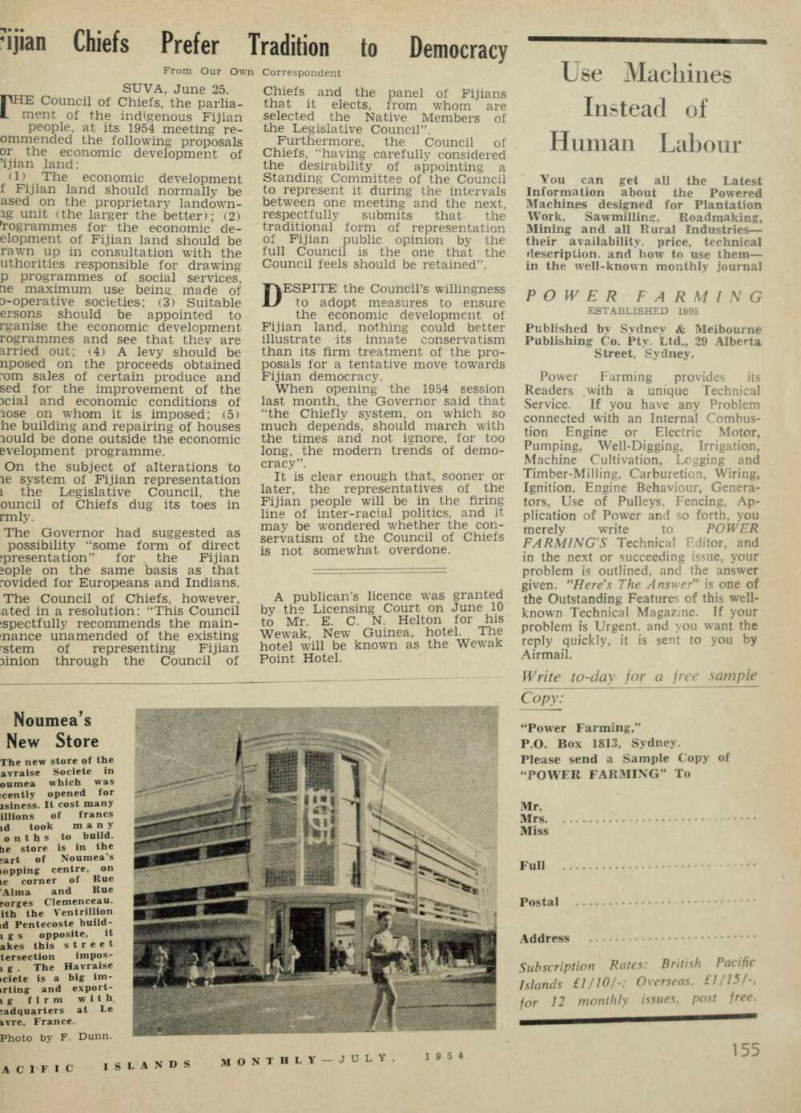
Noumea’s
New Store
The new store of the avraise Societe in oumea which was [?]cently opened for basiness. It cost many [?]illions of francs [?]d took many [?]onths to build. [?] store is in the cart of Noumea’s [?]opping centre, on [?] corner of Rue Alma and Rue corges Clemenceau. [?]th the Ventrillion
[?]d Pentecoste build
ings opposite, it akes this street tersection impos [?]g. The Havralse ciete is a big im [?]rting and export [?]g firm with
cadquarters at Le
avre, France.
Photo by F. Dunn.