Of Pacific Islands People
pp. 155-156 · Read in the full issue
Plans For The Welfare
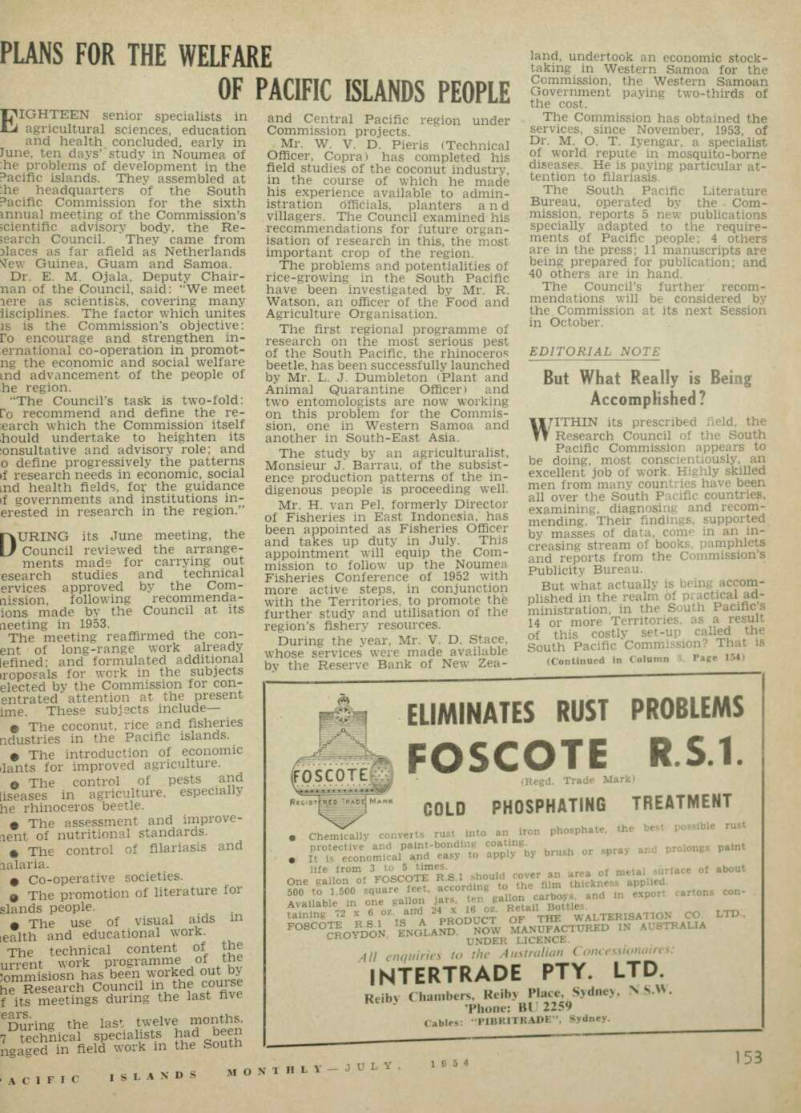
EIGHTEEN senior specialists in agricultural sciences, education and health concluded, early in June, ten days’ study in Noumea of :he problems of development in the Pacific islands. They assembled at :he headquarters of the South Pacific Commission for the sixth mnual meeting of the Commission’s scientific advisory body, the Re search Council. They came from Diaces as far afield as Netherlands 'Tew Guinea, Guam and Samoa.
Dr. E. M. Ojala, Deputy Chair nan of the Council, said: “We meet lere as scientists, covering many iisciplines. The factor which unites is is the Commission’s objective: ro encourage and strengthen in ernational co-operation in promot ng the economic and social welfare ind advancement of the people of he region.
“The Council’s task is two-fold; r 0 recommend and define the re ;earch which the Commission itself hould undertake to heighten its ;onsultative and advisory role; and o define progressively the patterns rf research needs in economic, social md health fields, for the guidance >f governments and institutions in erested in research in the region.”
DURING its June meeting, the Council reviewed the arrange ments made for carrying out esearch studies and technical ervices approved by the Com tiission, following recommenda ions made by the Council at its aeeting in 1953.
The meeting reaffirmed the con ent of long-range work already iefined; and formulated additional iroposals for work in the subjects elected by the Commission for con entrated attention at the present ime. These subjects include— e The coconut, rice and fisheries adustries in the Pacific islands. e The introduction of economic
ilants for improved agriculture.
o The control of pests and
[iseases in agriculture, especially
he rhinoceros beetle. • The assessment and improve lent of nutritional standards. The control of filariasis and lalaria. • Co-operative societies, a The promotion of literature for
slands people.
• The use of visual aids m lealth and educational work.
The technical content of the urrent work programme of the Jommisiosn has been worked out by he Research Council course f its meetings during the last five the last twelve 7 technical specialists had been ngaged in field work in the South
and Central Pacific region under Commission projects.
Mr. W. V. D. Pieris (Technical Officer, Copra) has completed his field studies of the coconut industry, in the course of which he made his experience available to admin istration officials, planters and villagers. The Council examined his recommendations for future organ isation of research in this, the most important crop of the region.
The problems and potentialities of rice-growing in the South Pacific have been investigated by Mr. R.
Watson, an officer of the Food and Agriculture Organisation.
The first regional programme of research on the most serious pest of the South Pacific, the rhinoceros beetle, has been successfully launched by Mr. L. J. Dumbleton (Plant and Animal Quarantine Officer) and two entomologists are now working on this problem for the Commis sion, one in Western Samoa and another in South-East Asia.
The study by an agriculturalist, Monsieur J. Barrau, of the subsist ence production patterns of the in digenous people is proceeding well.
Mr. H. van Pel, formerly Director of Fisheries in East Indonesia, has been appointed as Fisheries Officer and takes up duty in July. This appointment will equip the Com mission to follow up the Noumea Fisheries Conference of 1952 with more active steps, in conjunction with the Territories, to promote the further study and utilisation of the region’s fishery resources.
During the year, Mr. V. D. Stace, whose services were made available by the Reserve Bank of New Zea
land, undertook an economic stock taking in Western Samoa for the Commission, the Western Samoan Government paying two-thirds of the cost.
The Commission has obtained the services, since November, 1953, of Dr. M. O. T. Iyengar, a specialist of world repute in mosquito-borne diseases. He is paying particular at tention to filariasis.
The South Pacific Literature Bureau, operated by the Com mission, reports 5 new publications specially adapted to the require ments of Pacific people; 4 others are in the press: 11 manuscripts are being prepared for publication; and 40 others are in hand.
The Council’s further recom mendations will be considered by the Commission at its next Session in October.
Editorial Note
But What Really is Being
Accomplished?
WITHIN its prescribed field, the f? Research Council of the South Pacific Commission appears to be doing, most conscientiously, an excellent job of work. Highly skilled men from many countries have been all over the South Pacific countries, examining, diagnosing and recom mending. Their findings, supported by masses of data, come in an in creasing stream of books, pamphlets and reports from the Commission’s Publicity Bureau.
But what actually is being accom plished in the realm of practical ad ministration, in the South Pacifie s 14 or more Territories, as a result of this costly set-up called the South Pacific Commission? That is
(Continued in Column 3. Page 154)
(Continued from Page 153)
the question that earth-bound com mentators ask, and the Commission should try to answer it.
An impressive corps of experts re ports to the Research Council: the Council reports and recommends to the Commisison; the Commission, presumably, sends on recommenda tions to the six nations (Australia, New Zealand, France, Britain, United States and Netherlands) which created it.
And then what happens? How many of these expensively-wrought recommendations have been given actual shape in the field of Islands government? That is what the humble taxpayer should be told.
Is the South Pacific Commission really changing and improving the texture of Islands life? Or it is just a pleasant and very expensive toy for the diversion of a group of well endowed Commissioners If only a section of the Commission’s im pressive spate of publicity could describe the accomplishments of the Commission, instead of the recom mendations of its instrumentalities, one or two hard-working com mentators really would be grateful.