Times have Changed in Eden
pp. 84-86 · Read in the full issue
SWAIN'S ISLAND made one of its i rare appearances in the news earlier this year when an American Executive Order decreed that it should have a Village Council with a mayor, a policeman and an annually-appointed Gov earnment representative. This Order denoted the arrival of demo cratic “progress” following de mands by the Tokelau islanders who lived there to work the plan tation, for a stake in the land.
But for nearly a century before this, Swain’s was under the care free ownership of the Jennings family, any interference from bureaucracy and a description of these idyllic years is contained in a 20-year-old letter which has -just come to hand.
The letter was written by Mr. A. ;Schultz, a former resident of Tonga and Samoa w’ho lived on Swain’s for some years. He was a prisoner of-war in an American camp, and died soon after he was repatriated to Hamburg, Germany.
Since Mr. Schultz’s letter was written there have, of course, been radical changes on Swain’s Island, for many, the last “paradise” of the Pacific.
The Island’s present owner, Mr. A. E. Jennings, has a modern motor vessel to keep him in touch with Pago and all modern con veniences is his home. He also has :all the modern troubles. Workers are claiming higher wages, regulated hours and better living conditions— and there have even been strikes.
But civilisation had not intruded when Mr. Schultz wrote the follow ing;— ★ k BOUT 175 sea miles north of ,/T the Samoan Islands is a srpall, lonely island about 18 feet above sea level. It is called Swain’s Island, or sometimes Gente Her mosa or Olosenga. None of the great powers interested in the South Seas and competing for possession of the many thousands ?Q25 iSlandS had annexed it before The island belonged neither to the Samoan Islands in the south nor the Tokelau Islands (the Union Gioup) in the north. It had always been overlooked until in 1924 the owner Mr. A. E. Jennings, who was born there, went to Pago Pago and asked the Governor of American Samoa if he could influence Wash ington to take his island under American protection. He said the island was about 750 acres, without the lagoon. tiS£.fS le . ntly - the Confess of the United States agreed to the annexe non and on May 13, 1925. the Governor of American Samoa ar
rived from Pago Pago and cere moniously raised the American flag on Swain’s Island. (In the follow ing year, the northern Tokelau Islands, only about 100 miles dis tant, were transferred to New Zealand administration.) Once a year, on May 13, the American Governor visits the Island from Pago Pago to celebrate Flag Raising Day.
Swain’s is probably the only fer tile island in the world owned by a man who has never paid a penny for his ownership. It happened like this; IN 1856, the year that the famous old Hamburg firm of J. C.
Godeffroy and Son established its first branch in Apia, Samoa, there was living there a Mr. E.
Jennings, of New York. He was the grandfather of the present owner of Swain’s, and he had arrived at Samoa in one of the old whaling ships.
Jennings heard from the whaling crews about the mysterious island.
As one of the first customers of Godeffroy’s, he bought materials for a wooded house, utensils, pro visions and equipment and sailed for the island with his Samoan wife and their child.
He found there some two dozen Tokelau Islanders on a fishing ex pedition. They told him that the island was only temporarily in habited.
When the islanders witnessed the unpacking of Jennings’s goods and equipment and the wonderful Euro pean manufactures they had never before seen, they offered to stay with him as voluntary workers in his Garden of Eden.
He started to produce coconut oil in giant boilers which are still in existence. Later he planted the whole of his paradise and produced copra. He became a wealthy man and nobody contested his owner ship of the island.
Now t , his grandson drives his motor car on good roads through his plantations. He has named his new bungalow very appropriately
“Eden” or in the language of the island. “Etena”.
Yes, it really is a Garden of Eden, without snakes and tailor’s bills or even mosquitoes; where money means nothing, as it does not buy anthing; where nebody can land without permission irom Mr Jennings.
Nowadays the island, which can be sailed around in two hours, is inhabited by some 100 Tokelau Islanders of whom half are children.
Though they are not all angels, not one of them is missing from the Sunday service in the small church which Mr. Jennings has given them. Judging by the beautiful singing of hymns by these hundred happy human beings, they should be given the best seats in heaven The South Seas are the field of the missionaries, and here on Swain’s a sympathetic old Samoan mission ary of the London Mission preaches to his small community who know no troubles.
Coconuts, bananas, taros, paw paws are abundant. There are also troops of pigs fed with coconuts and of excellent quality, and numerous fowls, all contributing to the islanders’ kitchen. Last, but not least, are the rich fishing grounds which border on the miraculous.
A reef, only 100 yards from the beach, surrounds the whole island and inside the reef where the water is only a yard deep, as well as outside on the high sea, fishing is unlimited the whole year through
and the natives have become expert fishermen. v To witness the interesting fish ing for flying fish we went out with some natives in two high, sea canoes with outriggers of 12 inches diameter, across the reef after dusk.
Each canoe had a few dozen torches of dried palm leaves which were lit to attract the flying fish Standing upright in the canoes wuh nets on long poles like butterfly-nets, the natives caught small fish only one foot long and in one and a half hours both canoes had a catch of 202.
Another time, half a bucket of sardines were caught in a quarter of an hour from the beach. Then one of our brown friends dis covered a turtle track leading from the water across the white sand to the bush. He followed it and reappeared in a minute with 87 turtle eggs. Better still, he joyously told us that he would be able to catch the turtle too, as he knew for sure that it would come in the next 10 or 12 days to the same spot to lay more eggs.
And sure enough, at the given time we received the report that the turtle had been caught and that it weighed 280 pounds alive.
Another time the master ordered his servants to catch lobsters at night, and the next morning 20 lobsters were delivered to the house.
I was now convinced of the un excelled riches in fish round the island.
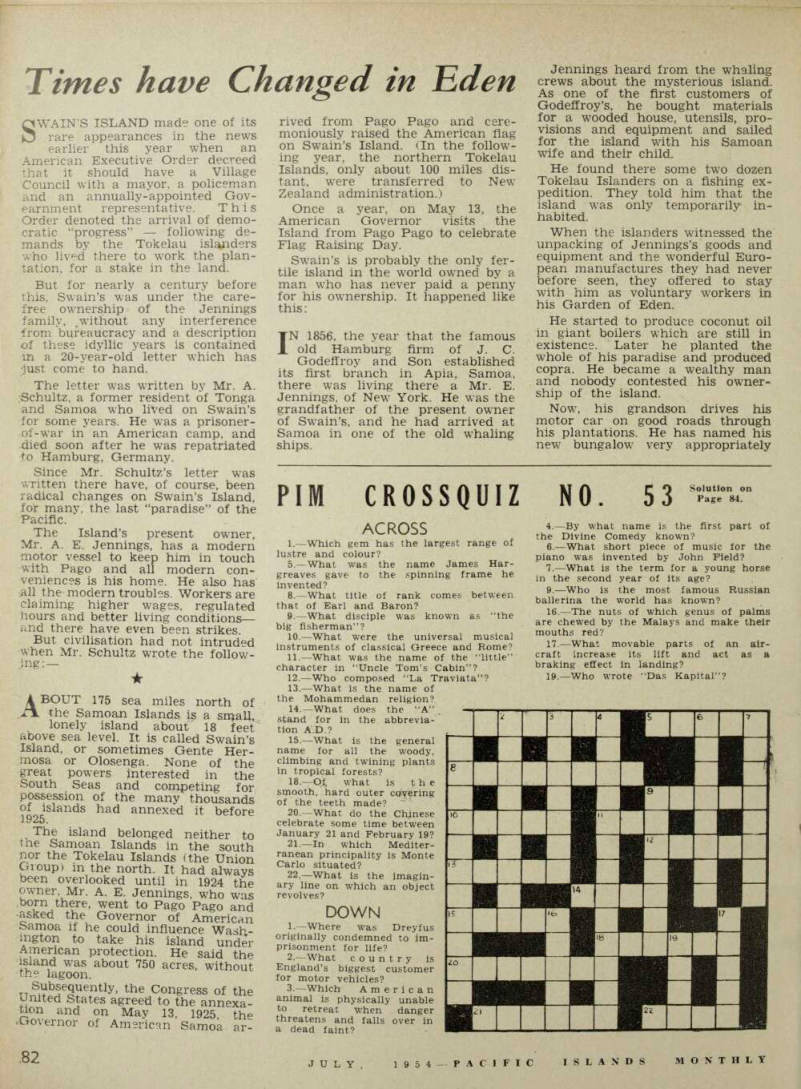
\|EN and women on the island have to work for the owner , on five week days for three or four hours to cut copra as pay ment for permission to live on the When ordered to do so they re turn to their home islands. do this volun tarily.
W omen “our Tu'Lf th S
women lour shillings worth of
(■Continued from page 83)
goods per month for their work.
Right in the centre of the island is a quiet lake about three-quarters of a mile long. It contains fresh water and is up to 40 feet deep, so tl>at a refreshing daily bath can be
eniqyed.
Three, or at the most four, times a year a small steamer of an English firm at Apia calls at the island. She lands goods and mail and takes a load of copra. There is no other connection with the outside world, no radio news dis turbs the peace and quietness. The mighty roar of the surf on the en closing reef supplies eternal music, the only true harmony in this solitude.
When I wandered about in some remote corners of the island I entered the small cemetery and was surprised to decipher on an old moss-grown tombstone the in scription: “Here rests Phoebe Ran b°rn Jennings; born 9th July I 860; died sth September, 1871.”
The young woman was the half caste daughter of the first owner of the island, who had married one of to^Gotr,. 0 ' the Hamburg