Charley the Fisherman.
pp. 82-83 · Read in the full issue
THE last great arrowhead of pelicans slid down to their anchorage at the far, western end of the, lakes; the final flush of the setting sun flared and died; and, suddenly, the lake shores were spangled. with the flares of the prawn-fishers.
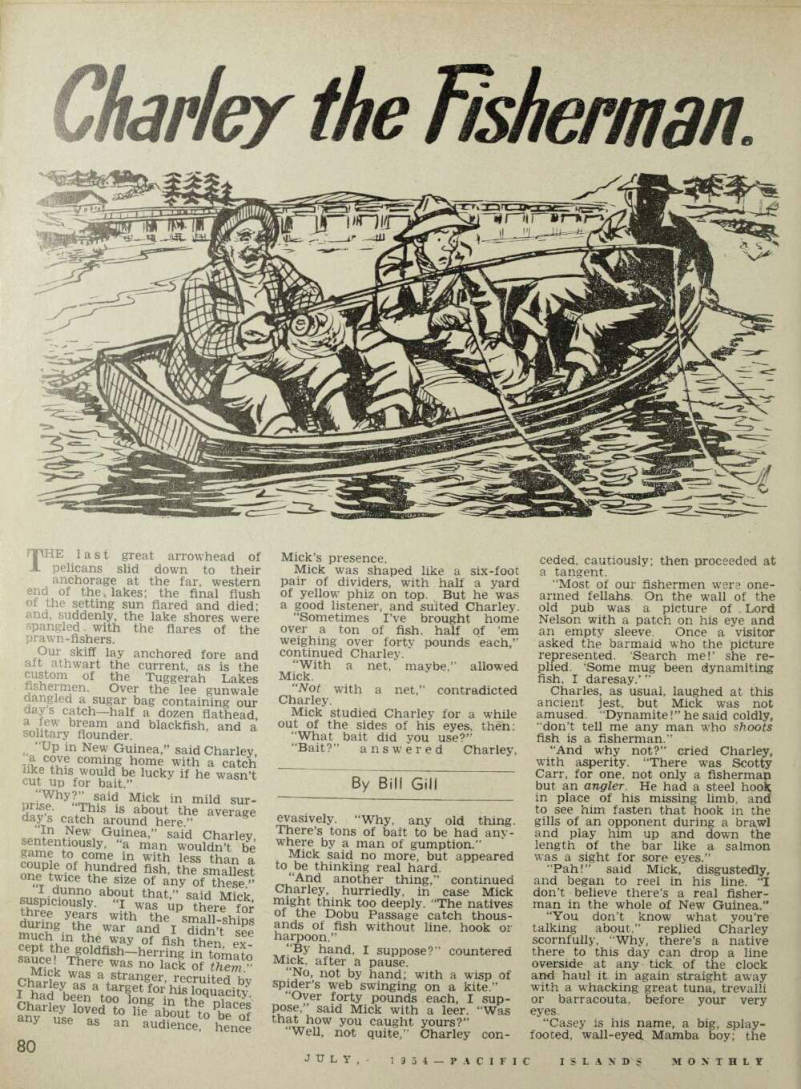
Our skiff lay anchored fore and ait athwart the current, as is the custom of the Tuggerah Lakes fishermen. Over the lee gunwale dangled a sugar bag containing our days catch—half a dozen flathead, a few bream and blackfish, and a solitary flounder, “Up in New Guinea,” said Charley, uL ?uf coml "8 home with a catch cm un UCky if he Wasn ’‘ ur 'l‘ 1 f hy ?.; saW Mick in mild sur rifl’v’c* .. 18 a hout the average day s catch around here ’’ 8 In New Guinea,” said Charlev eamp n fi° USly ’ m ? n wouldn’t be game to come in with less than n couple of hundred fish, the smallest one twice the size of any of these.” i dunno about that.” said Mirk suspidousiy. “i W as up therefor
during? with the small-ships
during the war and I didn’t «?pp the way of fl sh then, ex sauce®' in tomato sa “?. e ; There was no lack of them ” y use as an audience, hence
Mick’s presence, Mick was shaped like a six-foot pair of dividers, with half a yard of yellow phiz on top. But he was a good listener, and suited Charley.
“Sometimes I’ve brought home over a ton of fish, half of 'em weighing over forty pounds each,’’ continued Charley.
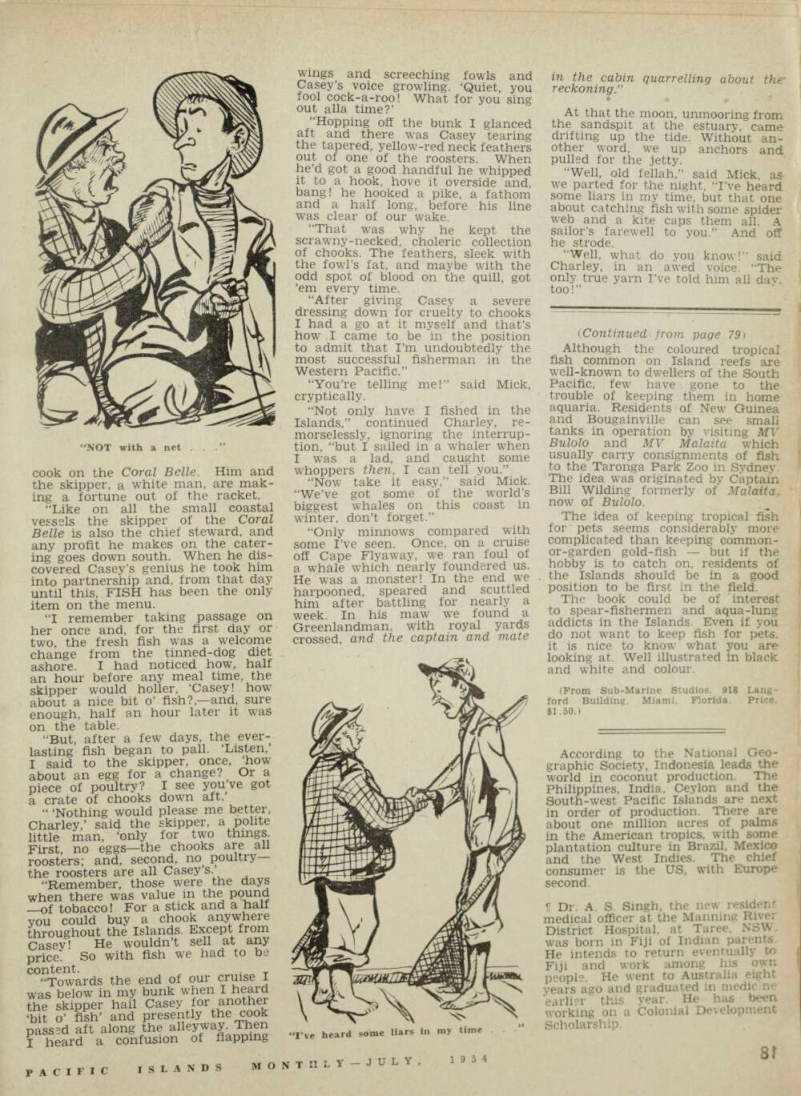
“With a net, maybe," allowed Mick.
“Not with a net,” contradicted Charley.
Mick studied Charley for a while out of the sides of his eyes, then; “What bait did you use?"
“Bait?” answered Charley,
By Bill Gill
evasively. “Why, any old thing.
There’s tons of bait to be had any where by a man of gumption."
Mick said no more, but appeared to be thinking real hard. another thing,” continued Charley, hurriedly, in case Mick nnght think too deeply. “The natives of the Dobu Passage catch thous ands of fish without line, hook or harpoon.”
“®y hand. I suppose?" countered Mick, after a pause.
“No, not by hand; with a wisp of spider’s web swinging on a kite.” ‘Oyer forty pounds each, I sup pose, said Mick with a leer. "Was that how you caught yours?”
“Well, not quite," Charley con
ceded, cautiously: then proceeded at a tangent.
“Most of our fishermen were one armed fellahs. On the wall of the old pub was a picture of Lord Nelson with a patch on his eye and an empty sleeve. Once a visitor asked the barmaid who the picture represented. Search me!’ she re plied. Some mug been dynamiting fish. I daresay.' ”
Charles, as usual, laughed at this ancient jest, but Mick was not amused. Dynamite!” he said coldly, "don’t tell me any man -who shoots fish is a fisherman."
"And why not?” cried Charley, with asperity. “There was Scotty Carr, for one. not only a fishermap but an angler. He had a steel hoolt in place of his missing limb, and to see him fasten that hook in the gills of an opponent during a brawl and play him up and down the length of the bar like a salmon was a sight for sore eyes.”
"Pah!” said Mick, disgustedly, and began to reel in his fine. “I don’t believe there’s a real fisher man in the whole of New Guinea.”
"You don’t know what you’re talking about," replied Charley scornfully. "Why, there’s a native there to this day can drop a line overside at any tick of the clock and haul it in again straight away with a whacking great tuna, trevalli or barracouta. before your very eyes.
“Casey is his name, a big, splay footed, wall-eyed Mamba boy; the
cook on the Coral Belle. Him and the skipper, a white man, are mak ing a fortune out of the racket.
“Like on all the small coastal vessels the skipper of the Coral Belle is also the chief steward, and any profit he makes on the cater ing goes down south. When he dis covered Casey’s genius he took him into partnership and, from that day until this, FISH has been the only item on the menu.
“I remember taking passage on her once and, for the first day or two, the fresh fish was a welcome change from the tinned-dog diet ashore. I had noticed how, half an hour before any meal time, the skipper would holler, ‘Casey! how about a nice bit o’ fish?,—and, sure enough, half an hour later it was on the table. •‘But, after a few days, the ever lasting fish began to pall. ‘Listen,’
I said to the skipper, once, ‘how about an egg for a change? Or a piece of poultry? I see youve got a crate of chooks down aft.’
“ ‘Nothing would please me better, Charley,’ said the skipper, a polite little man, ‘only for two things.
First, no eggs—the chooks are all roosters; and, second, no poultry the roosters are all Caseys.
“Remember, those were the days when there was value in the pound —of tobacco! For a stick and a half you could buy a chook anywhere throughout the Islands. Except from Casey' He wouldn’t sell at any price. So with fish we had to be content. “Towards the end of our cruise I was below in my bunk when I heard the skipper hail Casey for another ‘bit o’ fish’ and presently the cook passed aft along the alleyway. Then I heard a confusion of flapping
wings and screeching fowls and Casey’s voice growling. ‘Quiet, you fool cock-a-roo! What for you sing out alia time?’
“Hopping off the bunk I glanced aft and there was Casey tearing the tapered, yellow-red neck feathers out of one of the roosters. When he’d got a good handful he whipped it to a hook, hove it overside and, bang! he hooked a pike, a fathom and a half long, before his line was clear of our wake.
“That was why he kept the scrawny-necked, choleric collection of chooks. The feathers, sleek with the fowl’s fat, and maybe with the odd spot of blood on the quill, got ’em every time.
“After giving Casey a severe dressing down for cruelty to chooks I had a go at it myself and that’s how I came to be in the position to admit that I’m undoubtedly the most successful fisherman in the Western Pacific.”
“You’re telling me!” said Mick, cryptically.
“Not only have I fished in the Islands,” continued Charley, re morselessly, ignoring the interrup tion, “but I sailed in a whaler when I was a lad, and caught some whoppers then, I can tell you.”
“Now take it easy,” said Mick.
“We’ve got some of the world’s biggest whales on this coast in winter, don’t forget.”
“Only minnows compared with some I’ve seen. Once, on a cruise off Cape Flyaway, we ran foul of a whale which nearly foundered us.
He was a monster! In the end we harpooned, speared and scuttled him after battling for nearly a week. In his maw we found a Greenlandman, with royal yards crossed, and the captain and mate
in the cabin quarrelling about the'
reckoning.”
* * * At that the moon, unmooring from the sandspit at the estuary, came drifting up the tide. Without an other word, we up anchors and pulled for the jetty.
“Well, old fellah,” said Mick, as we parted for the night, “I’ve heard some liars in my time, but that one about catching fish with some spider web and a kite caps them all, A sailor’s farewell to you.” And off he strode.
“Well, what do you know!” said Charley, in an awed voice. “The only true yarn I’ve told him all dav. too!”
“NOT with a net . . .”
“I’ve heard some liars in my time . . ."