Tonga And Shirley
pp. 150-153 · Read in the full issue
Baker:
60 Years Ago
LIVING in retirement in Auck land are at least two people whose association with Tonga goes back a long way. One is Count Goedicke van Asten, whose writings have appeared in PIM from time to time over a period of years;* and the other is Mr. J. D. Whit~j combe, PlM’s representative recently' called on Mr. Whitcombe at Bayswater home and spent an in teresting hour looking through collection of old books and news paper clippings on Tonga, dating back to last century and covering an interesting and somewhat tur bulent chapter of Tongan history. The Whitcombe family’s connec-l tion with Tonga came about in this] way. Mr. J. D. Whitcombe’s father,] C. D. Whitcombe, graduated from a clerkship at Somerset House,] London, to Garibaldi’s army, in Italy; and eventually he went out] to Taranaki, NZ, with three] brothers.
In due course, Mr. C. D. Whit-J combe became Provincial Secretary] and Commissioner of Crown Lands,] and eventually Secretary to Sir] George Grey, then Colonial Gov-I ernor.
In 1885, the Union Steam Ship] Company, then planning services to 1 the Islands, sent Janet Nicoll, a 780-1 tons steamer, on a survey voyage to Tonga, Samoa, the Cook Islands] and French Oceania. A faded letter dated June 20, 1885, appoints Mrj C. D. Whitcombe, JP, as special representative of New Zealand Herald and Auckland News for the voyage. His subsequent lengthy re port on the voyage, the harbour facilities and trade possibilities along the route, was published ini NZ Herald on August 6, 7 and 8, 1885, and was undoubtedly in-i fluential in the establishment of aj regular shipping trade from New Zealand.
A little later, Mr. C. D. Whit combe met in Auckland the Rev.
Shirley Baker, then Premier of i Tonga and head of the Wesleyan!
Church, who asked him to act as* private tutor to the Tongan Crown: Price, Taufa’ahau. This was agreed] upon, and Taufa’ahau went to] Auckland, to live with the Whit-j combes, in 1888. Two years later,] when the Prince was to return to Tonga, he insisted that the Whit combes go with him. Mr. Baker appointed Mr. Whitcombe Principal of Tonga College, and Special Magistrate. Mr. J. D. Whitcombe was then a small boy.
The family, with the Crown Prince, arrived at Nukualofa on the
ry day that Shirley Baker (whose Drmy history is well known, and o involved to recount here) was ling deported. Naturally, the Dngan Government, now headed r a Tongan, Tukuaho, refused to cept the appointment of Mr. hitcombe which had been made r Baker. The Whitcombe family mt to Sydney, pending settlement the dispute. Mr. Whitcombe aimed that the appointment had en legally made, that he had been it to great cost and inconveni ice in getting to Tonga, and that ‘ was entitled to compensation if te appointment were not con •med.
Crown Prince Taufa’ahau was in- Jtent that Mr. Whitecombe go to mga, and he toured the villages Tongatabu with what probably as the first “magic lantern” seen ere, collecting funds to pay the hitcombe cost from Sydney. The mily returned to Nukualofa in 92, and Mr. Whitcombe senior was ►pointed Government Auditor, ►llowing the death of King Tubou in February, 1893, and the cession to the throne of the •own Prince, he became Foreign icretary, until 1890.
Young J. D. Whitcombe went to
school in NZ, and afterwards was in Levuka and Rotuma; but eventually he returned to Tonga
and served variously as Secretary to the Premier, Government In terpreter, Copra Inspector, and
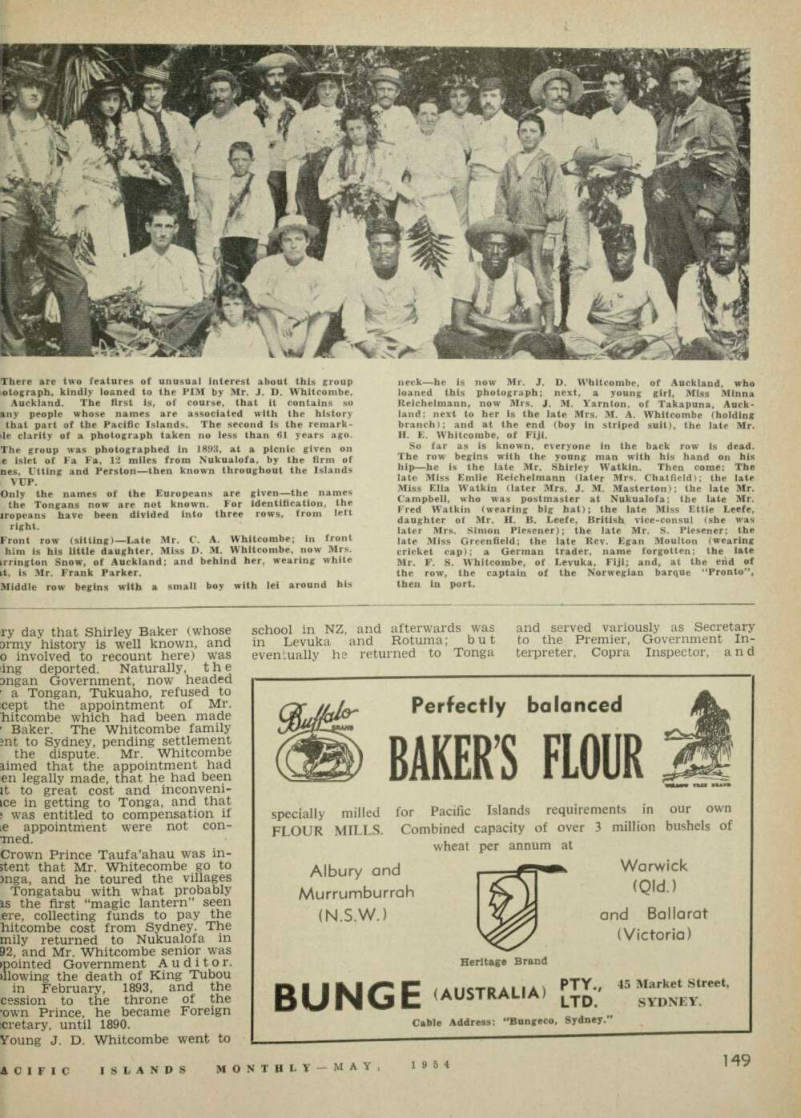
There are two features of unusual interest about this group photograph, kindly loaned to the PIM by Mr. J. D. Whitcombe, Auckland. The first is, of course, that it contains so any people whose names are associated with the history [?]that part of the Pacific Islands. The second Is the remark [?]le clarity of a photograph taken no less than 61 years ago.
The group was photographed in 1893, at a picnic given on [?]e islet of Fa Fa, 12 miles from Nukualofa, by the firm of [?]nes, Utting and Perston —then known throughout the Islands
[?]Vup.
Only the names of the Europeans are given—the names [?]the Tongans now are not known. For identification, the [?]ropeans have been divided into three rows, from left [?]right.
Front row (sitting)—Late Mr. C. A. Whitcombe; in front [?]him is his little daughter, Miss D. M. Whitcombe, now Mrs. [?]rrington Snow, of Auckland: and behind her, wearing white [?]t. is Mr. Frank Parker.
Middle row begins with a small boy with lei around his
neck—he is now Mr. J. D. Whitcombe, of Auckland, who loaned this photograph; next, a young girl, Miss Minna Reichelmann, now Mrs. J. M. Yarnton, of Takapuna. Auck land; next to her is the late Mrs. M. A. Whitcombe (holding branch): and at the end (boy in striped suit), the late Mr.
H. E. Whitcombe, of Fiji.
So far as is known, everyone in the back row is dead.
The row begins with the young man with his hand on his hip—he is the late Mr. Shirley Watkin. Then come: The late Miss Emlie Reichelmann (later Mrs. Chatfield); the late Miss Ella Watkin (later Mrs. J. M. Masterton); the late Mr.
Campbell, who was postmaster at Nukualofa; the late Mr.
Fred Watkin (wearing big hat); the late Miss Ettie Leefe, daughter of Mr. H. B. Leefe, British vice-consul (she was later Mrs. Simon Plesener); the late Mr. S. Plesener; the late Miss Greenfield; the late Rev. Egan Moulton (wearing cricket cap); a German trader, name forgotten; the late Mr. F. S. Whitcombe, of Levuka, Fiji; and, at the end of the row, the captain of the Norwegian barque “Pronto”, then in port.
lacher. He left Tonga in 1933, iiout the time his father died.
Mr. J. D. Whitcombe has many Dcuments and photographs con scted with his father’s and his n n work in Tonga—much of the .aterial is of real historical in rest. He has been working for some ;ars on a revised Tongan-English ctionary and vocabulary.