News Of The Small-Ships
pp. 144-148 · Read in the full issue
Polurrian Loses Skipper:
—Capt. Bill Hallam has left the Polurrian after a little over two years in charge of this well known inter-island ship. Under the charge of Capt. Hallam this ship has "saved the bacon" of many plantations in Bougainville district by making regular trips out from Rabaul with supplies and then collecting 300 tons of copra for the inward trip.
Capt. Hallam has kept the ship on a regular schedule, kept her in fine condition and made it a popular ship for passengers to travel by. He now plans to have a well earned holiday and then to take a position on an overseas vessel that will allow him to obtain extra ex perience and higher certificates. He is a young man and keen on his profession. His friends in Bougain ville will miss him on the bridge of the green-hulled vessel that ran as though on a train schedule and which has become part of the Bougainville economy.
Airco To Assist;— The Airco,
which carries 1,000 bags of copra and is skippered by Mr. Ron Auld. has been moving quite a bit of copra from Buka Island and Buka Passage under arrangements with the Bougainville Company, thus assisting the Polurrian with her task of lifting a valuable product from this heavy producing district.
Vig Shipping Weather:—
Port Moresby advises that weather
broadcasts for the New Guinea area are now being made, especially for shipping, on the Smallships frequ ency of 6225 kc s at 0030/0530 GMT, Monday to Saturday, and at 0030 GMT only, on Sunday and holidays.
The broadcast is made in morse only. Why it could not be repeated on voice is not clear, especially as this is primarily a voice frequency.
Now Here, Now There:
From June to September of last year a Japanese fishing fleet operated most successfully in waters east of New Guinea and the Solo mons and was mothered by the 11,000-ton freezer-ship Tenyo Maru.
In March, Tenyo Maru, accompanied by five 200-ton whale-chasers, dropped in to Wellington, NZ— homeward bound from the Antarctic with a full cargo of 4.000 tons of whale meat and some Adelie pen guins for a Japanese zoo. She carried a crew of over 300 men, only two of whom, the master and the radio officer, could speak sufficient English to deal with the ship’s business of fuelling and stores. No doubt, on discharge in Japan, Tenyo Maru will again head south with a tuna-fishing fleet. She is owned by Taiyo Gyogyo Kabushiki Kaisha of Tokyo. It is possible that the whale-chasers also have a dual role.
SUVA DOCKS—Though it is "likely to be some considerable time” before tenders are called for
:.he reconstruction of the Suva water-front facilities, according to x Fiji Government announcement, -wo representatives of the English consultant firm of Wilton & Bell .irrived there recently to carry out i.est-boring operations. One of the partners of the firm also arrived io consult with the various people interested in cargo handling.
Santa Teretia It.— The Gil
bert & Ellice Catholic mission-ship Hanta Teretia II cleared Suva late ipril after refit, returning to Tarawa r ia Funafuti.
BIG TOW:—Though little is leard of it, the US Navy regularly arries out some big towing opera ions in the South Pacific. In April, JSS Wandank, 900-ton Navy tug nth a crew of 5 officers and 50 atings, arrived at Pago Pago, E.
Jamoa, with two large barges in ow. Dropping one there she pre ceded to Kwajalein in the Marshalls vith the other, which was fully Daded with supplies. At Kwajalein, Vandank will hitch up to any empty arge and return with it to Pearl larbour —a round-trip tow of 6,000 liles.
The 125 ft x 30 ft barge brought 0 Pago Pago will be used to trans port heavy grading equipment and rucks to Ta’u Island, Manu’a Iroup, where roads and a new rharf are to be constructed.
Light Inspection:—Aiso Ex
acted in Pago Pago in April was he US Coastguard Cutter Kukui, vessel of 1057 tons gross, measur ig 190 ft x 30 ft with a speed of 12 nots. Kukui will make an annual ispection of lights and naviga ional facilities in American Samoa raters. Included in her crew are 2 Samoans who will have the pportunity of seeing their families Dr about 8 days. Two of the men, ttached to a Marine unit in Japan, ad been assigned to the vessel to hat they could visit their dying Either, a Samoan pastor in Mapu aga village, Tutuila.
Fiji Launch In Trouble:—
•ound for Suva in March the USS ! o.’s freighter Waihemo sighted a aunch, apparently adrift, in the icinity of Vatulele. Next morning he derelict was reported to the uva Harbourmaster who lost no ime in requesting the RNZAF to ike a look. A Sunderland and le Search and Rescue launch de patched, soon located the launch heik 20 miles WNW of Vatulele. fanned by four Fiians and two ndians, the craft had been out shing when the motor broke down, he was towed to Cuvu by the ,NZAF and later returned under er own power to Navua, where she 1 owned by Mi*. Alan Harrison, of le Navua Hotel.
Gilberts Search:—The Geic
rovernment vessel Te Matapula as, early February, reported en stged in a search for a surf-boat,
missing from Tabiteuea with two men aboard. Eventual results of the search are not known.
Back To Work: A’Oniu,
Tongan Copra Board’s 80-ton ketch, overhaul completed, returned to the group in April, calling en route with supplies at Raoul Island, Ker madecs, from Auckland.
THAT MAIN A LIGHT; —T h e long-awaited Maina Islet light, Aitutaki, Cook Is., came into opera tion in April. As now established, it is something of a mystery as to what exactly were the intentions of the designer. Clearly what was wanted was a light that would cover if not all waters to seaward, at
least all sectors from somewhat east of south, through west, to some what eastward of the main landing —so that vessels approaching from Rarotonga, from the Northern Group, or leaving for Rarotonga from the Arutunga landing, would have the advantage of the light.
The lamp installed is a standard type of ship’s mast-head light, covering only about 225 degrees of arc, which obviously does not fill the above requirements. An all round light mounted on top of the islet where it would not be obscured, or otherwise satisfactorily sited, would have been far more useful, and seemingly no more costly. The present light is said to be about
52 feet above sea-level, and gives two one-second flashes separated by one second, the cycle repeated every 15 seconds.
RAROTONGA D F:—lncapable of taking bearings of vessels using the smallships’ frequencies, but useful to larger deep-water craft, the re-siting of aerials for a direc tion-finding shore station at Raro tonga, Cook Is., was completed in April. The position is given as 21 degs. 11 mins. 45 secs. South. 159 degs. 48 mins. 03 secs. west. Bear ings will be given upon request on 500 kc s.
TINA TWO:—It is reported from the New Hebrides that the 112-ft refrigerated Fairmile vessel Tina Two went on Dentrecasteau Reef, Banks Group, on February 17 and became a total loss. The ship was owned by Barrier Reef Enterprises Pty., of North Queensland.
New Ship For Hebrides
SERVICE; —The Polynesie is a new ship of the Messageries Maritimes line which is being fitted out in France for the Sydney-Noumea-Vila run. This time next year she is to replace the Polynesien, well known to travellers to and from New Caledonia and the New Hebrides since before the war.
The new ship, of about 4.000 tons, with a length of about 330 feet, will be able to carry 2,400 tons fully loaded, as well as 36 passengers.
Powered with diesel engines, she will have an average speed of 15knots, enabling her to cover the Sydney-Noumea run in three days.
She is being fitted out with gyro* compass, radar, etc.
A reliable, up-to-date service such as the Polynesie is expected to pro vide should help to put New Cale donia back on the tourist map.
Neo Hebridais In Dock;—
Mr. Jean Hagen’s Neo Hebridais II entered Cockatoo Dock, Sydney* early in April for a routine survey.
She will be back in service at the end of May.
The ship has a tonnage of 1,266 gross and 726 nett, and has been running a regular cargo service be tween Sydney and Noumea since-
April, 1953, when she replaced the
of American Samoa, relieving former on the run for many years.
Agents are H. C. Sleigh Ltd.
News of Cruising Yachts
• WHITE HART, an attractive looking -48 ft motor sailer owned by Tony and Bridget Reeves of British Columbia, i& likely to be seen in the Islands. The owners are engaged in salmon fishing at present and as soon as funds are up to requirements, the vessel will be headed south-west for New- Zealand—via ports. 0 Lee and Ann Gregg in NOVIA, which was in French Oceania waters last year, have now arrived at Honolulu—after a punishing passage from Hilo where the 34 ft ketch had lingered for some time.
After enjoying, for a time, the luxuries of the Ala Wai yacht basin, Honolulu’s : well-provided yacht terminal, and the installation of a new auxiliary, the Greggs may head back to Hawaii Island for some more coastal exploration. • Ronald Johnson, who disposed of his yacht PAMPERO at Honiara and returned to Sydney some time ago, is understood to have sailed by passenger ship for Hongkong in March. He will probably j purchase another yacht or trading craft there and resume his voyaging in no par ticular direction. If someone should fancy] the craft and purchase her from him —\ well and good! • PAGAN, in which Bill Weld cruised j down through the Islands a couple of j years ago to enter the trans-Tasman Race I from Auckland, was reported in Hobart early this year and likely to head for New Zealand. • SORENGANA—wrongIy given last, month as SORENGAMA, a sizeable Baltic ketch owned by Captain Scott Elliot, of Plymouth, is apparently to remain in the Solomons as a trading vessel. This 80ton craft made calls only at the Marquesas, Suwarrow and Samoa In her run from Panama to Honiara. • TERN 11, continuing her voyage from England to Auckland, cleared Papeete, March 22, for Moorea and Bora Bora.
After an uneventful voyage, the 3,9 ft yawl.
•carrying Lieut. B. C. Pester, RNZN, and Ihis companion, Peter Fox, reached Auck lland at the end of April. • MANDALAY, from the Atlantic Coast •of the States, with owner Rockefeller in •command, sailed from Papeete March 13 —having been in that port since October 15 last. Anthony Richardson, of Daven [port, lowa, signed off before departure :and travelled to New Zealand by air, [returning to the States via Europe. His [place was taken in MANDALAY by Jack Grant, who had arrived in Tahiti in the yacht VENTURER of the Pacific Coast.
VENTURER was last reported in Hono lulu. MANDALAY, according to Richard son, would head westward as far as the New Hebrides, calling at Moorea, Bora Bora, probably Samoa and Fiji enroute, then turn north-east for Honolulu about next hurricane season. • Suva Yacht Club, most active and best equipped in the Islands area south of the Line, opened its 1!)54 season late March under the Patronage of His Excellency the Governor with a full programme of racing. Added interest was provided by participation on the part of men from HMCS ONTARIO which happened to be in port at the time. ONTARIO, also present at last season’s opening, had then won a trophy. • Yachtsmen cruising between New Zealand and Polynesia this winter—and there seem likely to be a few T —will have an added safety aid if they care to avail themselves of it. NZGV MAUI POMARE was to be equipped with a ZC-I R/T set early May, capable of operating on 2182/2)162 kc/s. Radio Officer Windsor reported that he would be ready and willing to maintain daily contact with radio-equipped yachts in the area of the MAUI POMARE’S orbit Auckland-Cook Islands. The MAUI POMARE does not maintain a watch on these frequencies, so a prior arrangement is called for.
Watch will, of course, also be kept on any other nominated frequency as re quired. • On March 18, the lone French yachtsman, Marcel Bardiaux, sailed
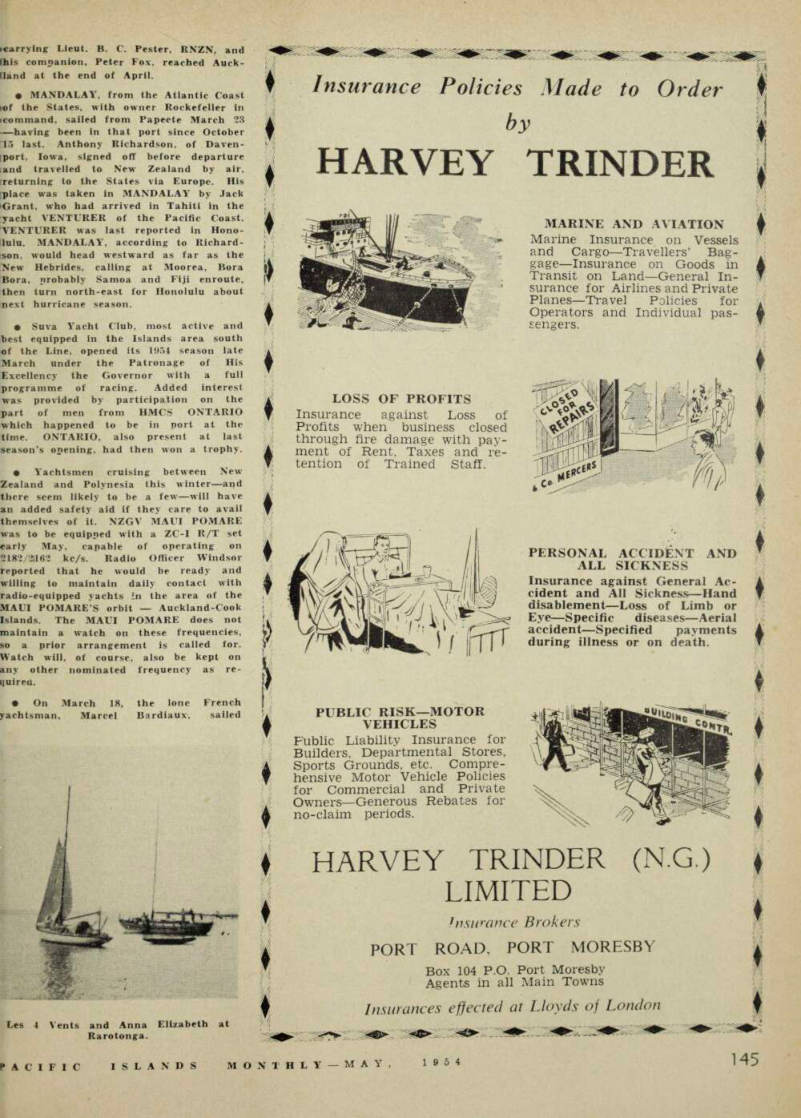
Les 4 Vents and Anna Elizabeth at Rarotonga.
LES 4 VENTS into Avarua harbour, Rarotonga, from Papeete.
M. Bardiaux arrived in Tahiti in May. 1953, after a solo trip from France to South Africa and round Cape Horn into the Pacific.
In 1951 he made a record small-boat crossing of the Atlantic in 28 days from Dakar to Rio de Janeiro. He sailed his 28-ft sloop south of Tierra del Fuego through the La Maire straits, taking advantage of a nine knot following current. Unfortunately, a south-west gale sprang up, meeting the current and caus ing huge confused seas. LES 4 VENTS capsized, but the freak seas righted her again although she came up minus most of her canvas. Eventually Bardiaux reached Valparaiso, and sailed from
Coquimbo, higher up the coast, across 4,885 miles of Pacific to Tahiti.
In Papeete he became friendly with a party of New Zealand “yachties” who invited him to visit them in Auckland.
He is now on his way to see his Kiwi friends. From Auckland his proposed route is to New Caledonia, then through the East Indies to Singapore, across the Indian Ocean to Madagascar and round the Cape of Good Hope. He will then cross the Atlantic again to Buenos Aires, head north to New York and recross the “pond" to France. • Two days before Bardiaux reached Rarotonga, the Dutch sloop, ANNA ELIZABETH was seen beating round Rarotonga’s coasts waiting for an oppor
tunity to enter Avarua harbour. Skipper owner Ernst Lamberty is well-known in Papeete and the Marquesas and visited the Cooks two years previously. His present crew consists of two Frenchmen, a Tahitian, and a seagoing cat.
They plan to visit Auckland in com pany with LES 4 VENTS and return to Papeete via Brisbane and Port Moresby.
fl Mr. D. V. Buck, of Wilton and Bell, the Fiji Government’s con sultants on the schemes for new dock systems for Suva and Lau toka, arrived in Fiji in April for discussions with Government and shipping and commercial interests.
Two engineers from London were taking borings for the Suva dock scheme, in April.
Kathleen Gillett (better known as plain Kathleen) leaving: Sydney for her journey to New Guinea. Now owned by Mr. Jack Thurston, who uses her as a floating office off his several plantations in the New Britain area. One of the only two genuine Colin Archer ketches believed to be in southern waters, she was built by Charles Larson, the Australian builder, for Jack Earle, the noted journalist and artist who took her twice round the world.
Mr. Reg Cookson, a philatelist, was the intermediate owner. He lived aboard the ketch in Sailors’ Bay. Sydney, for some time before he sold to Mr. Thurston.
She has been remasted and fitted with a Gardner diesel. —Photo by Bolling’s Studios.