‘Jerked Across The
pp. 137-139 · Read in the full issue

Reef’
Remarkable Salvage Feat In New Britain
)N Thursday, April 14, the Meklong, operated by Coconut Products Limited, with a couple f thousand bags of copra aboard, it a reef 12 miles north of Pondo, few Britain, at full speed (Hi nots). She rode over the reef for distance of a hundred feet, end ig up in 2i feet of water forward nd 6 feet of water amidships, with nly her stern over the edge of the 3ef, where she was drawing about ih feet.
From even the layman’s angle, ie was more or less high, if not ry. She might at that time have een considered by most people a )tal loss.
Private enterprise at Rabaul was nable to cope with the task of re oating this ship, although asked y the Harbour Master to do so. hereupon the Harbour Master Captain Thompson) called upon ie Papua and New Guinea Gov :nment Shipping Service (now tore or less out of service) to mder such assistance as might be essible.
Most people know that the Gov mment ships were put up for sale y tender; and all except two, the uali and the Kelaua, were sold; ad Agency Agreement expired on [arch 18. So only two forlorn abies were left, and without crews, ed up and awaiting sale or respective buyers.
N an hour the almost defunct , Line’s manager, Mr. J. H. Evans, had arranged to man the latter lip, using one of his office staff 3 a First Engineer (Mr. C. Hobler), is Asian fitters as Watchkeeping ngineers, a local Master (Mr. G. ox) from Messrs. Burns Philp & o. (from a ship under repair) and [even native boys; so that from er “lying up” position the M.V. alaua was made seaworthy within very short time.
They sailed from Rabaul on pril 15. The manager, Mr. Evans, Jtired some years from the sea ad now an office wallah and busi ess executive, was in charge. They eaded for Pondo, arriving at the :ene of the disaster in darkness, i the early hours of the 16th.
Navigating close up to the reef, ad still in darkness, they put lines aoard, as day was breaking. They lade a first attempt, on the first igh tide, to tow the ship off but ie would not budge an inch.
They then discharged cargo, lout 1,200 bags, into the Kelaua, hose stern was only 4 feet from ie reef. At high tide the same /ening (the 16th) they made a ;cond attempt to pull the ship off,
but with normal towing conditions she remained immovable.
Later in the evening, as a last resource, and risking Kelaua, Mr.
Evans decided to let the wires get really slack and took a run of about 100 yards at full speed. This smashed the 5-inch towing hawser on the port side, but there was still no movement from the ship on the reef.
Mr. Evans backed Kelaua again, for nearly 200 yards this time, and made the balance of the wire fast around the after bulkhead struc ture of the Meklong. With an all out effort he rang for full speed— which jerked the ship bodily over the rock which was holding her, so that she moved three feet astern and partly broke loose from the grip of the coral.
“This effort,” reported Mr. Evans, “again snapped the other 5-inch salvage wire, and it is a wonder that we did not pull the bitts right out of the Kelaua (which indicates that the ship is pretty solid). We then backed astern to the reef, close by the Meklong, with 5 shackles of cable out into a sort of bottomless pit of water, so that when the anchor eventually touched bottom we kept a steady strain onto the stricken ship.”
During the night the Kelaua men decided to remove the balance of the cargo, another 800 odd bags, and they even contemplated jet tisoning 70 tons of the Meklong’s fuel, pumping all her water over the side and blowing down her boilers, leaving her to all intents and purposes a derelict without power.
HOWEVER, with the rise of tide on the 17th, the unloading of cargo, and the fact that they had jerked the ship bodily over the rocks which locked her on the reef, the Meklong started to roll, and break up coral. At the top of
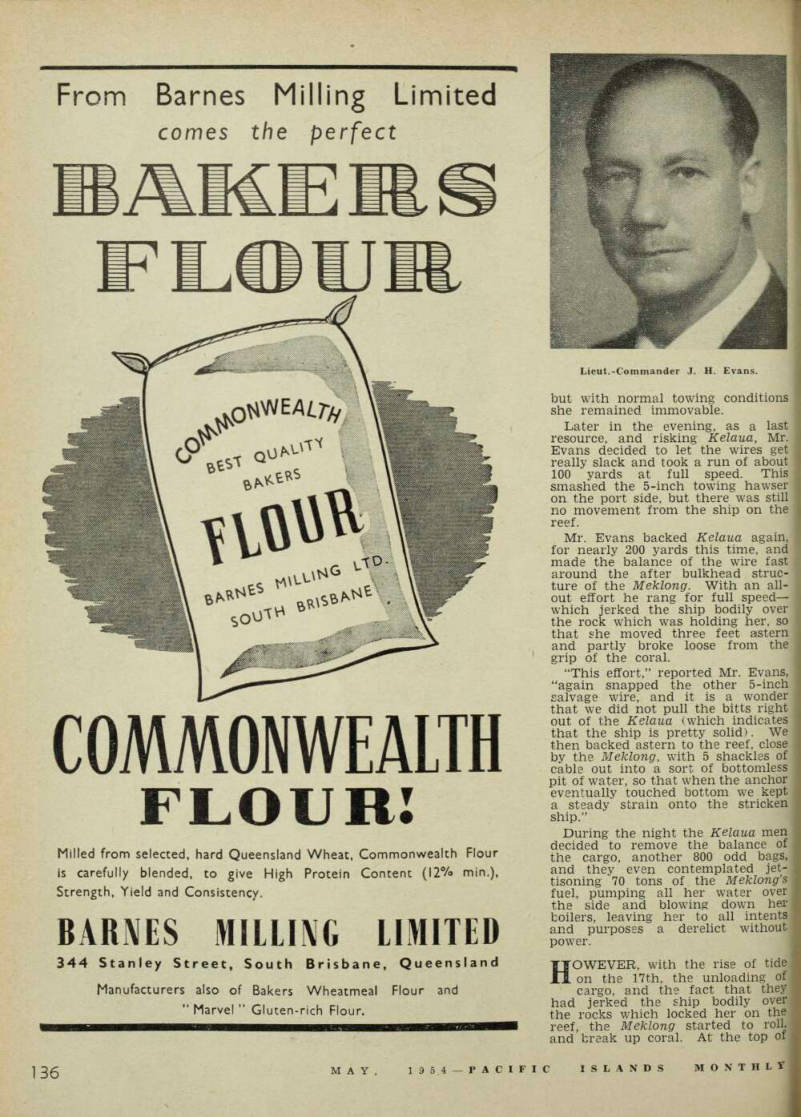
Lieut.-Commander J. H. Evans.
high water, and with the weight of the Kelaua, Meklong broke sud denly free, with a run. The two ships shot away from the reef and swung around precariously, likely to drift back on the reef again, still tied together, stern to stern.
But Kelaua managed to pull Meklong clear of the reef, and still keep clear herself. In doing so, she broke the bridle and the 'owing wire, which had been doubled and re-doubled. There were various manoeuvres during which. ;he Meklong turned over her motor ife-boat, with copra aboard, and >ank her motor pinnace, also full )f copra. But the Kelaua managed ,0 manoeuvre between the reefs in iarkness, and saved the Meklong’s notor life-boat.
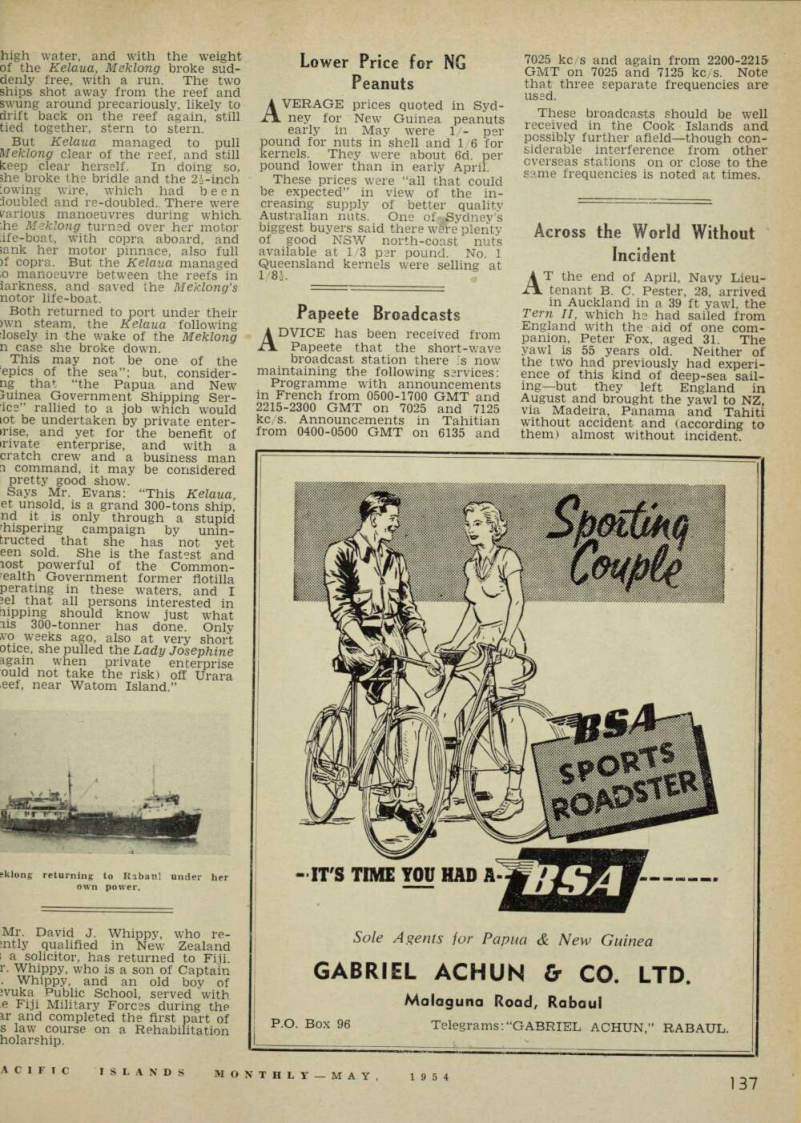
Both returned to port under their >wn steam, the Kelaua following dosely in the wake of the Meklong n case she broke down.
This may not be one of the epics of the sea”; but, consider ng that “the Papua and New Guinea Government Shipping Ser ies” rallied to a job which would lot be undertaken by private enter irise, and yet for the benefit of irivate enterprise, and with a cratch crew and a business man a command, it may be considered pretty good show.
Says Mr. Evans: “This Kelaua, et unsold, is a grand 300-tons ship, nd it is only through a stupid whispering campaign by unin tructed that she has not yet een sold. She is the fastest and lost powerful of the Common wealth Government former flotilla perating in these waters, and I 3el that all persons interested in lipping should know just what 11s 300-tonner has done. Only vo weeks ago, also at very short once, she pulled the Lady Josephine again when private enterprise ould not take the risk) off Urara eef, near Watom Island.”
Mr. David J. Whippy, who re mtly qualified in New Zealand 1 a solicitor, has returned to Fiii. r. Whippy, who is a son of Captain . Whippy, and an old boy of wuka Public School, served with e Fiji Military Forces during the ir and completed the first part of s law course on a Rehabilitation
holarship.
[?] eklong returning to Rabaul under her own power.