Rehabilitating the Pacifies Ageing
pp. 105-109 · Read in the full issue
Coconut Groves
A PAPER on the rehabilitation of coconut cultivation in the Pacific Islands was prepared by Mr. W. V. D. Pieris, Copra Tech nical Officer to the South Pacific Commission, and presented at the Pacific Science Congress, held at Manila, in November, 1953.
The paper was published in the January “Bulletin” of the SPC, and has been condensed in the follow ing article: Human life in the Pacific (said Mr. Pieris) would become intoler able if there were no coconut palms, and on the atolls it would become Impossible. Nothing has been found to take its place, and nothing is likely to be found.
Before the value of coconut oil was appreciated, and before it was discovered that the copra travelled better than the oil, the Islands sup ported much larger populations than now, and the needs of the people were mostly satisfied by the innumerable products of the coco nut palm.
Now, copra is money, the only source of money in most islands, and more and more of it is required.
But where is it to come from? There is only one hope—the rehabilitation of coconut cultivation.
A 16-months’ survey of the coco nut industry in the Pacific region showed the general picture in the Territories visited to be the same— —groves and plantations past their prime and, due to neglect, going out of production, or not producing as they ought. It was not unusual to encounter palms well over 70 years old producing 10 to 15 nuts a year; and 30 or 40-years-old palms pro ducing 20 or 30 nuts. (A 30 or 40years-old palm should produce 60 nuts a year with moderate atten tion) ,
Regenerating Plantations
Rehabilitation must be considered in two parts—regeneration of plan tations, and restoration of native groves to full economic production.
Plantations are divisible into those over 60 years of age, and those under.
Regeneration of plantations over 60 years consists of partial restora tion of soil fertility by the growth of leguminous cover-plants, followed by replanting with selected material and aftercare of transplanted seedlings, principally by the use of artificial fertilisers.
Regeneration of plantations under 60 years consists of (i) cultivation of the soil and weed control; (ii) application of mineral fertilisers; (iii) animal husbandry as a symbiotic arrangement of the greatest economic importance.
The restoration of native groves to full economic production is a more complicated task. Well over
90 per cent, of the land under coco nuts is in the ownership of the islanders.
The first problem is not one of replanting—it is the reduction of overcrowding and the creation of a semblance of correct spacing by thinning out the palms already pre sent.
The prerequisite to thinning out is a survey of each area to be treated, followed by a census of palms. It will then be possible to calculate the present concentration of palms of all ages per acre and
the maximum number of palms the area could carry at a planting dist ance of not less than 28 feet.
The next step is to remove all palms over 60 years. Concurrently, all palms over 50 years should be marked for removal at the end of ten years. The third step is to take
out all abnormal, unhealthy and barren palms.
The fourth is to take out all seed lings and young palms under five
years, heed being paid to planting distance.
The fifth is to set about the final correc tion of planting dist ance. This has to be a compromise, because straight rows cannot be achieved. But by careful removal of excess palms to an average planting distance of 28 feet, an
uneven straightening
out of rows can be accomplished.
While steps 1 to 5 are being worked through, empty places in the groves should be filled.
Only selected seedlings raised from selected seed-nuts obtained from
selected high-yielding
palms must be used.
When native groves have been transformed, they will require culti vation and weed-control as on plantations. As
soil becomes depleted of phosphorus, nitrogen and potash, due to the continued export of copra, these ingredients will have to be replaced.
Need For Coconut
Research
Besides a relative lack of statistics on extent and production of coco-
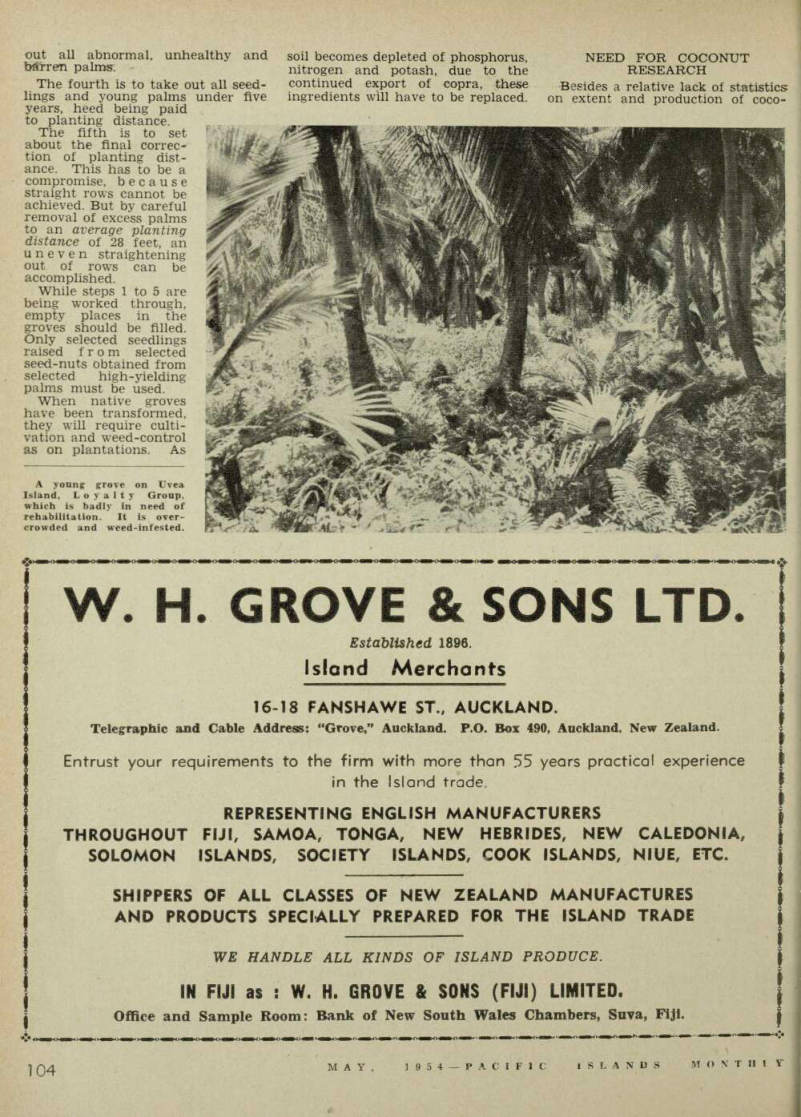
A young grove on Uvea Island, Loyalty Group, which is badly in need of rehabilitation. It is over crowded and weed-infested.
nut palms, there are few statistics on age-distribution of palms in the islands. But what is most deficient is information on soils and fertiliser requirements. Atoll soils need in tensive study. For instance, it is surmised that chlorosis of palms on atolls is due to an iron defici ency induced by excess calcium.
Field experiments have still to be carried out to confirm this.
Soil surveys are under way in certain territories. This work has to be extended to the whole region and hand in hand should go fer tiliser trials. In the absence of such research, it is impossible to recommend correct fertiliser mixtures.
The whole programme of rehabil itation will be slowed down or spoilt if growers are not supplied with continuous technical advice —based on research. One or two territories can meet this need to a large ex tent, but are not in a position to add more personnel to their agri cultural services or to set up local research stations. These territories will look to the South Pacific Com mission for assistance and “clear ing-house” information.
Technical advice on all aspects of coconut cultivation is the most urgent requirement in the Pacific.
A prosperous coconut industry can pay for all transport, social, medical ind educational services required by the islanders.
Economic Felling
In further articles, Mr. Pieris dealt with the felling and disposal Df old palms.
He pointed out that replanting of properly spaced plantations is usually done by planting seedlings in the squares or triangles formed oy the old palms. The seedlings develop under the canopy of the old stand, and under good management ;hey bear not later than the seventh pear.
At this stage, the old palms have ;o be removed, a difficult and costly mdertaking, because in felling care nust be taken not to damage the poung palms.
The part of the old palm that does the greatest damage on falling s the crown. To lessen danger, the isual method is for climbers to go ip and cut off the fronds half-way down the stalks, leaving the un opened central fronds intact. The oalm is then accurately felled two or three feet above ground level, rhe cost of such work is high, even
vhere labour is plentiful.
A cheaper, quicker, and more officient method is to poison the oalms before felling. This is usually lone with an arsenical weed-killer.
Dne ounce of the substance is ooured into a hole 12 inches deep, drilled at the base of the palm.
The advantages of poisoning are; [i) the palm dies and the fronds dry up and fall, leaving a clean item w 7 hich can be felled with pre
cision; (11) with the death of the palm, it ceases to compete with the young replants for moisture, soil nutrients and sunlight.
But it should be remembered that the poison acts locally where it is injected, and is not translocated along the trunk to the crown. This means that the trunk can still serve as a breeding ground for rhinoceros beetle unless it is rendered inaccessible or destroyed by fire.
Disposal Of Dead Palms
In Ceylon, where the rhinoceros beetle is prevalent, one measure
of control consists of keeping plantations clean and free of de caying trunks, which serve as breed ing places.
When palms are felled the trunks are cut into 6-foot sections and split lengthwise. The boles are dug up and also split in the same way.
The split»sections of the trunks and boles are stacked with the cut surfaces upwards, and left to dry.
In sunny, windy weather drying should be complete in less than a fortnight.
The crowns, from which the branches have been removed pre
paratory to felling, are split in halves or quarters through the bud tissue and also left to dry.
The split crowns and dried branches are then placed inside and against the enclosures made by the stacked split trunks and boles, and fired. If drying is complete, the whole mass will burn to ashes; otherwise, further fir ing will be required. In any case, once the material is charred, the female rhinoceros beetles will not lay eggs in it.
Anzac Day was cele br ated in Samarai, Papua, by a dawn ser vice at 5.30 am; a march-past and service later in the morning; and a luncheon for all former Servicemen. All functions were well at tended. The Rev. A. G.
Daw conducted the re ligious services.
If District Commissioner K. C.
Atkinson and family returned to Papua from leave in April and will
go to Abau, where he will 'take up duties as DC for that District.
Formerly he was at Kikori.
A well-kept plantation on Bougainville Island, an ex ample of post - war re habilitation of an overgrown plantation. Fallen branches are heaped centrally along the avenues of properly spaced palms.