Tahiti's Peak
pp. 81-84 · Read in the full issue


First Climbers On
Mr. Jay Gives Events in Correct Sequence
THE claim by Messrs. Marcel Varuamana, Alphonse Hollande and Raymond Tiaore, that they were the first to climb Mount Oro hena (the highest mountain in Tahiti, 7,339 feet)—which claim was published on page 33 of November PlM—is very strongly challenged by Mr. M. Jay, of Taharaa, Tahiti.
In the first place, says Mr. Jay, the natives of Tahiti were on top of Orohena long before the Euro peans arrived: and he sends, as proof, photographs of an ancient wall, and a skull, found on the mountain-top.
Further, he says, the track used by the three gentlemen named was actually cut, some time before, by Mr. Jay and his party, in June, 1952 and September, 1953. On the latter occasion, they were forced to shelter for a week by bad weather, and ran out of food: so they went down for supplies. While they were away, the three other men came up, used the newly-cut track, covered the last 300 yards with the aid of a rope, an~ called themselves the conquerors of Orohena.
“They were in such a hurry to get back to Papeete, and claim their distinction,” says Mr. Jay, “that they failed to notice the quite con spicuous evidence of a previous oc cupation!”
In order that history may not be wrongly compiled, Mr. Jay gives us some details of previous climbs.
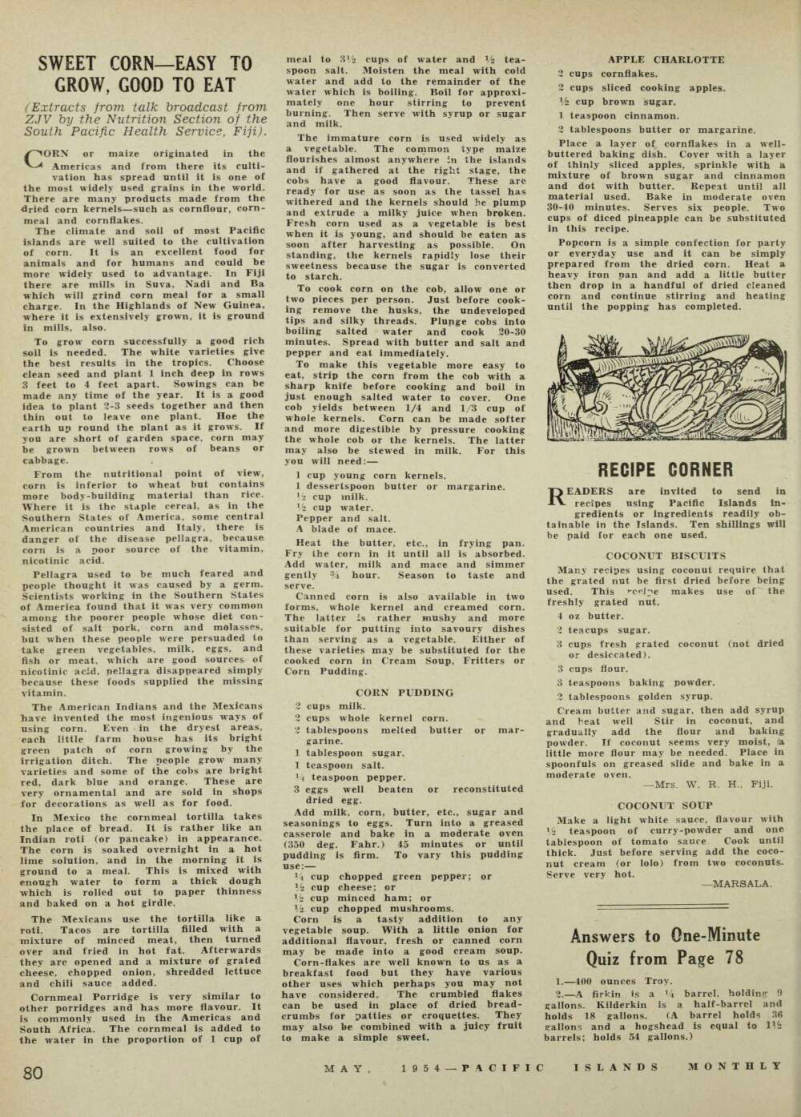
Evidence suggests that Tahitians many times climbed to the top of Orohena. They built a Marae there and exposed human skulls there on—Mr. Jay’s party found two of them.
THE route used by the natives (called Fiimato, or rock-climb ers) was on the east side of the mountain, and was very difficult, and is now entirely forsaken. Mr.
Jay goes on;
(Continued on Page 82)
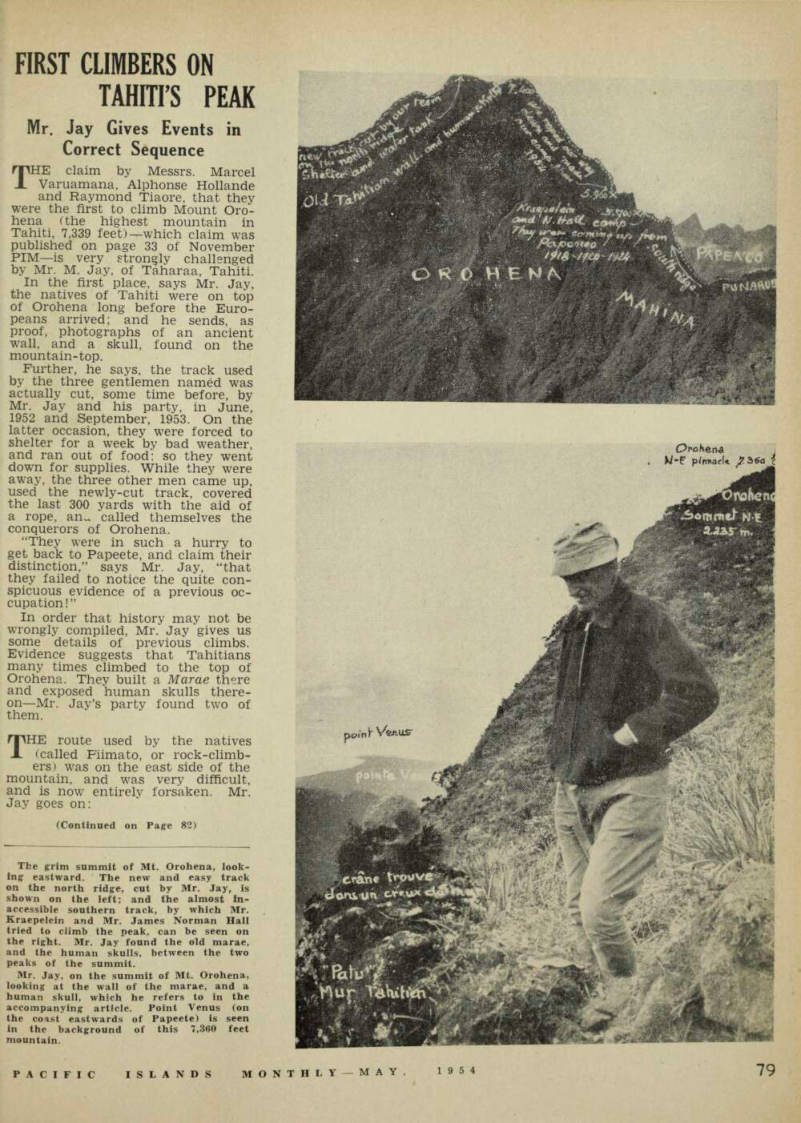
The grim summit of Mt. Orohena, look ing eastward. The new and easy track on the north ridge, cut by Mr. Jay, is shown on the left; and the almost in accessible southern track, by which Mr.
Kraepelein and Mr. James Norman Hall tried to climb the peak, can be seen on the right. Mr. Jay found the old marae, and the human skulls, between the two peaks of the summit.
Mr. Jay, on the summit of Mt. Orohena, looking at the wall of the marae, and a human skull, which he refers to in the accompanying article. Point Venus (on the coast eastwards of Papeete) is seen in the background of this 7,360 feet mountain.
(Continued from page 79)
With the view of finding an easier route to the summit of Tahiti, we for several years explored the dif ferent ridges of the mountain; and finally, in June, 1952, we started to cut an entirely new track, on top of the north ridge. This was a much longer but fairly easy route, along which we built shelters and water tanks, setting steel cables at difficult points.
At the beginning of September, 1953, we were up in the mountain and working to finish the track.
Only a few hundred yards of narrow ridge was still to be roped, when we ran out of cable; and, at the same time, we met a violent storm, which blew fiercely for a whole week.
When the weather cleared, ex hausted and without any food left, we came down for a short rest. That was when a camera-man who knew little about Tahitian mountains, conceived the comic idea of taking our “first climb” from us, and went up along our new track . . .
IN the article in November PIM, mention is made of former climbers. Here certain correc tions can be made. The perform ances of Bjarne Kraepelien (1918) and James Norman Hall, the writer (1920-1924), stay to this day un surpassed.
These mountaineers tried to reach the top of Orohena by the south ridge, which is a succession of sheer cliffs of bare rock, some of them 250 ft. high, and quite a different proposition to the long north ridge, on which we cut our track, which is fairly easy and safe.
Out of mountaineering friend ship, I made it a point to find the highest camp reached by previous expeditions on the south ridge, where I kne“w they had left a record.
For this quest, we roped our way down from the top of Orohena, along the south cliff. At 5,950 ft. we made a camp; and next day, at the foot of a difficult rock at 5.700 ft., we were lucky enough to find a bottle, still well corked, contain ing the records written in Nor wegian by Kraepelien, in Tahitian by Teriieroo, and three records in English written by James Norman Hall. Of these three men only Bjarne Kraepelien is still living, far away in his own country.
I insist on the point that the team (of which you published a photograph in November) never set foot on Kraepelien’s and Hall’s track, and they certainly did not do better than did these former climbers. As far as a “first climb” is concerned, there is no ground whatever, in my opinion, for such a claim, since Orohena was in days gone by a religious site, the im portance of which will appear more closely established when other documents already collected have been published.