Tropicalities
pp. 75-76 · Read in the full issue
Magazine Section
Ring Out Wild Gas
Cylinders !
IT appears, from a recent official announcement, that bells may not be tolled without good and sufficient reason in the distant Gilbert atolls. Bells, in fact, appear to be in extraordinarily short supply.
Here are the words of the Pro clamation: Bells — Bairiki: As from Monday, Bth February, bells will be rung only as follows: By police in PWD Lines, 7.50 a.m., 11.55 a.m., 12:55 a.m., 4.55 a.m.; Saturday, 7.50 a.m. and 11.55 a.m. only. This will be a time check, the constable ringing the bell having obtained the correct time from the Wireless Operator at Bairiki Post Office. The bell will be an empty gas cylinder, (b) By Churches (on empty gas cylinder near respective churches) ;— Catholics-. 8 a.m., 2 p.m., 7 p.m. Sun day only; LMS: 8 a.m., 9.30 a.m., 2 p.m., 7 p.m. and last Wednesday of every month for Ladies’ Service, 2 p.m. Churches will also ring bells on Christmas Day, New Year’s Day and Easter Monday or on any other day on giving prior notification.
What lies behind the announce ment we may never know; but its import should shock the ancient guild of bell-makers —or ringers, or the shade of Tennyson or whoever it was who wrote the poem about “Ringing out wild bells to the wild
sky.”
Jps.
Uplift!
PAGO PAGO reported late March that a representative of Ex quisite Form Brassiere Corpora tion of the United States would shortly be arriving in Eastern Samoa to investigate the possibility of setting up a factory there.
Presumably production would be aimed at the Pacific Islands trade.
In an article in April PIM, it was reported how crazy Fijian women were for those under-garments, but that they could not afford the prices asked for the imported article.
No Hongi, By Request
FROM Sydney Morning Herald’s “Column 8”: Rangi, the Maori guide who re cently was in Australia on a good will tour, visited the pylon of the Harbour Bridge during her stay in Sydney. And there, quite by accident, she met a group of New
Zealand soldiers, one of whom was fust as hr own-skinned as Rangi her self.
Greatly excited, she bestowed upon him the traditional Maori Hongi by rubbing noses. The soldier, whose name was Jack McCarthy, blushed and explained that he was from Western Samoa and that Samoans do not rub noses.
The Virtues Of Plantation
Rubbish
A CAUSE for some wonderment to thinking folk is that while white rice and white flour are banned for issue to native labourers in Papua-New Guinea—and very rightly so—the village native seems able to buy any quantity of both, and to gorge himself upon same without hindrance!
From Moresby the Native People’s session, the evils of white rice and white flour are spoken of.
On one occasion I explained all this to a nearby “Trade Man,” who had been buying each commodity in half-ton lots for some time for his trading and his bake-house. After politely listening to my careful ex planation, his broad nose began to turn up (I swear it did!) and he told me loftily that brown flour and brown rice might be alright for working boys on plantations but “me feller no like.” Brown bread and brown rice was considered in the villages to be “rubbish belong plantation boy, that’s all.”
I mentioned this to a District Services official who smiled and said natives could, of course, please
themselves what they ate.-
Fpa.
Classification Difficult
A COPY of Grimble’s best-seller, A Pattern of Islands, soon to be filmed in Samoa, reached the austerity of the South Pacific Com mission’s library a few months ago.
A librarian wrinkled puzzled brows over it, and then carried it to a high official: How should it be classified? Geography, history, gen eral description, or what? Much of the material has been criticised be cause of overmuch colour and ex aggeration, and officialdom evidently held some such view. Officialdom’s verdict: “Classify it as Fiction,” and it was so.
Jaf’S Single-Handed War
In Ng?
SOME New Guinea natives are likely to be surprised if a plan which originated in Kobe, Japan, is carried out.
It was reported from there re cently that 100,000 leaflets, to be scattered over NG jungle country, were on their way to the Territory from Japan, via a Catholic mis sionary in Melbourne.
It seems that a certain Kobe family, which lost a son in NG dur ing the war, refuse to believe that he was killed, and think that he is holed up somewhere with the na tives, not knowing that the fighting is over.
The leaflets will ask him to sur render and return home.
Several parties of Japs held out in NG for a year or more after the war, but the chance of anyone emerging now is slight, although not impossible.
Pamphlet-dropping is not new to the New Guinea natives. Both sides tried it between 1942-45.(Over)
DRUMMOND THOMSON went to New Guinea in 1920, after serving in both the AIF and the BEF during the 1914-18 War.
He became manager of Numa Numa, plan tation on Bougainville, where a British firm had started planting in 1912, during the German times. Mr. Thomson re mained at Numa until he was taken into the Navy in the Second War, and he served as Naval Liaison Officer between the Coastwatchers and the US Forces in the Solomons.
He was awarded the US Legion of Merit for his services.
After the war he went back to Numa as general manager, and in 1949 became managing director of his firm—the Buka Plantations and Trading Co., Ltd.—which owns Bonis plantation in Buka Passage as well as the 4,000-acre coconut plan tation at Numa Numa.—BRETT HILDER.
He Saw It In A Dream
r;E dice are loaded against criminals when there are men like this in the Force, and when things like this can happen: On March 20, at Port Moresby, an employee of Kriewaldt’s found that a watch was missing shortly after a man had been seen near the watch counter. The matter was reported to the police, but only a vague description of the man was given although it had been noted that he wore a beard.
A CIB detective stationed in Moresby thereupon went home one night and dreamed of a man at Rouna who had a beard, who had stolen the watch and who later had shaved off the beard. He men tioned the dream to another de tective the next day, and on the strength of it the second police man went to Rouna, found the man who had lately shaved off a beard, questioned him and got him to ad mit that he had stolen the watch.
Result; A month’s gaol for one John Patrick McCarthy, of Horni brooks Constructions, Rouna.
Incidentally, the case spotlights the metropolitan character Moresby has assumed. At one time, no man in his right mind would have at tempted to steal anything while wearing such a highly conspicuous ornament as a beard. Bearded or otherwise, all residents were known to all other residents, up to a dist ance of 500 square miles.
Pamplemousse From The
Jungles Of Tahiti
DILIGENTLY cared for and daily watered by the master of Wairuna, a case arrived in Apia early March and was safely delivered to the consignee, Mr.
Eugen Paul, who reported that his ten pamplemousse had arrived in first class condition, looking healthy.
They were immediately rushed to a mountain retreat where, it is re ported, the public has not yet been permitted to view them. They had come from Tahiti.
For days after their arrival, Mr.
Paul’s phone jangled and people steadily inquired: “Have they got hair, or feathers? Are they new ani mals being introduced? Can they fly yet? But all received the same reply: “Wait and see”
However, we feel that ere this ap pears the cat will be out of the bag, and the secret of the pample mousse revealed.
It was Oscar Nordman, the con signor, up to his games again. He could have had them entered on
the manifest in English—but that would have spoilt the fun—for, after all, they turned out to be just a variety of large, sweet citrus trees,
grown only in Tahiti.-
Jps.
Pigs + Tilapia == Vicious
Circle
THE Sigatoka Agricultural Station, Fiji, has just imported fifty fingerlings of an African fish whose only name seems to be Tilapia mossambica and whose pur pose is to provide a source of animal protein to the Colony’s pigs.
Tilapia appears to be a most ac commodating fish. Described as “hardy and prolific,” it appears necessary only to toss a few into a pond—salt or fresh water makes no difference. His tastes are simple. But there’s one thing that he does ap preciate—a pig-pen right alongside his pond. First the pigs flavour the water, a vigorous growth of algae is thereby promoted, the fish eat the algae—and the pigs eat the fish, and some of the algae. Re sult: a cheap source of animal pro tein for pigs.
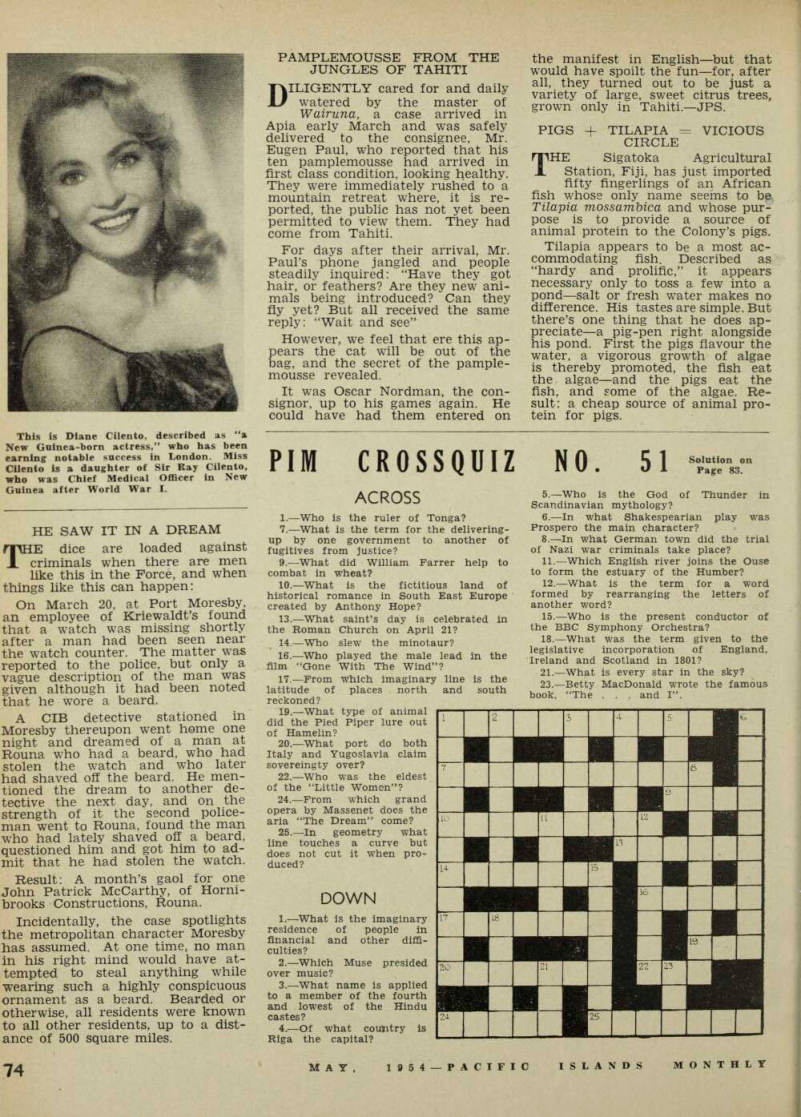
This is Diane Cilento, described as "a New Guinea-born actress,” who has been earning notable success in London. Miss Cilento is a daughter of Sir Ray Cilento, who was Chief Medical Officer in New Guinea after World War I.