Malaria—“An Entirely Preventable Disease”
pp. 57-97 · Read in the full issue


r T'HE following article is reprinted from the South Pacific Commission’s “Quarterly Bulletin.” It was written by Dr. Robert H. Black, a malarlologist of the School of Public Health and Tropical Medicine, Sydney, who has undertaken several malaria surveys in the South Pacific for the SPC.
At least two of Dr. Black’s premises— namely, that malaria is entirely prevent able and that quinine has no suppressive qualities whatever (although combined with other drugs it has eradication properties)—will be challenged by many old-timers who believe that long ex perience has taught them all there is to know about malaria.
Up until military necessity made it imperative, in 1943-45, to find some re liable suppressive for troops engaged in malarious theatres of war, one went to the South-West Pacific Islands and ex pected to, sooner or later, contract malaria and thereafter have recurring bouts of it.
And there certainly was always a great deal of hocus-pocus about its treatment, cures being almost as numerous as per sonalities.
To-day, although some of the older European residents still persist in their theories, it is admitted, by most In habitants of the malaria-islands, that the disease, with the help of scientific drugs, has lost most of its terror.
In the belief that it is wholly pre ventable, natives from the malaria-free parts of the NG Highlands have been, in recent years, permitted to go to the malaria-infested coastal areas to work.
It is incumbent upon their employers, however, to see that they receive regular suppressive treatment; and on their return to the Highlands they are detained in quarantine for eradication treatment.
It is interesting to note that recently some Highlands labourers have been re moved from their employers’ control and repatriated because they had become victims of malaria.
AS the result of modern research there are now available
synthetic drugs which are
effective in the complete suppression
of the malaria which is found in the South Pacific area.
However, attacks still are not in
frequent amongst Europeans resident
in highly-infected countries.
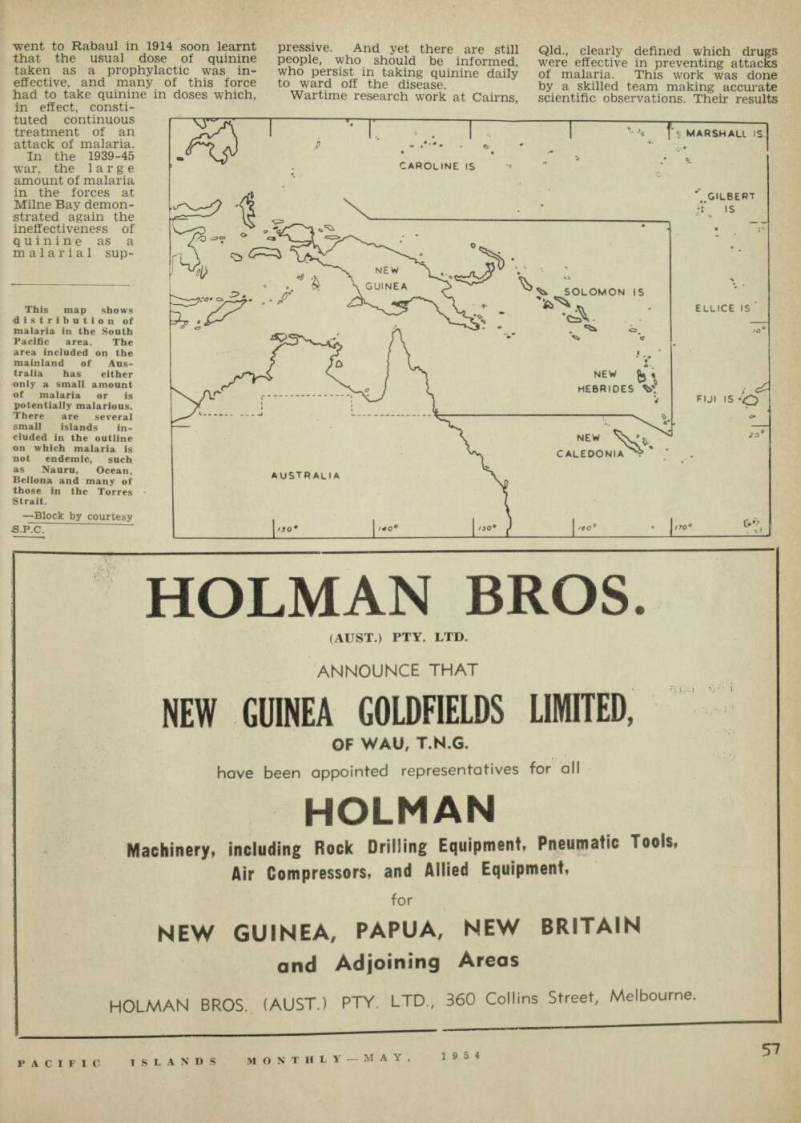
The countries in which the disease occurs in the South Pacific are shown on the map. A few islands included in the area are
aaturally free from endemic malaria,
such as Nauru, Bellona, and some
of the Torres Strait islands. Others, such as Samarai, have been freed of it (See map on page 57).
The amount of malaria in New Guinea, Solomon Islands and New Hebrides varies from locality to locality, and may be absent in some; but in general the incidence of malaria in these areas ranks
high when compared with other
parts of the world.
The malignant tertian infections
are deadly when untreated; and the benign tertian infections are well-known for their tendency to be followed by persistent relapses following ordinary treatment.
The old belief still exists that liv ing in these areas necessarily entails suffering from attacks of malaria, and even blackwater fever. Indeed, malarial attacks are so prevalent in Europeans that each one is his own physician when it comes to treatment. That this position is un satisfactory is evident when at tacks occur among New Guinea residents visiting Australia. It appears that the medical briefing
of new residents is absent or in adequate, or is done by misinformed old residents, whose experience has been gained from numerous attacks of malaria and probably one or two attacks of blackwater fever.
The legend that quinine will pre vent attacks of the malaria seen in the South Pacific is a persistent one, fostered by those residents who went to the tropics when quinine was the only drug available for its treatment. These people have been so exposed to malaria and have had so many attacks that they have acquired some immunity to the ' disease, as do the natives of the country. But this partial immunity has been acquired at the expense of many weeks of sickness.
The Expeditionary Force which
went to Rabaul in 1914 soon learnt that the usual dose of quinine taken as a prophylactic was in effective, and many of this force had to take quinine in doses which,
in effect, consti tuted continuous treatment of an attack of malaria.
In the 1939-45 war, the large amount of malaria in the forces at Milne Bay demon strated again the ineffectiveness of quinine as a malarial sup
pressive. And yet there are still people, who should be informed, who persist in taking quinine daily ward the disease.
Wartime research work at Cairns,
Qld., clearly defined which drugs were effective in preventing attacks of malaria. This work was done by a skilled team making accurate scientific observations. Their results
This map shows distribution of malaria in the South Pacific area. The area included on the mainland of Aus tralia has either only a small amount of malaria or is potentially malarious.
There are several small islands in cluded in the outline on which malaria is not endemic, such as Nauru, Ocean, Bellona and many of those in the Torres Strait. —Block by courtesy
S.P.C.
cannot be challenged by retailed heresay information on the failure of anti-malarial drugs which has been printed in the lay press.
At Cairns it was shown that quinine was ineffective in prevent ing malaria, but that Atebrin would prevent malaria attacks and cure malignant tertian infections. Chloro quine was also investigated and, to wards the end of the war, very sat isfactory results were obtained with Paludrine.
The strain of malignant tertian malaria from the Aitape-Wewak area, which was resistant to Atebrin, was found to be readily controlled by the use of Paludrine.
These results showed that troops who suffered from malaria were not regularly taking their suppressive drugs. The parasites, from the evidence available at present, have not changed, so it may equally well be said that Europeans still suffer ing from attacks, are not regularly taking suppressive drugs.
THERE are several drugs avail able for the efficient suppression of malaria. They are effective when they are taken and taken regularly.
In the Australian Army it be came the responsibility of an officer to see that all his men took their suppressive drug daily. In a family, an adult should be responsible.
Drugs which can be used are:
Paludrine: One tablet (lOOmgms.) every day. Children over 12 years as adults, dose scaled down for younger children according to age and weight, but no child, however young, need be given less than 25 mgms. at any one time (there
are 25 mgm. tablets available); Chloroquine: Two tablets (500 mgm.), on the same day every week (children, 1-4 years i tablet, 4-8 years 1 tablet, over 8 years—adult dose); Daraprim: One tablet (25 mgm.) on the same day every week.
It is a common thing to find that children do not like the taste of Chloroquine, but can be made to take Paludrine. (Chloroquine is practically synonymous with Niva quine and Aralen). Daraprim is a rrecent addition to the ranks of anti malarial drugs, and experience in its use is as yet somewhat limited. A sufficient amount of drug for the effective suppression of malaria for one year costs less than £AI (z.e., Jess than one penny per day), which is very cheap insurance against this disease.
It is stressed that these drugs must be taken regularly, for it is upon their continued administration at regular intervals that their anti malarial effects depend.
WITH one of these strict regi mens of suppression, no attacks of malaria will occur, despite residence in localities of high malarial incidence.
If the drug is continued for a month or more after leaving the malarious country, all infections -with malignant tertian malaria will be cured, but the individual will become liable to attacks of benign tertian malaria when he stops tak ing his suppressive drug.
If the absence from the malari ous country is to be brief, then the suppressive drug should be continued.
If it is to be prolonged, courses of treatment with drugs such as Plas moquine or Primaquine combined -with quinine, Paludrine or Chloro <juine are available which will, in the vast majority of cases, eradi cate the residual benign tetrian in jection from the body. Such courses of eradication should be taken by people who have finished their period of residence in the tropics, and by those leaving the area for prolonged periods.
Casual visitors to malarious areas -would be well advised to take a suppressive drug during their stay in infected islands and for a month thereafter, taking an eradication -course if they suffer from benign tertian malaria after their return home
Treatment Of Indigenes
REFERENCE, so far, has been to the suppression of malaria in non-immune Europeans. All that has been said concerning them may equally be applied to natives of the South Pacific who come from non-infected countries and who are equally susceptible to malaria. This was learnt early in the history of the missions in New Guinea, when Polynesian teachers were installed along the south coast of Papua and many died.
In more recent times, labourers have been and are being brought from non-malarious Wallis Island to the New Hebrides, where they re ceive the same malaria suppressive drug as Europeans. Similarly, in Papua-New Guinea, native labourers from the non-infected parts of the Highlands must be given malaria
suppressives when they are brought to work on the highly-malarious coast of that country. All these cases are comparable to the non immune European who is going to a malarious country to do a job of work and then returns home to a non-infected country, and whose anti-malarial regimen has been dis cussed.
The position is different in the case of the native labourer coming to work in a malarious area from a village which is malarious. De pending on the amount of malaria in his village, this native has in his lifetime built up a varying amount of immunity to the malaria which occurs in his village. At the new location where he is employed, he encounters new strains of the para
site, and may suffer from attacks despite his immunity.
Attacks of malaria in labourers represent a wastage of labour. This wastage is readily eliminated by ad ministering suppressive drugs. In this way a labour force with its attendant wastage from malaria can be effectively increased at a very small cost per annum for sup pressive drugs.
IT must be realised, however, that the immunity the native has acquired depends for its con tinuance upon repeated contact with the malaria parasite. When this contact ceases, as in the case when suppressive drugs are given, then the immunity lessens.
(Continued on Page 95)
By the time the native is re turned to his malarious village he will have become liable to attacks of malaria again, as he was when a child. Back in his village he will not be taking suppressive drugs— even if he could afford them, we have seen how difficult it is even for unsupervised Europeans regularly to take their suppressive drugs.
Thus, the expediency of slightly increasing the labour force of a country actually results in reducing the immunity to malaria of the young adult males of the population.
It would be a very cynical attitude which would countenance this approach to the malarial problem.
If, however, there were no malaria in the village to which the labourer returned, the whole aspect of the Sroblem would be changed, and it ; in this approach that many countries have made progress.
The problem of village control of malaria is a complex one, and must be studied individually from country to country. Methods suitable in one place may result in waste of money in another.
Meanwhile, the European should set an example by taking great care with his malarial suppressive regimens and thus averting at tacks. Malaria is an entirely pre ventable disease.