No Champagne
pp. 40-41 · Read in the full issue
Cheaper Fares and No Champagne Tourist Air Services in Operation in Pacific
TOURIST class passengers on trans-Pacific airservices are not served with champagne; nor do they receive any free drinks or cigarettes. They get no sleepers: have slightly less seat space than first-class passengers, and a little less attention from the hostesses..
They may derive consolation, how ever, from the knowledge that their fares are costing them 20 per cent, less, and that despite the curtailed privileges, they will get there just the same.
The three companies operating trans-Pacific services—BCPA, Can adian Pacific and Pan American — all installed a number of tourist class seats on April 1. In some of them movable bulkheads are used to separate the tourist section from the first-class, so that either section can be extended or contracted at intermediate stops to meet any changing demands.
The three companies report satis factory business with the tourist seats in the few weeks that they have been available, but they do not know whether they should be plan ning for a greater or lesser number
of these in the future: At this time of the year, seats of any kind in overseas planes are at a premium, therefore current demands are not necessarily an indication of the normal state of affairs.
Tourist passengers need not fear that they will be compressed into too small a space for their cheaper fare. The minimum space that
each passenger- must be allowed is specified in international aircraft regulations. First-class passengers get a little more space than speci fied and pay for the privilege.
The three Pacific operators all offer the same conditions of travel to their tourist passengers: Baggage allowance is 44 pounds, compared with 66 pounds first-class, and
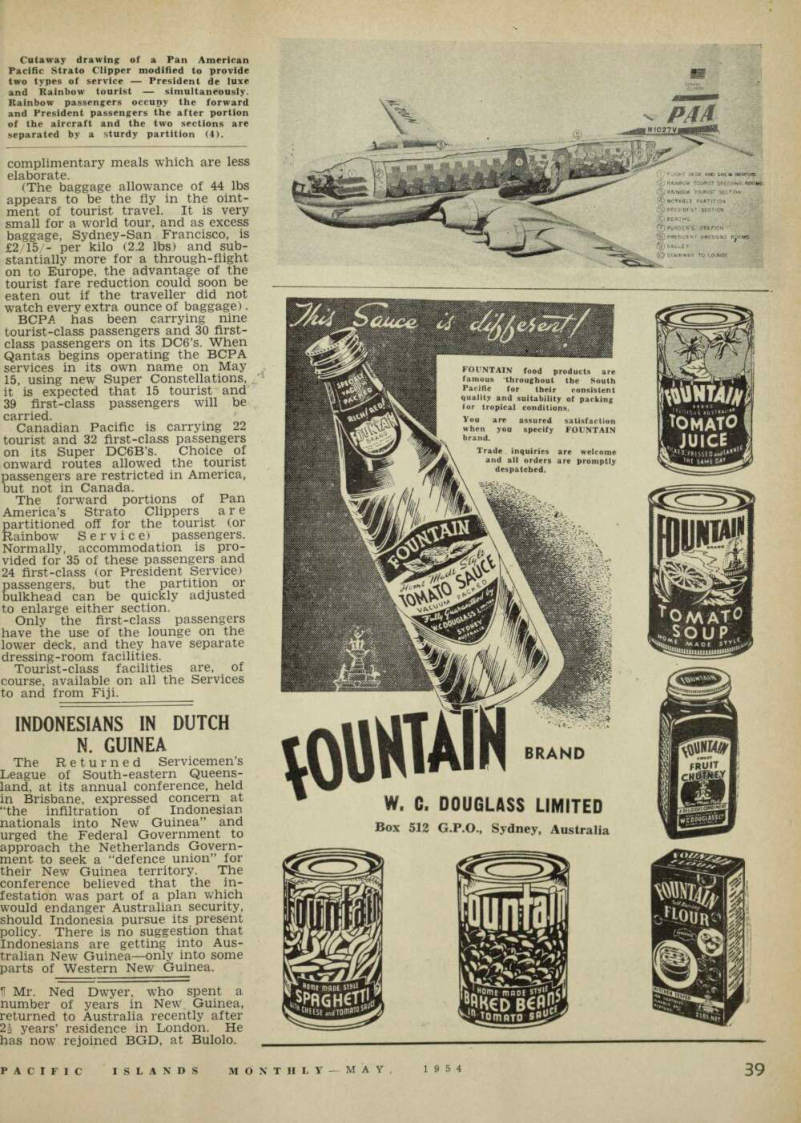
Cutaway drawing of a Pan American Pacific Strato Clipper modified to provide two types of service — President de luxe and Rainbow tourist — simultaneously.
Rainbow passengers occupy the forward and President passengers the after portion of the aircraft and the two sections are separated by a sturdy partition (4).
complimentary meals which are less cl^bor^tc (The baggage allowance of 44 lbs appears to be the fly in the oint ment of tourist travel. It is very small for a world tour, and as excess baggage, Sydney-San Francisco, is £2/15/- per kilo (2.2 lbs) and sub stantially more for a through-flight on to Europe, the advantage of the tourist fare reduction could soon be eaten out if the traveller did not watch every extra ounce of baggage).
BCPA has been carrying nine tourist-class passengers and 30 first class passengers on its DC6’s. When Qantas begins operating the BCPA services in its own name on May 15, using new Super Constellations, it is expected that 15 tourist and 39 first-class passengers will be carried.
Canadian Pacific is carrying 22 tourist and 32 first-class passengers on its Super DC6B’s. Choice of onward routes allowed the tourist passengers are restricted in America, but not in Canada.
The forward portions of Pan America’s Strato Clippers are partitioned off for the tourist (or Rainbow Service) passengers.
Normally, accommodation is pro vided for 35 of these passengers and 24 first-class (or President Service) passengers, but the partition or bulkhead can be quickly adjusted to enlarge either section.
Only the first-class passengers have the use of the lounge on the lower deck, and they have separate dressing-room facilities.
Tourist-class facilities are, of course, available on all the Services to and from Fiji.