‘Pom-Pom’
pp. 22-140 · Read in the full issue
Horrors Of The
J. P. Shortall Describes Trip to Rarotonga
Rarotonga, Apl. 24.
THERE are two roads to the Cook Islands from the outside world.
One by air to Aitutaki and thence by whatever offers in local shipping to Rarotonga. The other is “poor man’s” route, by sea from Auckland—the route that most people have to take.
The latter, by way of New Zealand’s monster-c hil d, Maui Pomare, is an education in State control, if nothing else. For cer tainly no private enterprise would be permitted to carry 30 passengers under the conditions prevailing aboard the “Pom Pom” (as she is generally known)—certainly no one would travel in her if there were any competition.
Not that the slightest blame rests with the men aboard. The wonder is that stewards can be found to sail in her under the conditions prevailing. Briefly, here are some of them.
In line with so many Government enterprises, a constant air of mystery surrounds the “Pom Pom’s” operations. Where any regular passenger shipping line can let the public know a couple of days in advance of her time of arrival, within at most two hours, that is rarely the case with “Pom Pom”.
Time and again relations of passengers inquire of the Agents, rise at unheard-of hours to get to the wharf in time next morning, and then find on their arrival that the reported ETA was hours out.
The vessel is in, tied up and all ashore—or she’s not now expected until sundown.
Island Territories Office has one information, the Agents another, the Harbour Board often a third — and the Harbour Board signal-man in the lookout has the correct one — but not until he sights her. De partures are just as vague. A time may be set; then word comes from Wellington to “get her away”—so cargo is locked out and away she goes.
And what departures and arrivals!
One wonders whether the Auckland dry cleaners really appreciate what they owe to the brute and her vicious oil-burning galley, which has belched its smuts over many a light summer frock, expensive hat, or a newly-bought light tropical suit worn by traveller or friend.
Or the heart specialists, who’ve reaped their guineas as a result of the nerve-shattering yoops of the “Pom Pom’s” siren as she clears the wharf on her inglorious errand.
Everything abo a rd the Maui Pomare is “not our fault”—a
truth freely admitted—from her eight 5’ 7” bunks in what was once her smoke-room, to her unbelievable toilet facilities.
Hard by the pantry door, in the busiest part of the ship, is the men’s lavatory—one only—and shower room. There is no bath for passengers.
The shower room is truly some thing out of this world. Shut the door, except at dead of night, and you’ll have it all but smashed in by some justifiably irate steward.
Either you harden your heart and brave the battering—or, if you prefer to be popular, you leave the door open and get on with the job while stewards duck around you—washing dishes, filling water-bottles and on sundry other chores, that can be done nowhere else.
This sole male passengers’ shower room contains a hand basin but no mirror “because people would shave in there if there was a mirror”! Where the eight inmates of the smoke-room, up above, are sup posed to shave is no one’s business —for there is a mirror there but no hand basin. The well-equipped traveller in the “Pom Pom” comes aboard with his own hand-basin— and a bucket.
Apart from stewards, there are other lesser distractions in the men’s shower room. An intervals, in a beam sea, there is a snort from somewhere down in one corner, and a jet of salt water belches in, while another lesser jet shoots from the hand-basin plug hole.
Then anyone foolish enough to get in that lavatory-bathroom cul-de-sac near meal-time finds himself cornered by a temporary table and a flock of stewards passing dishes of food down the precipitous companion-way. The galley, of course, if away aft, across half a cable-length of sea-swept deck, where an errant sea may delete one course from the menu now and again!
LIVABLE when the weather is fair, the “Pom Pom” is utter misery for women, in head seas.
Not that the old vessel is not seaworthy or a good sea boat. She is. But her construction is such that
the “promenade” deck is one with the foc’sle head. When laden, she naturally scoops up plenty of head seas—and there is nothing in the form of a breaker to deflect them overboard. Hundreds of gallons of Pacific Ocean sweep aft and roll athwart-ships, making it possible for passengers to venture on deck only bare-footed!
Men can leave their cabins be low to congregate in the smoke room, where other men are sleeping—or vomiting freely into large, wooden waste-paper baskets!
To escape the stifling atmosphere below, the women-folk, in this sort of weather, huddle on the edge of No. 2 hatch—like passengers on the cross-harbour ei g h t-forty-five wearing raincoats and wondering bleakly why they let their husbands talk them into this affair.
Unfortunately for six footers —or even five-foot-eighters—the de signer of the smoke-room (if there was a designer) never considered the possibility of its use as an eight-berth cabin. Eleven feet two inches may be all very well for smoking—but when a couple of six footers lie kicking their lower ends together all night in the space available the dimensions assume a new importance. Still, quite truly, “nothing can be done” and “it’s not our fault”!
There’s no better or more popular chief steward in the South Pacific than Wally Kane, but even he can scarcely be expected to inquire into passenger lengths, and have the booking agents arrange for a maximum combined length of under eleven feet two inches when assigning berths in the Smoke Room!
Even at that, the smoke-room is the most liveable place in the “POM POM” for with the port-holes screwed down, and not a sug gestion of forced ventilation below decks, a warm-weather trip in the ship’s proper passenger accommo dation is pure hell.
AND can nothing really be done?
It can in the smoke-room, at least. At the moment <pnly one window opens.. At very little
(Continued on Page 138)
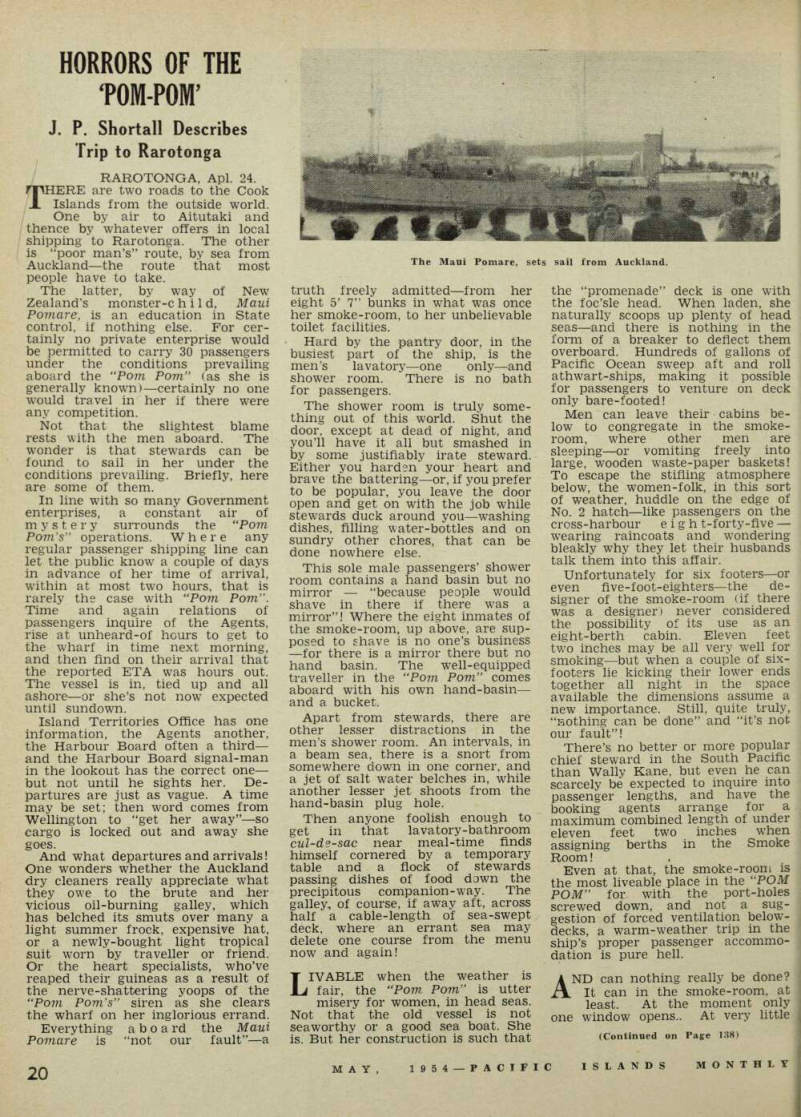
The Maui Pomare, sets sail from Auckland.
expense the other could be made to do so. There could be correctly placed reading-lights—and there could be sliding curtains on rails a foot or so clear of the bunks, to screen seasick passengers and to screen the individual bunks. Women then might even make use of the main central portion, if only in bad weather when the deck is un inhabitable. And would a few more curtains on the windows to screen the upper-bunk men from the blazing sunshine cost so much?
And some have been heard to say that “a quid’s worth of public funds invested in a new and even slightly musical dinner gong would be money well spent, if only for prestige value”—though prestige rates dead low in the "Pom Pom”
New Zealand’s late distinguished Polynesian son, the late Sir Maui, was ill-served when his name was hitched to this illegitimate. Island residents forced to travel in her, can only cry. “How long, oh Lord?”
STILL, succour may be in sight.
Next January, an important decision will have to be made.
The ship will be required to under go a major refit, which on some estimates may cost £70,000 or more, and should give the vessel another ten years of legal life. There will be no visible improvements, of course.
The money will merely keep her going “as is”, as far as the pas senger situation is concerned. So little can be done to improve the passenger situation, which is so completely inadequate for the trade.
Can it be really sound economics to spend that sum, plus the normal £30,000 to £50,000 loss that must also be met, on so complete a mis fit as this vessel?
Surely it would be better to spend even more, if necessary, in subsidising a suitable privately owned ship for the trade.
There can be no doubt that|, given such a vessel, a minimum of 100 round-trip passengers could be booked from New Zealand trip after trip, all. the year round, on this popular run—even if the vessel ran only to Rarotonga. Numbers of people, if able to obtain a firm booking well in advance for such a holiday cruise, would rush to avail themselves of it.
Even under the present policy of totally discouraging round-trippers from New Zealand to the Islands there are more on the waiting lists than can be handled for years. How that trade could be boosted by ad vertising needs no emphasis.
Meanwhile Maui P omar e is an intense “pain in the neck” to almost everyone associated with her passenger operations—and will soon be inadequate as a cargo carrier from the Cook Islands, as fruit ex ports show a steady increase.