The Troubles Of The G&E Administration
pp. 140-145 · Read in the full issue

Isolation, Insufficient Staff and Money, Too Much Bureaucracy
From Material Suvvlied by Jack Thornton.
IRREVERENT persons in the Gilbert and Ellice Islands Colony— a bit of near-Micronesia rarely visited by non-official Europeans— call the archipelagoes “the Gilbert and Sullivan Islands.”
More people should see the “Colony.” It provides an interesting example of the good things, and the bad things, which occur when a benevolent bureaucracy, liberally
spiced with planners, is given its head in an isolated and helpless community, The Gilberts were named after one of their discoverers, Captain Gilbert, of the Charlotte, in 1788; and not after W. S. Gilbert, as some to-day are inclined to believe. A pity. If ghosts can be satirical, WSG would have found here some
delightful exercises for his shadowy pen.
Hereunder are listed some of the quaint things which make a visit to the G & E Colony memorable. But let it be said at once that these com ments are not aimed at Resident Commissioner M. L. Bernacchi, or High Commissioner Sir Robert Stanley. The latter have been sent, in very recent times, to govern the war-torn and economically-de pressed Territories of the British Western Pacific; but they are with out adequate funds and equipment; and, in spite of everything they can do, their trained staff changes so often that it is like a kaleido scope. None envies them their task.
But the conditions which entitle these places to be called “the Gil bert and Sullivan Group” and the Solomons “the Cinderella Territory,” and the New Hebrides “the Pande monium Government,” are a reflec tion upon the British Colonial Of fice, which imagines that these large archipelagoes can be treated, in a rapidly-changing world, as a forc ing-ground for unfledged bureau crats, and a testing-ground for near-Socialist Planners. Without the co-operation of private enter prise, the Administrators’ task is hopeless.
BEFORE 1942, private enterprise was encouraged to go into these groups and develop trade and industry, and provide necessary transportation. The Pacific War of 1942-45 wiped out the British Ad ministrations and all European traders and producers. When the gentlemen of Japan retired, there were Socialists in high places in London; and the Colonial Office sent forth the word, “No more private enterprise here henceforth the Gilbert and Ellice Islands are re served for the natives. What the natives cannot do for themselves, we shall do for them.”
And it was so. And those who would like to see the results of So cialism, pure and undefiled, opera ting without interference by capital istic organisation, should visit the Colony.
Retail distribution is in the hands of native co-operative societies, aided by the Government. Whole sale distribution is taken care of by the Colony Wholesale Society (CWS), which nominally controls all trade and the gathering and shipment of copra, but which is simply Government Control in an other form.
CWS appeared soon after the war as The Government Trade Scheme, and was initially operated by Gov ernment officials. As one high official delicately put it, “they failed to place it on a sound business footing.”
Some of the irreverent still tell about the official who ordered 30,000 tea-strainers, presumably to be pur chased by 20,000 coconut-drinking Gilbertese!
Presently, the Government Trade
Scheme was re-designated Colony Wholesale Society, as from January I, 1949, and a trained merchant from a private firm in Fiji was put in charge. In its first year, with a turnover of £185,000 (all amounts ?iven in Australian currency) its arofit was £36,000. In 1953, its turn )ver must have been £250,000, with arofit accordingly. It cannot miss, vith the Government behind it, all ;he native co-operative societies lelpless before it, and no competi ;ion of any kind.
But—sophisticated people from mtside say that the whole set-up jrobably is illegal, because it is not •egistered as a company, does not jperate under charter, and is not fficially a Government organisation, ;hough clearly under Government jontrol.
The CWS, of course, under present :onditions, is a godsend to the im joverished Administration. And, in airness and logic, there really is no ■eason why the profits of the Colony’s trade should not help to )ay the costs of the Colony’s ad ninistration.
It is the effect of the Government aonopoly that is so lamentable. One ices so many evils that arise when he cleansing breeze of competition s replaced by the stifling atmos )here of monopoly and bureau cracy, rHERE is, for example, the matter of shipping. The CWS operates three small vessels; of the re
mamder of the Colony’s fleet some of the little ships are wholly or semi-privately owned. Outsiders are horrified when they hear the private owners on the subject of the lack of safety devices and measures on CWS boats. They have demanded an official inquiry, but no one takes any notice.
Tarawa atoll is the Headquarters atoll. Government has nine launches for communication between the islets of the atoll. They are des cribed as dirty and badly main tained.
There has been Administration wrangling about Headquarters ever since the end of the war, when the Government abandoned Ocean Is land and settled upon Tarawa atoll.
A succession of officials have alter nated between the islets of Bairiki, Betio, Bonriki, and Bikenbo; the high officials still are undecided about HQ; movements back wards and forwards across the lagoon, say the critics, have represented a waste of at least £lO,OOO and now there are some 20 European officials at Bairiki, and 15 semi-Government personnel at Betio —and still no decision.
In the old days the trading con cerns, being careful of their ships, beaconed the innumerable lagoon passages of these low-lying atolls — an essential thing. A Colonial De velopment grant of £18,500 was made for a Marine Beaconing Scheme.
After it had erected 50 permanent marks to show the channel from the sea to Bonriki, “the proposed site for Colony HQ”, and after employing a master mariner for about a year to plan, cost and organise the beacon ing of channels throughout the Colony, the Government, “due to expense,” abandoned the Scheme..
Buoys and equipment, said to be all
ordered and paid for, lie rotting on the beach at Betio.
OTHER quaint things happen. The Customs fly a flag that a Gov ernment Ordinance has declared obsolete. Residents pay 5/- for a radio licence, but the only broad casting service is a twice-weekly
news summary, morssd in Gilbertese.
One gets a motor driver’s licence for 5/; but there are no tests, and no Government roads, anyway.
The hospital is on Abaokoro islet, 12 miles away from Betio and Bair iki —the launch takes 11 hours in fair weather to cross. Except at high tides, patients have to wade’or be floated half a mile to shore. It is embarrassing when women, at the point of child-birth, are on the launch, and it is delayed by bad weather or breakdowns.
The radio station is at Betio and the post-office at Bairiki—awkward in bad weather.
And—most remarkable of all in this South Pacific, where philatel ists are just the natural prey of the various Islands Governments—the post-office is not allowed to supply scamps to overseas dealers, even if the order is accompanied by dollar bills!
Canned meats and soups are duti able. Canned fruit and vegetables are not. The folk there say, humour ously, that this is “a hang-over from Cripps’s . day.” A refrigerator with moving parts is classed as machin ery, and pays a duty of 10 per cent.
A kerosene-operated “frig” is called non-mechanical, and taxed 12 per cent. One could continue these Gil bertian stories ad lib.
At the end of 1953, Treasury accounts were only a year behind.
An official said; ‘‘Big improvement on last year—they then were 18 months behind.” That is sufficient comment on staff shortage, and the restless comings and goings of per sonnel.
THE Colony is strictly reserved for the natives by a benevolent Government. But it appears to a casual observer that the native copra producers get a pretty raw deal from that same Government.
The Government, through the CWS, gathers in all the copra pro duced in the group, and sells it to Britain under the Ministry of Food
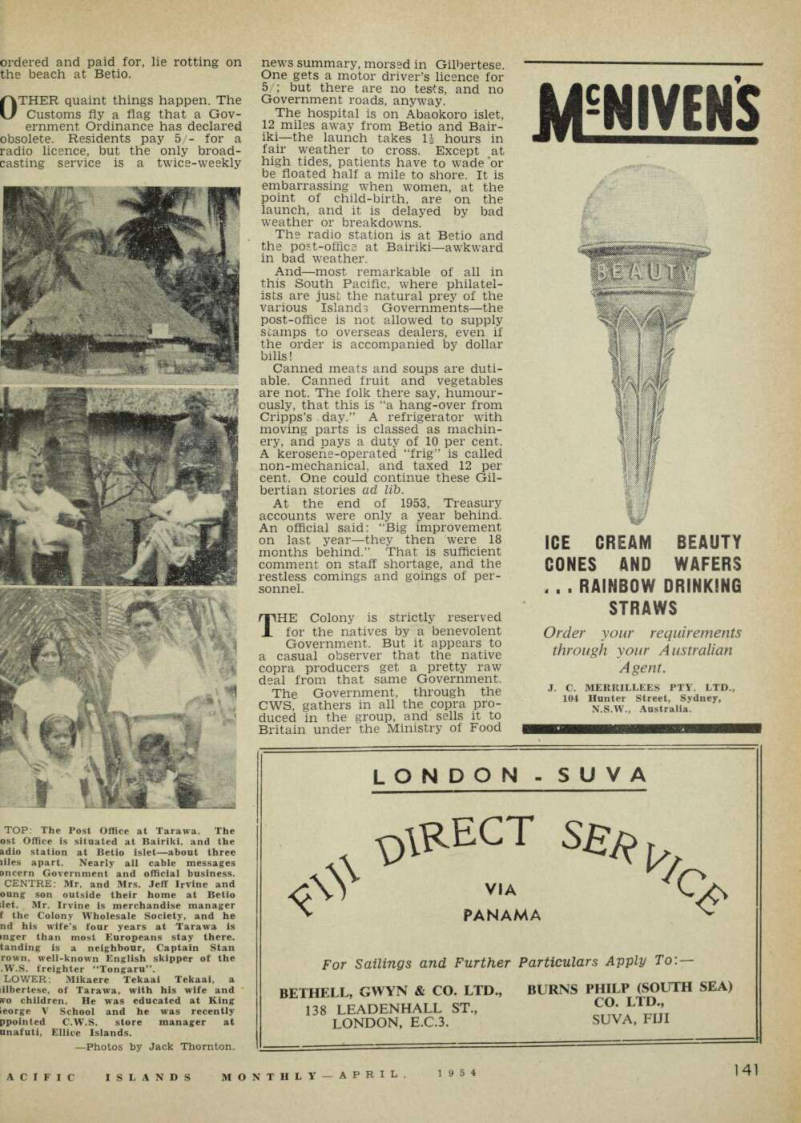
TOP: The Post Office at Tarawa. The ost Office is situated at Bairiki. and the adio station at Betio islet —about three niles apart. Nearly all cable messages oncern Government and official business.
CENTRE: Mr. and Mrs. Jeff Irvine and oung son outside their home at Betio let. Mr. Irvine is merchandise manager f the Colony Wholesale Society, and he nd his wife’s four years at Tarawa is (?)ger than most Europeans stay there. tanding is a neighbour, Captain Stan rown, well-known English skipper of the .W.S. freighter “Tongaru”.
LOWER; Mikaere Tekaai Tekaai, a (?)ilbertese, of Tarawa, with his wife and Wo children. He was educated at King (?)eorge V School and he was recently ppointed C.W.S. store manager at unafuti, Ellice Islands.
Photos by Jack Thornton.
mtract. The price paid in 1953 to le Governments of Fiji and New uinea by the MOF was £65 per n Sterling fob for first grade, with reduction of a couple of pounds ir lesser grades—that is, about £BO jr ton Australian. But the native pra-growers have not been getting uch more than £26 or £27 Aus alian per ton in 1953. It is re nted that the Gilbertese are “be ming very dissatisfied.” Little mder! Incidentally, how much of ose large profits made by the CWS made out of native copra bought ; £27 per ton?
Gilbertese labourers, loading copra ito a Bank Line ship at Tarawa a w months ago struck for more ra ms, in addition to overtime pay. i as not to delay the ship, the Gov nment conceded the demand — it reduced the price paid for pra to native producers by 10/- :r ton! Since then, it is “as you ire” —the labourers are receiving e same as before, and the 10/- per n has been restored to copra oducers. But the ungrateful ilbertese are still complaining.
In a private letter, Mr. Thornton ys: “I have tried to be fair, and kept the background many un vourable impressions gained in casual wander through the archi lagoes. But, for all that, the pic re is not a pretty one. The Ad inistration officials are doing a mfortless, thankless job out on ese sun-grilled atolls, and one can aise their devotion to duty. But ere is little else to praise. This ice where, officially, all is for the tive and nothing for the capit stic minion—this Paradise for the anners —has angles to it which ve to be seen to be believed.”