In Papua-New Guinea
pp. 123-131 · Read in the full issue
Current News Items From Our Correspondents In Papua-New Guinea
Another Hotel For
Moresby?
In the Port Moresby Licensing Court, on March 25, Walter Ambrose Morrissey made application for a provisional licence for a new hotel at Boroko, Port Moresby.
The proposed new hotel would be named the Boroko Hotel and would be just off the Rouna Road at the 4-mile. The hearing was adjourned for 28 days.
Bringing P-Ng Under
Uniform Liquor Laws
The special Commission into liquor licensing hours in the Terri tory concluded its sittings at Port Moresby on March 24.
Mr. W. E. Sansom, the Commis sioner, has been conducting an ex haustive inquiry throughout the Territory of Papua and New Guinea concerning the present Liquor Ord inance. He has been interviewing
the licencees of the hotels, and officials from the Clubs. Consider able difference has previously existed between the liquor laws valid in Papua and in New Guinea.
It is understood that the present inquiry is being made with the in tention of bringing the whole of Papua-New Guinea under the one set of rules, regulations and laws.
Building Up—Not, Out
Port Moresby people are looking for another European school site.
The matter was raised briefly at the March meeting of the Town Advisory Council, which set up a sub-committee to investigate a suit able site.
One member, Mr. C. L. Anthony, who is Assistant Secretary for Lands, said that it would be a good I de a if the sub-committee thought about the possibilities of building upwards; that, in fact, Port Moresby people generally might think about building upwards— meaning multi-storied buildings and that town land was running short.
Dog-Fights
Some matters, once started, have a habit of developing!
In Port Moresby, in March, the police one week-end decided to
enforce the regulation which for bids dogs on the European section of the bathing beach. They did this after there had been many complaints about this at the Ad visory Council, one member produc ing regulations and demanding that the police do something about them.
When enforcing the regulations, the police advertised that un registered dogs which were not claimed after three days, would be destroyed and that registered dogs would be returned if claimed—but that the claimants would have to pay a fee to the pound, and would also be liable to a fine for having the dog on the beach.
In the first week, the police shot four unregistered and, apparently, unwanted dogs. But one of the dogs
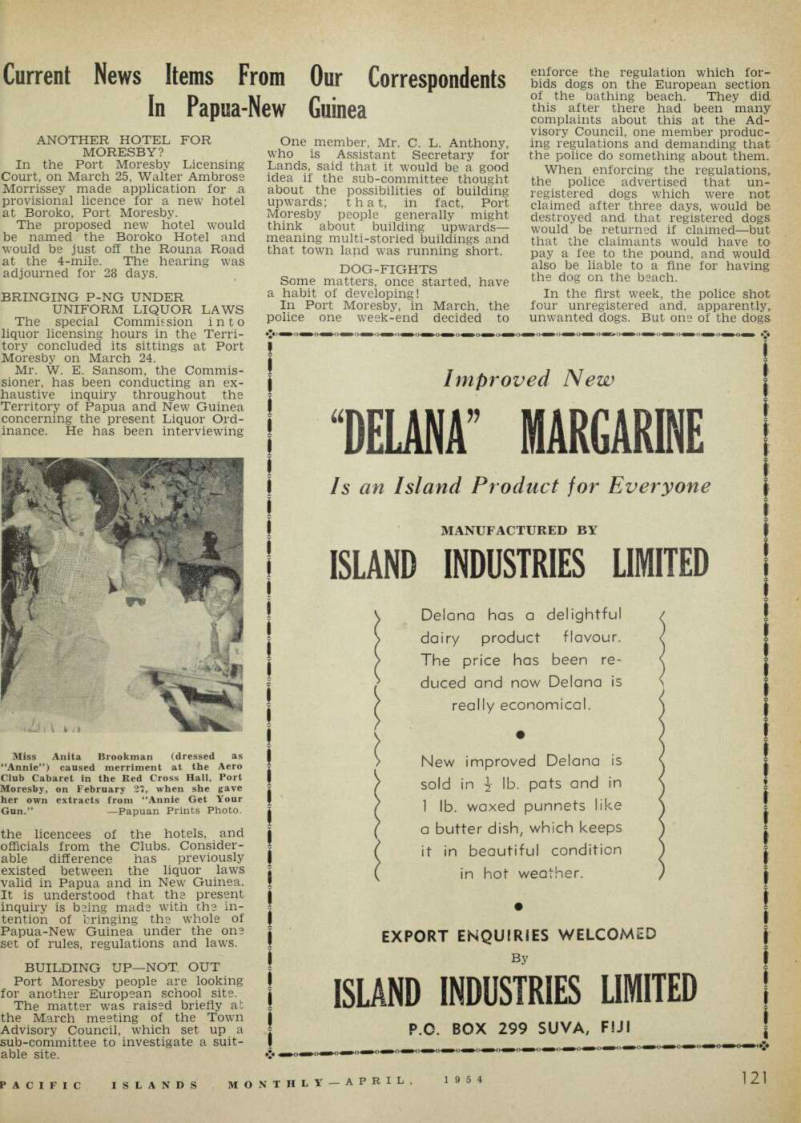
Miss Anita Brookman (dressed as “Annie”) caused merriment at the Aero Club Cabaret in the Red Cross Hall, Port Moresby, on February 27, when she gave her own extracts from “Annie Get Your Gun.” Papuan Prints Photo.
was owned by a prominent Port Moresby woman, who had lost it, and who found out what had hap pened to it only when she reported to the police that it was missing.
There were, as the novels say, words.
Native-Grown Rice In
Demand
At the March meeting of the Madang District Advisory Council there were questions asked as to what was happening to the rice pro duced by natives in the district. (See article, page 58, this issue).
Some members said that the Agricultural station had told them they could buy some at the native pillages where it was produced. How ever, as the villages they were told by the natives, that the rice be longed to the Department of Agri culture. Again rice had been seen being carried into the local stores.
Mr. W. Cahill said that as em ployers of native labour, planters had helped the natives to obtain their rice mills and had given them bags, md that consequently planters should have the right to buy rice.
The Council carried a resolution that the Agricultural Department ?ive planters the opportunity to buy pillage rice, when available.
More Airservices Needed
For More Newspapers
Port Moresby Advisory Council suggested in March that Qantas
increase its services to the Terri tory.
Council carried a resolution that the Government Secretary be asked to inquire into the possibility.
The matter came up when a letter was read from a Port Moresby newsagent asking for the Council’s help in obtaining an in crease in newspaper quotas from Australia.
The newsagent said that Qantas had cut, by 50 per cent., the number of newspapers which it would carry at a reduced freight. There were far more orders for Australian newspapers in P-NG than could be supplied.
“Many A Slip ...
Two unusual accidents happened in Rabaul recently. Mr. Jimmy Joyes, well-k n o w n planter of Bougainville, sustained a fractured ankle when jumping from the Polurrian gangway to the wharf.
Mrs. Nell Richards, a well-known resident of Rabaul, slipped when leaving her bed one morning and broke her hip. She was unable to rise and was undiscovered for about an hour. She has left for Australia for treatment.
Overseas Visitors
In connection with the disposal of the Jap tanker Naruta which has graced Rabaul harbour in one way or another for about 10 years, Cap tain A. M. McCulloch (RN Retired)
visited Rabaul in March. He is a marine surveyor for Mollers Ltd., of Hongkong.
Another recent visitor to the Ter ritory is Mrs. J. D. Schroder, who arrived from Germany to see her two sons—Don, of the Department of Civil Aviation, Wewak; and
Russ, who is with the New Guinea Company in Rabaul. Mr. Schroder, Snr., is an Australian migration official, at present stationed at a migrant camp near Bremen. Mrs.
Schroder prefers the climate of Bremen to that of NG during the wet season.
Views On “Going-Finish”
Mr. Ernie Hitchcock paid a re cent visit to Rabaul. He looked remarkably fit and, much younger than any man of his age has any right to look. He is at present grow ing cocoa and coconuts out on Djaul.
Most old-timers, says Hitchcock, leave the Territory for good, and within a few months or a year, they return because they just can’t settle down anywhere else.
Maybe next year, he says, he will go away for a long holiday of a year or two, then if he finds it pos sible to embrace the idea of living elsewhere, he can return to New Guinea and make arrangements to “go finis”—and mean it.
New Church For Rabaul
The firm of Rudder, Littlemore and Rudder, Architects of Port Moresby, and Sydney, are appar ently intending to leave their mark on New Guinea generally. Mr.
Peter Rudder, their New Guinea representative, has been in Rabaul a couple of times over the past three months, and amongst other
projects, it is understood that he has been instructed by the Church Council, to call tenders for the re construction of St. George’s Church of England, in Malaguna Road.
The most important work this firm has done in Rabaul, to date, was directing the construction of the new and palatial store for Colyer Watson (NG) Ltd.
Face-Lift For Bank
Considerable alteration is being carried out in Rabaul on the pre sent Commonwealth Bank Building.
Work includes an addition to the front, which will contain offices for the Manager and Accountant, and a general re-arrangement of the interior of the old structure, which will give greater counter
space for the ever-growing number of customers.
The man in the street has been heard to say: “But why go to all that expense when they are going to build a new bank, anyway!”
However, it is very pleasing to see another “new” face in the main street. Building in Rabaul was at a standstill for too long while the fate of the town was in the bal ance. To move, or not to move, that was the question. Now the question has been answered, the building programme is getting under way.
Town Land Available
It is understood that 120 blocks of land in Rabaul will become available for tender by the end of March. Some of them are situated on the landward side of Malaguna Road, down towards the wharf area; and others on what used to ae Carpenter’s Matapi farm. So many people are interested in building, now that Rabaul has been declared a permanent town site, that there will probably be several hundred applications lodged by genuine land seekers.
New Guinea Memorial
Scholarship Fund
(Q’Land Div.)
Information Has been received :rom the secretary to the Trustees )f the Queensland Division of the Memorial Scholarship Fund hat following the result of the ex iminations, held at the end of 1953, ;here will be no award granted in •espect of that year.
Eileen Gordon, award winner for .951, has forfeited the third year >f her Scholarship. She has passed he Junior examination and has oined the staff of the City Branch ff the Commonwealth Trading Sank. It is gratifying to hear that, n the few weeks Eileen has been employed there, the Bank officials lave selected her for special train ing.
Kavieng Hotel Changes
Hands
Mr. George Clark, popular licencee f the Kavieng Hotel, New Ireland, las disposed of his lease to Mr. oseph Gappy, a former employee f the Department of Civil Aviation, labaul.
The Clark family has been run dng the Kavieng Hotel for the past ouple of years, and feels that a mg holiday is necessary. As it is Iways difficult to find suitable taff in this part of the world, it (as decided to dispose of the lease ather than to attempt to find a nanager. However, the Clarks do ot intend to desert the Territory; 7 hen their holiday is over, they will eturn.
Pilot Now Mushroom
Expert
Back in the Thirties, Mr. Douglas Ilphinstone arrived in New Guinea
as a pilot for Guinea Airways. Since those days he has flown over all parts of Papua-New Guinea, and after the war, returned to the staff of Mandated Airlines, at Lae. How ever, a couple of years ago he de cided to retire to the Highlands and take up a farm. To-day he can be found at Garoka, growing such things as potatoes.
Word has drifted around that he is also experimenting with mush rooms—“as big as saucers,” accord ing to popular rumour. This corre spondent has written requesting a
shipment, but only reply to date has been to the effect that the supply does not exceed local demand. We can only wait and hope.
In the meantime, we listen, envi ously to the conversation of people returning from Garoka who tell the tale of how he supplies mushrooms to Mrs. Ellen Pitt at the Garoka Chalet. Knowing what a cook that same Mrs. Pitt is, we no longer wonder at the glazed look of satis fied remembrance which lights the eye of the visitor. (Over)
Papuan Scouts Financed
Their Own Queen-Seeing
One of the least publicised Queen seeing Papuan delegations was that of the 26 members of the Papuan Scout Group, who, under the leader ship of Assistant District Scout Commissioner Ben Heape and Mrs.
Heape (who is a Cub Master), left Port Moresby on February 7 and sailed again for home, from Bris bane, during the last week in March.
During their visit they have been in Canberra (where they formed a guard-of-honour for the Queen at Government House), Sydney and Brisbane (where they again per formed guard-of-honour duties).
The boys financed their own trip by selling £1,200 worth of bottles, native baskets and mats and hold ing jumble sales and concerts.
They were very popular wherever they went and, particularly in the last weeks of their tour in Queens land, have had “a whale of a time” themselves, surfing and being shown around South Queensland’s beach resorts.
Another Plantation Brawl
In late March there was a clash at Kessa Plantation, in North Buka, between natives from Lae, and some local natives employed on the plantation. There is generally strong feeling between all New Guinea natives and Buka natives when employed on the same planta tion.
In this instance, there was some damage done to several of the participants and one badly cut head. The District Officer at Buka Passage took prompt action. The injured native, together with seven others, were taken to Sohano so that further investigations could be made.
Plantation brawls are becoming increasingly frequent.
Showing Natives How To
Make Better Copra
Mr. Eric Wilson, the Agricultural Officer at Sohano, has been on a patrol through Small Buka with the object of getting natives to clean up their groves, cut their copra regularly and to make a better grade of copra than is at present being produced by them. Mr. Wil son will visit all villages and in struct the natives as to their re sponsibilities under the Copra Ord inance and point out the need for greater care in production.
At the present time many of the native copra driers are primitive in the extreme, and, despite excellent nuts to work on, the dried copra leaves much to be desired as to quality.
Buka natives frequently put a tabu on cutting copra for a certain period, and, meantime, the nuts germinate and put forth shoots and the copra content of the nuts is thus both lessened in quantity and deteriorated in quality.
What The Police Don’T Like
About Pm Drivers
Following a tightening-up of traf fic regulations around Port Moresby, where density of traffic is increas ing constantly, Moresby police of ficers indicated that the things they liked least about Moresby drivers were: • They failed to give correct hand signals—or any signals at all; • They stopped in the middle of the stream of traffic to pick up or offload passengers; • They drove with faulty lights and handbrakes; and too many had noisy exhausts—this was particu larly so wun lorries and motor cycles.
Hawkesbury To Show Flag
Her Majesty’s Frigade Haiokesbury will make a flag-snowing cruise around Papua from March 27 to April 15 calls will be made at Morobe, Kiriwina, Woodlark, Mis ma, Rossel, Calvados Chain, Milne Bay, Samarai and Port Moresby, rhe frigate will arrive in Sydney m April 22. She carries a comple nent of nine officers and 65 crew nembers.
Plan To Give Ps Houses
Following discontent among 3 -NG Public Servants over the lousing position in Port Moresby ind elsewhere, the Public Service Commissioner, Mr. T. A. Huxley, las outlined plans put forward to Canberra to overcome this.
The plans, even if accepted, will lot produce houses for Public Ser vants very quickly, but if they pro luce them at all, it will be a step orward.
The plans are that building firms )e asked to contract for large scale lousing projects to be built within l specified time. It is known that ome Australian contractors would ie interested in the project.
It was suggested by the PS As ociation in March that recruitment or the P-NG Service should cease ntil married officers, who are al eady in the Service, have their lousing requirements filled. Mr.
Sve le appr a Jac^ h ?o the probtofnd no solution at all.
Long-Service Medals For
Two More Natives
In Rabaul recently the District missioner, Mr. J k McCarthy presented Long Service Medals to Sambotan Batele and Kabolon Kui who, between them have Administration service of 66 years Kakilon is a native of Amele near Madang began his working life as personal servant 1 trict Officer, joined the Customs Dept m 1927, was a coxswain when the Japs invaded Rabaul in 1942, lived with the Tolai people throughout the occupation and is now chief
po " erh ° use attendant at Kokopo. bambotan was born in New Ire- J an d, joined the German Adminis tration in 1915 as a Quartermaster on . the Sumatra and continued to Administration vessels when l he , Australia ns took over. In 1934 he -i transfer i;ed to land duty as a During the Jap occupa he. , too >, escaped capture by living witn the Tolai people; he joined the Administration after H l6 w^ r and stlll 18 m the Customs De P a^ ent with what must be a record 39 years service rattoatq no o
Rations Or Money ?
The problem of natives receiving money from employers in lieu of
rations has been occupying the at tention of Administration officers throughout the Territory. (Regula tions insisting on rations and not money have been in operation over a year.) Health Director —Dr. John Gun ther—had something to say about it in March —he believes that em ployers who give money instead of rations are breaking the law and showing no personal interest in the welfare of the natives.
During 1953, of an average casual labour force of 34,000 workers in the Territory, only 268 were granted permits. There were 305 group per mits, covering just under 1,000 casual workers.
Permits are granted only when the District Officer is satisfied that the native can be relied upon to spend the money on food, and to buy a balanced ration; or where a native lives in his village, and can satisfy the District Officer that he has an adequate supply of native foodstuffs: or where employers have a group of casual workers who live in their own villages, and can ob tain sufficient supplies of native foods. (This is a “group permit.”) Apparently natives have been spending their money on soft drinks, bread and biscuits. The practice of paying in lieu of rations is most widespread among em ployers of house-boys, etc., who
consider it is not worth the trouble of buying the boys’ ration.
It has been alleged that the stan dard of the ration mass-produced by some firms in the Territory is pretty low, and that some stores charge 24/6 for stuff which can be picked off the grocery shelves for 15/-.
Dutchmen See How It Is
Done.
A team of Dutch medical officers arrived in the Territory in late February for a medical conference at Minj, in the Highlands. They left in March after touring various parts of the Territory.
The leader, Dr. H. J, Biljmer,
formerly the Director of Medical Services in Dutch New Guinea and now special adviser to the Governor of Dutch New Guinea, Dr. Van Baal, was interested in how the Aus tralian administration safeguarded the health of native labourers re cruited from the Highlands. Dutch New Guinea is thinking of recruit ing from its Highlands to help over come a labour shortage.
Australia-Ng Freight
Reductions
The Australia-P-NG freight re ductions, announced by the two big Territory shipping lines, which took effect from March 1, were welcomed in the Territory, especially by planters.
However, in one case at least, the reductions were not all that they seemed.
The greatest reduction is on cement, which is now £3 a ton less to ship. But little or no Australian cement has been coming into the Territory for some time, because contractors just cannot buy it!
Cement has been coming from Japan direct, at a lower price, and there is plenty of it.
Looking Over P-Ng Roads,
Rivers And Bridges.
Mr. H. G. Strom, Divisional En gineer with the Victorian State Rivers and Water Supply Commis sion, arrived in the Territory on March 3, for a survey of some of the Territory’s trouble spots.
He is a noted expert on river control and was particularly in terested in the Edie Creek wash away which caused trouble for Wau at Christmas, the Mumeng Creek, and the Markham River bridge approaches.
With Mr. Strom was Mr. R. H.
Cochrane, the chief road and aero drome engineer with the Common wealth Department of Works. Mr.
Cochrane looked at general road problems, of which there are plenty in P-NG.
Hunting Down The
Telefomin Murderers
Eighty-eight arrests have now been made in connection with the murder of two patrol-officers (Har ris and Szarka) and two native constables near Telefomin, last November. Ten of the natives will face capital charges and the others are believed to be the instigators of the crime. The arrests have been the result of four months of in
tensive patrolling.
At Mendi, in the Southern High lands, in March, a patrol in charge af Patrol Officer F. V. G. Esdale vas attacked about three miles lorth of the station. In driving off :he attackers, two of the natives vere shot, one fatally. By the end )f the month normal relations had aeen re-established in the area.