News Of The Small-Ships
pp. 97-110 · Read in the full issue
It Happened In April;—In
this month, just 61 years ago, the Rarotonga-built 60-ton schooner Goldfinch sailed from Mangaia for Rarotonga and was never seen again.
Commanded by Capt. George H.
Short, and with W. C. Miller as Mate, the vessel had sailed from Avarua, Rarotonga, on April 20, reaching Mangaia, 120 miles to the south-east, safely and sailing again on the 28th. Aboard were six pas sengers including two Europeans— Robert P. Washbourne and Stephen Cecil, apparently residents of Man gaia. There was an unnamed Euro pean cook and three Rarotongan AB’s in the crew.
Rarotonga Court records show that months later the personal ef fects of Europeans were disposed of by auction.
ADRIFT:—CiviI Aviation Depart ments’ 70-ton trawler CA -70, adrift with engine trouble between Samarai and Woodlark Island, E.
Papua, early March, caused a com motion in Search & Rescue.
An Administration vessel was at first reported unable to locate CA-70 in bad weather. Later, radio ad vice was received from the derelict that assistance was required for three injured men, and a Catalina aircraft flew out to take them off.
The “incident” was still incom plete at time of closing these notes.
Jap Ship Wrecked And
ABANDONED:—Though few de tails were available, a Japanese 160ton fishing vessel was reported ashore on Rossel Island, E. Papua, March 15, the crew having appar ently been taken off by another Japanese vessel and the wreck abandoned. This is the third case reported in New Guinea waters in the past year. Latest wreck took place during a spell of bad weather in the area. Late January a smaller craft was reported ashore and abandoned in the Northern Solomons area.
MAUI POM ARE \—After a speedy overhaul NZ Island Terri tories Department’s Maui Pomare sailed for Rarotonga, well down to her marks, March 16. Second Offi cer R, H. Woods, reaching retiring age, came ashore against his will and was replaced by Mr. R. A.
Fraser of Scotland, who recently arrived in New Zealand as Mate of the Wellington Harbour Board’s new pilot launch Tiakina, on delivery from an English shipyard.
DUTCH VISITOR: —van Kins hergen, a Dutch frigate, bound for Hobart to participate in anniversary
celebrations, made a call at Port Moresby early March.
Joining Noumea Fleet? —
Mr. Lew Graham of Nukalau re ported in Auckland early March that a 70-ton wooden, standard-type British trawler, built in Scotland and lately owned in Malta, would probably be going to Noumea soon
"to join the local Smallships fleet.
Named Maid of Pinto, the vessel was said to be under consideration by Reuter's Agency of Noumea, who last year lost their coaster Jeanne d’Avc in local waters.
Nukualofa Smallships
WATCHES: —Though some changes may take place this win ter, Nukualofa Radio currently maintains watch for local Small ships at 0020/0520 0820/2020 GMT for 15 minute periods. Ships call on 4190. VSB replies on 4240 kc/s. Alternatively, ships and coast station use 2095 kc;s if required, and VSB will also use 5769 kc s on request.
Seeks Pearling Beds:
Seeking new pearling beds and areas suitable for the establishment of culture pearls, a CSIRO-chartered pearling lugger has recently been operating out of Thursday Island with Mr. Thompson of the CSIRO in charge of research.
MARIA DEL MAR: —Captain Savoie’s Maria del Mar, Noumea bound from Sydney late February took a hammering off the NSW coast when she encountered a south-moving tropical depression. r The old ship took some heavy seas aboard. Some cargo was lost prior rto arrival at Lord Howe Island.
Fairmile At Work: — Airco,
remembered on the Queensland coast as Corsair, a tourist cruiser,
is repprted doing good work under charter to Bougainville Co., owners of Polurrian, on the Rabaul-Bou gainville run—with general cargo out and copra back.
Fiji Inter-Island Subsidy:
—ln view of the improved state of communications within the Fiji Group, through extension of air services, roads and additional com
petitive shipping tonnage, the Fiji Government has decided to review, within the next 12 months, its pre sent policy of subsidising the op erations of one privately owned vessel in the inter-island service.
Meanwhile, tenders are being called for the present year for a vessel to maintain a required sche dule of calls. BP’s 434-ton Yana
wai, largest vessel in Fiji waters, has had the contract for some years, maintaining 16 round-trips.
It is possible that in future the Government will let tenders only for services to Rotuma
AKL’S AND FS’S:—When people who should know—Naval authori ties and men who had served in American wartime supply-ships— were unable to identify an AKL type, we decided that it was high time to write to Pacific Micronesian Line, Inc. of Guam, who, together with Island Trading Co., operates some of these vessels in the Micro
nesia inter-island trade. Micro nesian Line’s President A. M. Pil grim, with the usual American co operation and thoroughness, promptly provided the answer in great detail.
From his figures it is evident that Camano, which called at Rabaul, Sydney, Suva and elsewhere in the South Pacific late 1951 and early the following year, was an AKL— civilian name FS, for “freight, steel.” Built as naval supply ves sels for use in the Pacfic during World War 11, they are steel ves sels 177 ft 0.a., 30 ft. in beam, 14.3 ft. moulded depth, twin screw, powered with a pair of GM 6-278- A motors and with a service speed of 10 knots. They have a cargo capacity of 17,200 cubic feet. And,
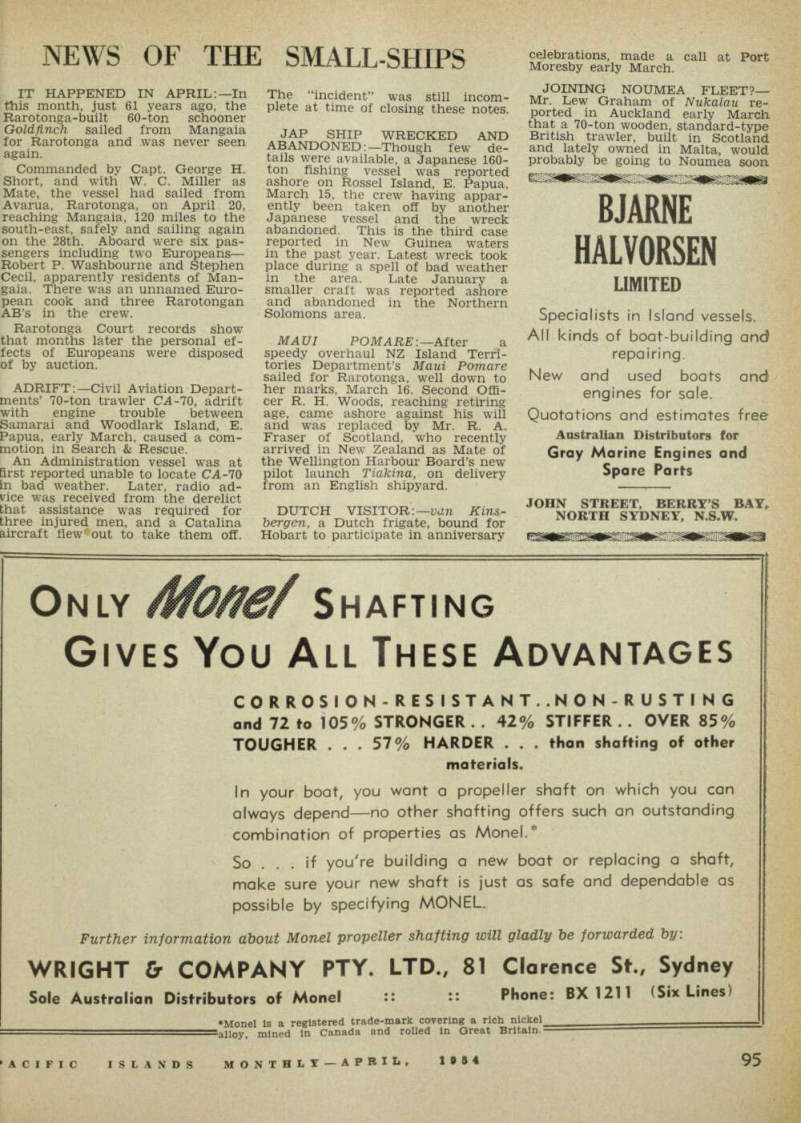
Owner and crew of Ho Ho 11—Mr. and Mrs. Birger Bryhn, James Marsters of Rarotonga, Denis Gordon of W. Aus tralia, and Edwin Eargle of Alaska.
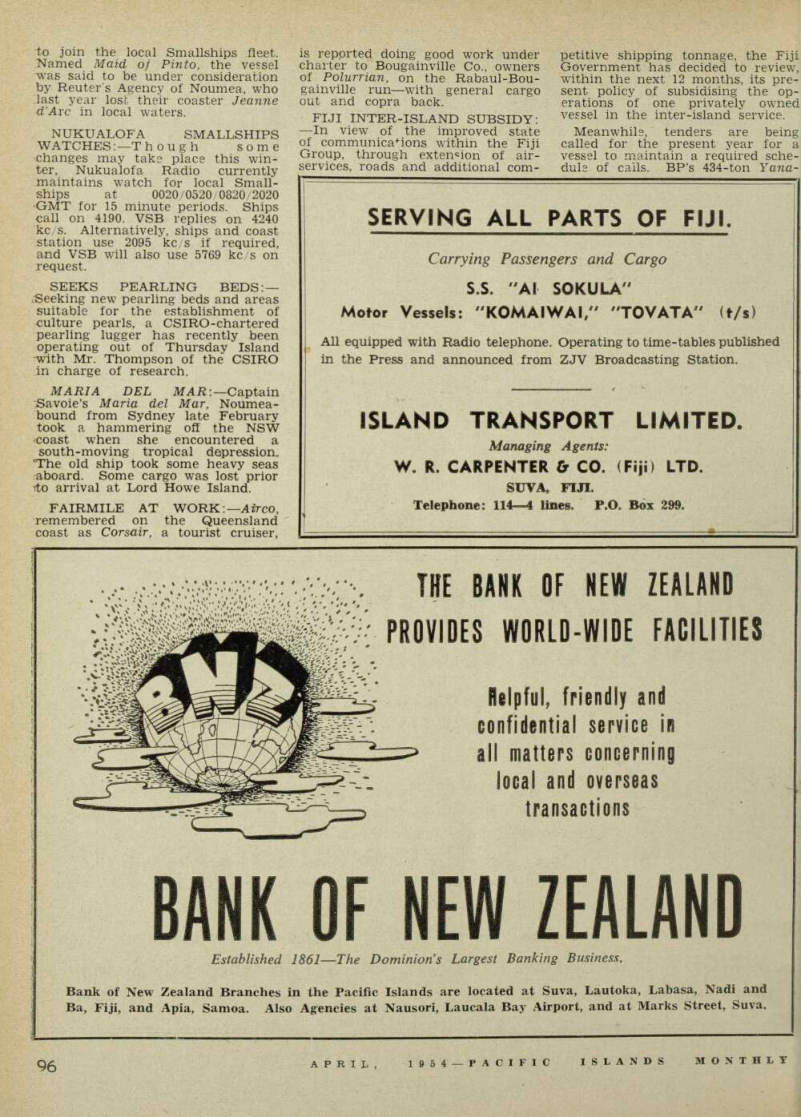
Ho Ho II on arrival at Auckland.
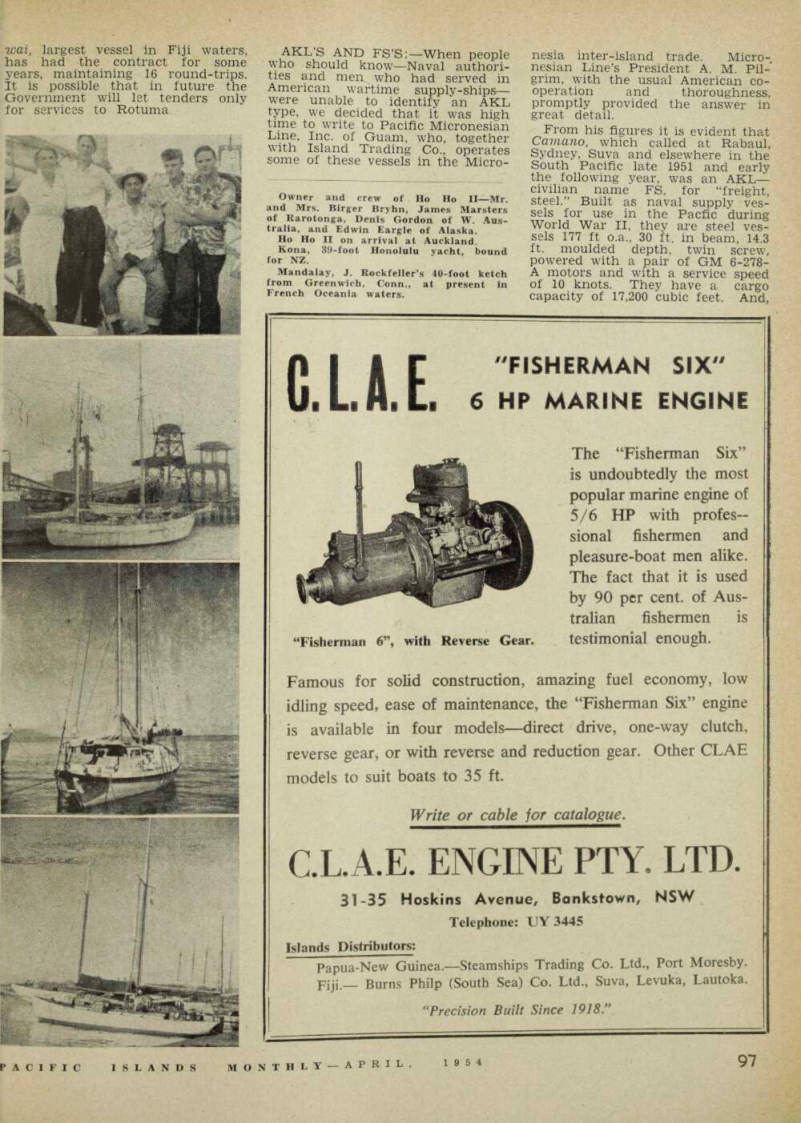
Kona, 39-foot Honolulu yacht, bound for NZ.
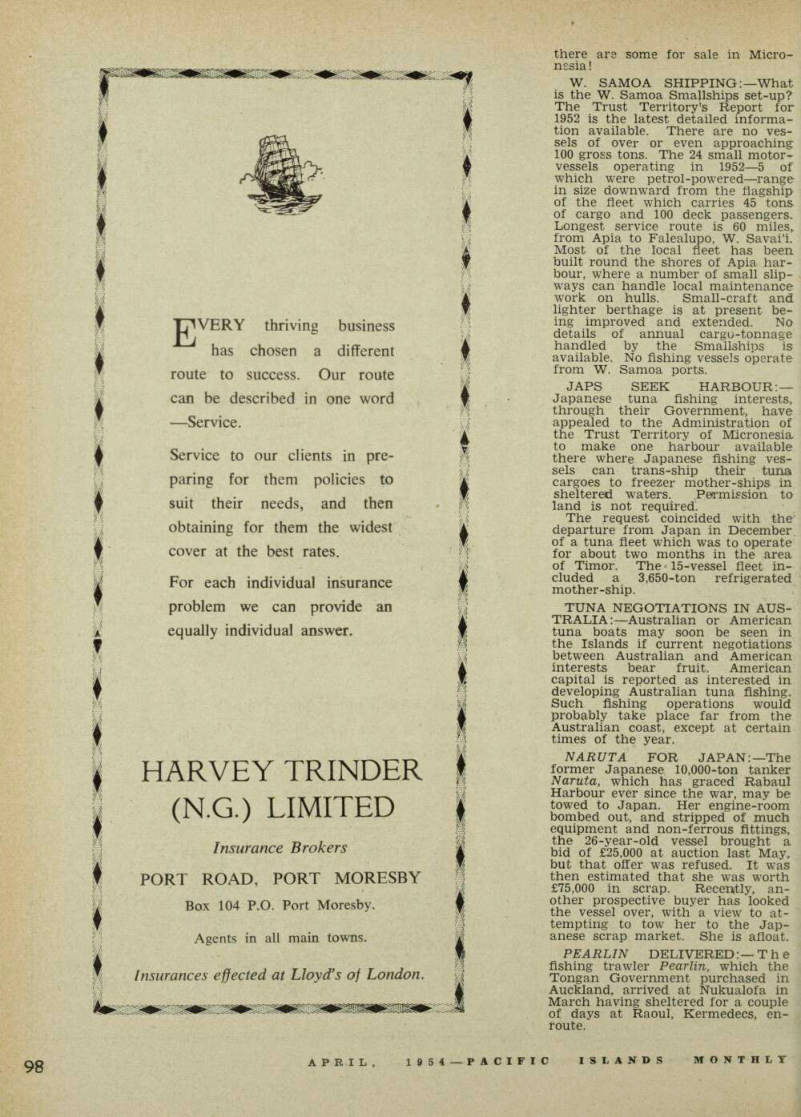
Mandalay, J. Rockfeller’s 40-foot ketch from Greenwich, Conn., at present in French Oceania waters.
there are some for sale in Micro nesia !
W. Samoa Shipping:—What
is the W. Samoa Smallships set-up?
The Trust Territory’s Report for 1952 is the latest detailed informa tion available. There are no ves sels of over or even approaching 100 gross tons. The 24 small motor vessels operating in 1952—5 of which were petrol-powered—range in size downward from the flagship of the fleet which carries 45 tons of cargo and 100 deck passengers.
Longest service route is 60 miles, from Apia to Falealupo, W. Savai’i.
Most of the local fleet has been built round the shores of Apia har bour, where a number of small slip ways can handle local maintenance work on hulls. Small-craft and lighter berthage is at present be ing improved and extended. No details of annual cargo-tonnage handled by the Smallships is available. No fishing vessels operate from W. Samoa ports.
Japs Seek Harbour:—
Japanese tuna fishing interests, through their Government, have appealed to the Administration of the Trust Territory of Micronesia to make one harbour available there where Japanese fishing ves sels can trans-ship their tuna cargoes to freezer mother-ships in sheltered waters. Permission to land is not required.
The request coincided with the' departure from Japan in December of a tuna fleet which was to operate for about two months in the area of Timor. The 15-vessel fleet in cluded a 3,650-ton refrigerated mother-ship.
Tuna Negotiations In Aus
TRALIA: —Australian or American tuna boats may soon be seen in the Islands if current negotiations between Australian and American interests bear fruit. American capital is reported as interested in developing Australian tuna fishing.
Such fishing operations would probably take place far from the Australian coast, except at certain times of the year.
Naruta For Japan:—The
former Japanese 10,000-ton tanker Naruta, which has graced Rabaul Harbour ever since the war, may be towed to Japan. Her engine-room bombed out, and stripped of much equipment and non-ferrous fittings, the 26-year-old vessel brought a bid of £25,000 at auction last May, but that offer was refused. It was then estimated that she was worth £75,000 in scrap. Recently, an other prospective buyer has looked the vessel over, with a view to at tempting to tow her to the Jap anese scrap market. She is afloat.
Pearl In Delivered: T H E
fishing trawler Pearlin, which the Tongan Government purchased in Auckland, arrived at Nukualofa in March having sheltered for a couple of days at Raoul, Kermedecs, en route.
A’Oniu On Survey:—Tongan
Copra Board’s 120-ton wooden ketch, A’oniu, arrived at Auckland for annual refit, March 3; Captain James G. McCormich expected the job to be completed by the end of the month.
Captain McCormick said that he understood the Copra Board was contemplating the purchase of a modern vessel of 400-600 tons—per haps similar to some of the attrac tive Dutch-built coasters that have recently arrived in New Zealand waters. He understood they would steer clear of old second-hand vessels.
NUKULAU : South Pacific Shipping Co.’s Nukulau went from Suva to Auckland early March where she is undergoing survey and improvements to officer’s accommo dation. Captain McKenzie Arnot returned to Suva to take com mand of M.H’s Altair and Captain James Ure who travelled from Auckland to Suva to join the ship as chief officer, has been promoted master. Captain Ure was a former master in BPC phosphate vessels.
Nukulau will be some time refitting, during which period a decision will be made as to which of several pos sible trades she will be put to. She now has a crew of part-Fijians and other Islanders signed on in Suva.
Port of registry remains Famagusta, Cyprus. The 400-tonner is cur rently available for charter.
Mahvrangi Lost:—The Loss
of the Fairmile launch Mahurangi was reported briefly as late news last month.
She departed from Rarotonga on February 25 with 145 drums of aviation gasoline aboard, bound for Aitutaki. At 4 pm on the same day the 300-tonner Rannah, also loaded with gasoline, sailed for Aitutaki and overtook Mahurangi at 8 am the following day. At 4 pm that afternoon, when Rannah was ap proaching the discharge point at Aitutaki, she maintained a routine
radio schedule with Mahurangi, then 12 miles south of the island.
Captain John Blakelock reported that a serious leak had developed and asked for assistance. Rannah immediately returned and accom panied her to Aitutaki.
Immediate discharge of Mahu rangi then commenced at about 5.30 pm and continued until about 10 pm, the sea then being too rough to continue, about 60 drums hav ing been then discharged.
Mahurangi had lost both anchors at Rarotonga on her previous voy
age and was incapable of attempt ing to anchor. There was considerable spilt gasoline in and on the decks of the vessel, as a result of some drums breaking adrift and it was considered most unwise to bring her into the vicinity of Rannah, which by then had anchored.
The leak continued to increase and Mahurangi was abandoned at 11.30 pm, her engines out of action, about 2 miles west of the landing.
She sank in deep water about miles south of Maina islet at 6.40 am., Rannah then standing by and picking up 48 drums of gasoline which floated clear. The wreck did not come ashore on Aitutaki but sank immediately.
The leak was thought to have come from the bolt holes of a shaft bracket or from a ieak otherwise associated with the vibration caused by a mis-aligned shaft. Work on a shaft ' bracket which had come adrift on the previous voyage had been attempted under water at Rarotonga, there being no slipping or beaching facilities anywhere within the Lower Cook Group.
The vessel, which was owned by Mr. H. R. Jenkins, now of Sydney, and chartered by Mr. D. C. Brown of Rarotonga, owner of Rannah, had not been surveyed or drydocked for a considerable period.
Maina Islet Llght:—Though
not associated in any way with the loss of Mahurangi, the further wreck in the vicinity of Aitutaki
seems to have had the effect of speeding up completion of the Maina Islet light, equipment for which has been lying at Aititaki for about a year. Work was being pushed ahead early March on the 6-feet-cube concrete base for the 40-foot tower. The light will be an electric one, operated from storage batteries which will require re
charging about every six months.
Characteristics of the light have not yet been announced. It will be a most valuable aid to navigators ap proaching Aitutaki main passage from the south or west.
EUA IKI LlGHT:—Since this light collapsed a couple of years ago overseas copra vessels ap-
proaching Nukualofa from the east ward, and not equipped with radar, have lost a valuable aid.
Complaints have been lodged against the decision not to re establish the light for the present.
No regular traders at present ap proach Nukualofa from eastward and it is understood that the Tonga marine authorities consider that their limited funds can be better spent at present. One facility re cently completed is a new beacon on Hakaau Mamau reef in the western approaches to the Tongan capital port.
Recruiting Craft:—Owned
and skippered by Mr. Jack Thurston of Rabaul, the 45-foot Colin Archer type ketch, Kathleen, arrived at that port from Australia in March.
Mr. Thurston will use the ex-yacht to recruit and transport labour to his plantations.
Rarotonga Radio
WATCHES: —Rarotonga Radio has advised that 2182 kc/s watches as shown in the International List are not maintained by the station.
Local vessels, when at sea, are con tacted at 0030 1930 GMT—and at 0730 GMT if required also, ships using 2182 or other frequency, and ZKR replying on 2012—0 r on 6899 kc-s, Rarotonga uses 2012 for com munication between Lower Group Islands at frequent intervals throughout the day, and vessels with this frequency can contact Rarotonga initially during these in ter-island schedules. But where possible, yachts and other radio equipped smallcraft heading for the Cooks, are advised to request Raro tonga to listen for them at the times mentioned above, naming their own ship frequency, before leaving their last port. For ex ample, if leaving Papeete for Raro tonga, the Papeete radio station will always pass the information on —as will any other Islands stations.
Rarotonga makes no routine weather broadcasts, but receives from Nadi, Fiji, a Cook Islands fore cast each day at about 2200 GMT, and ships requesting information after that time will be given the latest news. There is no broadcast ing station in the Cooks. (Over)
Left to right: Mahurangi, converted Fairmile, which foundered off Aitutaki. Chief Officer R. J. Rae returned to New Zealand from the Cook Is. after some months in Rannah which has operated throughout the hurricane season. Charlotte Donald completed annual refit in Papeete and returned to service in the Cooks late March.
Delivery Costs:—£I7-Odd In
wages to tie up a 400-tonner sounds unbelievable—but that’s what it cost the Nukalau at Dar win recently, enroute from Cyprus to Suva. Port regulations called for the employment of six men for a minimum four-hour period—to do a job that one of the crew could well have done in five minutes, if permitted. At Port Moresby a single boy did the same job for about four shillings—even diving off the wharf to capture a short thrown heaving line rather than wait for a second throw!
JAP TUNA PLANS:—Japanese fishing companies together plan to huild 1,280 wooden tuna-fishing vessels totalling 107,400 tons, and a further 230 steel craft totalling 61,500 tons during the period 1954- 58. Total cost will be the equiva lent of £A6 i millions.
By the end of 1958 the Japanese tuna fleet will then comprise some 2,225 vessels totalling 231,320 tons —which shows Japanese faith in the tuna industry as a dollar earner.
CASE IN POINT:—Last month it was pointed out that a great many Japanese fishing vessels include a number in their name, and that identification without inclusion of that number is often impossible.
A case in point is the Japanese vessel ashore and abandoned on Rossel Island reef, E. Papua. The vessel was described in press despatches as Sumiyoshi Maru.
Lloyds, and other international publications, show a whole series under this name—each followed by a number. No number, no identi fication.
Samoa Coastal Survey—
HMNZS Lachlan will again carry out survey work on the W. Samoa coast this winter. She will leave Auckland, May 17, and return July 5, Apia Harbour and its western approaches were surveyed last year.
The vessel this year will be com manded by Commander G. S.
Ritchie, DSC, RN.
To Service Outposts:—
Holm Shipping Co., of Wellington, NZ, reported in March that they have on order overseas, a new vessel which, in addition to her coasting duties, will serve the meteorological outposts of Camp bell Island and Raoul Island —and provide their occasional link with Norfolk Island. Delivery is not ex pected before late 1955. It is be lieved the vessel will be similar to the company’s new Dutch-built Holmwood of 800 tons gross which they took delivery of last year.
What The Atom Age Means:
—Most arresting shipping news of March must have been the atomic pollution of Japanese tuna vessels located up to 1,200 miles from the source of the Bikini-Eniwetok hydrogen-bomb explosion radio active coral dust being carried that
distance, and possibly further, by the ocean currents.
Extraordinary, however, was the fact that when the Fukuryo Maru, the most seriously affected vessel, arrived at Misaki still covered with radio-active dust and with her crew all suffering radiation burns, no immediate steps were taken to check her tuna cargo. Not until after it was sold through retailers
and probably eaten, was it dis covered to be highly radio-active.
The effects may not yet be evident, but the incident caused a great stir in the Japanese fish canning in dustry, which has now decided to check all future tuna and stamp on each tin for export, “Guaranteed free of radio-activity”—or some thing similar.
Some of the vessels affected be longed to the Taiyo Fishery Co. of Tokyo—the organisation which operated so successfully in the Solomons area last year.
Another W. Samoa Coaster
LOST:— Calmar, another small vessel belonging to Messrs. O. F.
Nelson & Co., was lost in the Faga malo Passage, north coast of Savai’i, early March. The company lost their Gaualofa on the south coast of Savai’i some time ago.
Calmar struck a rock in the passage and sank in deep water. No lives were lost. Vessel and copra cargo were insured.
Papeete Smallships
WATCHES:—Tahiti’s Chief of the Service of Posts and Telecommuni cations has supplied the following information of interest to radio telephone equipped vessels heading for Papeete. Mahina Radio main tains watch on 8287 kc s for short periods daily at the follow ing times: 0030 0230 0610,1615/1800 2100 GMT. Mahina normally re plies on the same frequency but can also use 2620 kc s and 4386.2
kc s if requested. Mahina will, of course, by prior arrangement, listen on . any other nominated frequency at the times mentioned.
No 2182 kc s international distress watch has yet . been established. All local vessels use 8287 kc s.
Weather broadcasts for the French Oceania area are made from three stations Mahina Radio, Tahiti
Meteorological Centre, and Papeete short-wave broadcast station —as follows: 0025 GMT from Met on 7500 kc s; 0510 GMT from Papeete S W on 7125 kc/s; 0610 GMT from Mahina on 8287 kc/s; 1825 GMT from Met on 7500 kc/s; 2215 GMT from Papeete S W on 7125 kc/s. All these voice broadcasts are, naturally, in French.
Near-Mishap To Tahitien ;
—Messageries Maritimes modern and attractive liner Tahitien was saved from a possible disaster by smart action on her bridge on March 14 when clearing Papeete Pass. When nearing the inner entrance to the Pass as she sailed for Sydney at 4 p.m. the starboard notor suddenly failed. Some quick thinking and the dropping of an anchor just halted the vessel in time. Motor repairs were effected md the ship cleared the Pass next norning.
NOTICES:—Recent Notices to Vlariners report a reef eastward of Alim Island, in the so-called Western Islands, west of Manus, and alterations to the positioning af buoys in Seeadler Harbour, Manus.
Showing The Flag;
3MNZS Hawea, in February-March, Daid visits to Suva, Labasa, Funa futi, Nanumanga, Kwajalein—where she was instructed to fuel and pro ceed with other American vessels to carry out a three-day unsuc cessful search for a missing British jet bomber thence to Tarawa, vhere the ship’s company was entertained lavishly for three lays. Next stop was Nui, in the Ellice, and again to Suva before •eturning to Auckland on March 23.
Nadi Fishermen Cause
STlR; —Three part-time fishermen )f the Nadi Airport Staff, Fiji, ’orced off their course by rough seas md squally weather which sprang ip while they were at sea in their .aunch, caused an air search to be jet in motion early March.
The fishermen, Messrs. R. L.
Wild, K. StClair and S. Belenski, nade a safe landing at the delta Df the Nadi River, though their aunch was swamped, but a Panair 3C4 which was asked to go up and issist in the search for the launch suffered damage when she overshot ;he runway on again landing, the lose-wheel collapsing and the nose )f the aircraft and two propellers
suffering damage.
The fishermen spent an uncom fortable day isolated on the river lelta before a boat could reach ;hem, due to flooding of the river.
Master Of Tungaru: —On
completion of furlough, Captain S. 3rown arrived at Suva in March ;o resume command of the G & SIC CWS freighter Tungaru, which i relieving master had brought :rom Tarawa to Suva for annual efit. During his holiday, Capt.
Brown skippered a yacht in the rrans-Tasman race, in which his vessel was placed second. It is re- Dorted that the yacht was the smallest in the race, and that it tveraged about 3 1 knots for the fasman crossing. —Jack Thornton.
News of Cruising Yachts
• ANNA ELIZABETH, 37 ft. steel latch double-ender owned by E. W.
Lamberty, and LES 4 VENTS, 38 ft 6 in. cutter from France via the Horn, both called at Rarotonga in mid-March. The Dutch yacht, with four aboard, was heading for Auckland via Kermadecs after a lengthy stay in French Oceania waters.
Marcel Bardiaux, sailing alone, had been in Papeete since May. He arrived at Rarotonga via Leeward Group, and also intended to clear there for Auckland. • ONRUST will probably now remain in Tasmanian waters for some time.
Dirk Tober reports that he may take a job there at the tin mines, after some coastal cruising. • LADYBIRD seems likely to be first Auckland boat to head Islandwards this season. Cyril Hill, custodian of the big Okahu Bay yacht terminal, and his wife, plan to clear for Papeete early May.
With them will probably be P. Edmonds who last year cruised in TAURANGI.
Like most of last year’s Auckland boats,.
LADYBIRD will head west from Papeete as far as the New Hebrides, thence home, Other likely starters this season: LADY STIRLING, IMATRA, and possibly MARCO POLO—a home-brew 38-footer of sturdy appearance which was recently launched. Owner-builder Tony Armit i& said to be planning a world cruise, with companion Noel Millen, also of Auck land. • ARTHUR ROGERS, after some months in New Zealand waters, will probably head out for the Islands early June. Tom and Diana Hepworth have vacancies on a cost-sharing basis for several people who would like to join the Brixham for a five-months’ circuit
from Auckland to Tonga, possibly Samoa, thence Fiji. New Hebrides, New Caledonia, and back to Auckland. Until sailing day the boat will lie at Auckland Harbour Board slipway wharf. • SEVEN SEAS—yet another of that name—a steel double-ender similar to ONRUST, cutter rigged, cleared Scheven- Ingen, Holland, for New Zealand via Panama and the Islands in mid-March.
Owner Andree Tenoever Bouwmeester. aged 24, plans to settle in New Zealand »r Australia. • HO HO 11, flying the Norwegian ensign, arrived unexpectedly at Auckland February 28, having called at Norfolk island enroute from Noumea. This big, solid, 55-ft. Colin Archer ketch came iown through the Islands from Panama to Sydney three years ago, remaining at Sydney for a lengthy period, leaving when import duty was about to be levied, and lias lately been some months in Noumea.
Captain Birger Bryhn and his Swedish ivife hope to remain permanently in New Zealand —if the yacht can be sold.
As crew for the passage south from Voumea, HO HO II took aboard three men who had been crewing the Fairmile aunch PHILANTE II now owned there >y Monsieur Martinet, a local chemist.
Fames Marsters had joined PHILANTE II it Rarotonga. Edwin L. Eargle of Inchorage, Alaska, a USAF pensioner, and Denis Gordon of W. Australia, had joined ‘HILANTE II at Noumea later. Another 2ook Islander, also named James Marsters —a cousin of the other—still remains with he Fairmile at Noumea. Two crew members from Tahiti had earlier left PHILANTE II in Suva. HO HO II made i fine-weather passage south. All her ;rew now have jobs ashore.
The English translation of Captain Iryhn’s book on his pre-war trip round he world in HO HO I has recently been mblished and should prove most interest ng to Islands residents. It is well llnstrated. • YANKEE, Irving M. Johnson’s 96 ft trigantine from Gloucester, Mass., arrived it Papeete February 12, with 23 persons iboard, having left her home port November 1 last and called .at the Salapagos and Pitcairn since clearing ’anama. A month’s stay was planned ,n French Oceania, A photo of the ;raceful steel vessel, former German pilot •oat, which we have received, says that his is her sixth round-the-world cruise —but we believe that the Johnson’s —and lot this YANKEE have made the five irevious cruises. YANKEE No. 2 was icquired after World War 11. She sets •ut November 1 every third year—arriving lome again May 1 eighteen months later, rhe hand-picked volunteer crew of young nen, aged 18-25 years each pay £4-£5 ter day to go along.
Though the vessel has twin 55-HP liesels, she rarely uses them and is ndeed a splendid sight under full spread »f canvas.
Next port is understood to be Pago *ago, in mid-April. Other Island ports ;cheduled are not yet known. • SORENGAMA, said to be an Bft-ton tetch-rigged steam yacht, square-rigged m the main, dropped in to Suwarrow itoll, Cook Is. briefly on January 28, iccording to advice received from Mr.
Tom Neale, only resident of the island.
Reported as owned by Captain Scott- Eliot, and with a crew of five, this English craft after clearing Panama called at the Marquesas thence direct to Suwarrow, She later was to call at Samoa, and was last signalled at Honiara, February 38. No details of this sizeable craft are shown in Lloyds Register of Yachts and few details have so far come to hand. She appears to be making a quick run with few calls. • MARINER, 34 ft Seattle. Wash., ketch, owned and manned by George Karl and Jim Robinson, arrived at Papeete, February 15, from Pitcairn Island, having called their enroute from the Galapagos. Destination is now re ported as “indefinite”, but a three months’ loiter is planned for French
Oceania. Earlier, New Zealand had been .given as final port. • PLEIADES, which we reported as departing New Zealand some months ago in commencement of a world cruise, re turned to New Plymouth, NZ, in February after cruising for a time on the E. Aus tralian coast. A second departure may take place later. • A new chart of the Galapagos has recently been issued and should be of particular interest to cruising yachts—No. 1375 (British). • NORDLYS, said to be a Colin Archer type ex-Norwegian pilot cutter, and variously described as “a little over 20 feet” and. by another informant, 36 feet in length, arrived at Cairns early March, «nroute to New Zealand from Norway.
Owned by Einar Jakobsen, a 30-year-old Norwegian electrician, the yacht took the unorthodox east-bound route, coming through the French canals to the Mediterranean, thence the Red Sea to -Colombo and Tanjong Priok. At Colombo the owner was joined by a 26-year-old American, Joe Bormel, who has been hitch-hiking his way around the world since December, 1952. Bormel planned to leave the yacht in Australia, and Jakob sen intends settling in New Zealand. He will soon head for Auckland. It had heen thought earlier that NORDLYS might make a call at Port Moresby, en route to Cairns. • NORDLYS again a confusion of names—American 72 ft. schooner, arrived Sit Papeete March 17, from San Diego via Acapulco, Taiobae, and Takaroa. Owned by Walter S. Johnson, Jr., the handsome
craft had seven other persons aboard with the owner.
NORDLTS (Northern Lights) was built in New York in 1937, has a beam of 17 ft. and a draft of 10.5 ft. Plans are to remain in French Oceania waters until August, then sail for Hilo. Hawaii.
Owner Johnson, it will be remembered, sailed in MISTRESS to Papeete last year in the Honolulu-Tahiti Race.
« TAHITI, a little 30 ft. ketch with owner R. H. Barney and sailing com panion L. A. Smith aboard, dropped in to her name-place March 19, having left Los Angeles January 20 with calls at Taiohae and Takaroa enroute. TAHITI, built in Los Angeles in 1946, is a shallow draft type, 4.5 ft. on a 10 ft. beam, Destination is given as “not decided”— 4 months in Fr. Oceania is planned.