He Paints in Tahiti
pp. 81-82 · Read in the full issue
Story of a Nonagenarian Watercolourist Told By Walter Smith.
William Alister Mac
DONALD, noted British water-colourist and book illus trator, who lived and practised his art in the South Seas during the ’twenties and ’thirties, has recently returned to Tahiti. Twice he left these parts (1934 and 1939) intend ing to remain in the Old World.
But, as the local saying is, “they always come back.”
Now 93, Mr. Macdonald is a re markable example of a man who has retained his mental and physi cal faculties far beyond the average span of life. He travels widely, always alone. Two years ago he circled the world The portrait, page 80, made in January of this year by Frederick Simpson, the well-known photo grapher of Papeete, Tahiti, repro duces the physical appearance of Mr. Macdonald to-day. He reads ordinary print without glasses. He formerly wore glasses, but some years ago he discarded them, and now says that when one has reached a certain age they are not of much assistance to the eyesight.
He attributes his longevity to that wise maxim: moderation in all things.
He still practises his art. He has always painted in water-colours. It is his opinion that this medium lends itself with greater propriety to the painting of the blue seas, the strands, and the palms of the South Pacific than the more drama tic and “loud” medium of oil cffiours. Tahiti he thinks is a para dise for water-colour painters. Re cently he has been living on the island of Moorea, adjacent to Tahiti, and is steadily producing canvases. He observes with amused surprise that he has a local repu tation, and has no difficulty in sell ing his pictures.
After serving in the British Army Supply Department in World War I. Mr. Macdonald sailed for New Zealand in 1921, but the vessel called at Tahiti, and he became en tranced with that spot. Thereafter, luring the greater part of the sue
ceeding 18 years he lived and painted in Tahiti and the Tuomotu or Low Islands.
The year 1921 saw also the arrival in Tahiti of James N. Hall and Charles Nordhoff. the writers, and with them his friendly inter course was con tinuous during his entire stay in the South Seas. He and Hall planned a book, in collab oration, on Tahiti, but this was never undertaken, chiefly because Hall was engaged during this period in his joint work with Nord o f f.
which produced such well-known works as Mutiny on the Bounty, Hurricane, The Dark River, etc. Mr. Macdonald did, however, illustrate one of Hall’s books, Tale of a Shipwreck.
In the twenty years 1890-1910, Mr. Macdonald made a series of water colour drawings of London bridges, churches, inns of court, street scenes, river scenes, histori cal graves, and the like. Through the generosity of Viscount Wake field of Hythe these were presented to the City of London, and are now preserved to the public in the Guildhall Art Gallery.
In 1917, reproductions of many of these paintings and drawings were published in a handsome book entitled London Recalled, with topographical descriptions by E.
Beresford Chancellor. This writer was a well-known authority on all things pertaining to London, ancient and modern. He died while the book was being printed. It is from his introduction to London Recalled that most of the facts of Mr. Macdonald’s life are here ex tracted.
Macdonald was born in the Free Church Manse of Brora, a parish of Clyne, Sutheorlandshire, where his father was the incumbent. He was four years old when both his parents died, and he was placed un der a guardian living at Thurso, the most northerly town in Scotland.
In the village of Melvich, under the care of his maternal grand mother, he spent the following six years, in sight of the Orkneys glimmering across the wild Atlantic seas. After attending Rattray’s School in Aberdeen, where he had his first lesson in water-colour drawing, he was placed by his guardian in a bank, and later ob tained a post in the London and Westminster Bank. Meanwhile, he began attending the evening classes of the St. Martin’s School of Art.
At the age of 24 he left the bank, and after a sketching tour with two other artists on the Norfolk Broads he established himself at Green wich. During this period he sailed on a fishing boat to the North Sea, the fruit of which was a set of sketches with an account of line cod-fishing, which he sold to The
(Photos by Frederick Simpson .
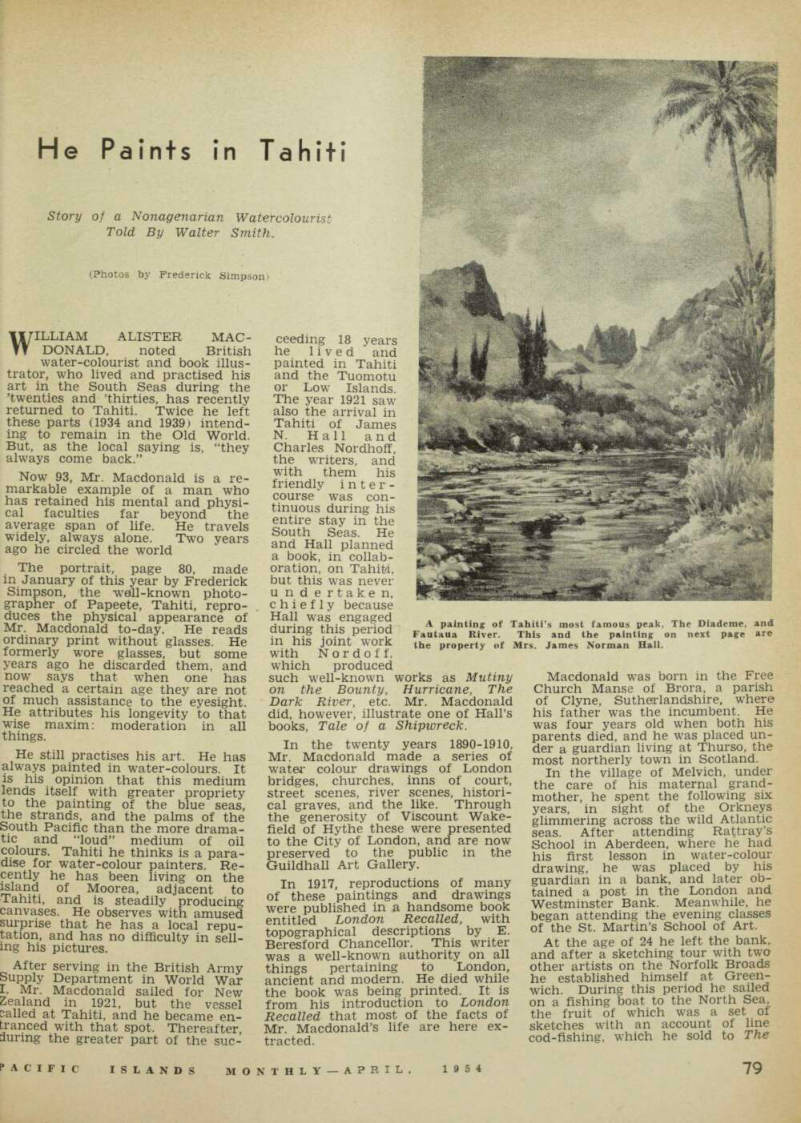
A painting of Tahiti’s most famous peak, The Diademe, and Fautaua River. This and the painting on next page are the property of Mrs. James Norman Hall.
Tiu.o+rn+o* t nn/inn a; Pm* for 11
flrft succeTstui ven
ture in art.
He experienced the proverbial
“hard times” of the artist, but cpn tinued his studies at the Westmin ster School of Art. A water-colour of the Thames from Blackfnars Bridge was accepted and hung by the Royal Academy, and received the commendation of George Moore, then art critic of The Times.
He lived at this time mainly by painting river scenes and by doing small and highly finished drawings which he sold through the medium of the Kensington Fine Art Society.
After a trip to Portugal, which left an indelible impression on his mind, he returned to England, married, and lived in Danes Inn, the Strand (Danes Inn is no longer in existence), and at No. 8 Fig Court, Temple. It was in the 15 years of his life in this picturesque spot that he executed most of the water-colour drawings that are now
the property of the City of Lon don. There followed years of teaching; this did not, however, abate his steady and industrious de votion to the practice of his art.
Then came the war of 1914-1918, Mr. Macdonald’s service, followed by his trip to the South Seas. Now, for the third time, this artist, who was busily painting 25 years be fore the death of Queen Victoria, is once again in Tahiti. Not to stay, however —he plans to end his days in his homeland.
William Alister Macdonald.
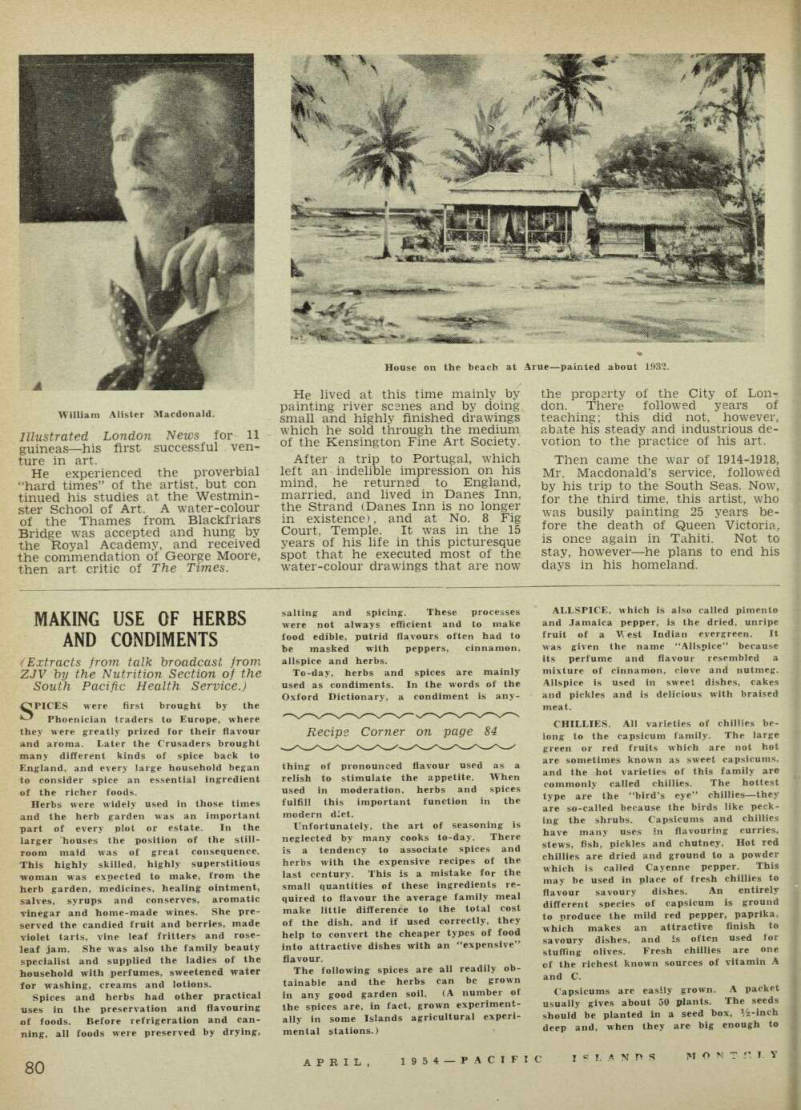
House on the beach at Arue—painted about 1932.