Galip Nuts
pp. 51-52 · Read in the full issue
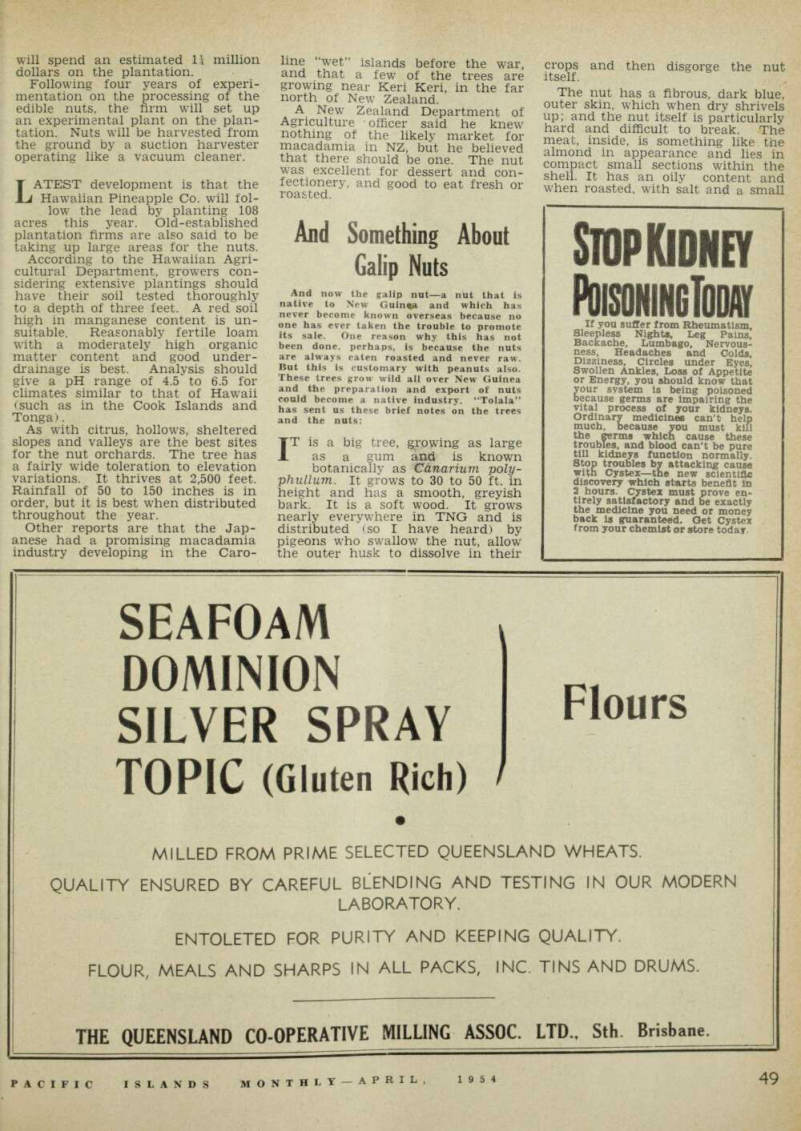

And Something About Galip Nuts
And now the galip nut—a nut that is native to New Guinea and which has never become known overseas because no one has ever taken the trouble to promote its sale. One reason why this has not been done, perhaps, is because the nuts are always eaten roasted and never raw.
But this is customary with peanuts also.
These trees grow wild all over New Guinea and the preparation and export of nuts could become a native industry. “Tolala” has sent us these brief notes on the trees and the nuts: IT is a big tree, growing as large as a gum and is known
botanically as Canarium poly
phullum. It grows to 30 to 50 ft. in
height and has a smooth, greyish
bark. It is a soft wood. It grows nearly everywhere in TNG and is distributed (so I have heard) by pigeons who swallow the nut, allow the outer husk to dissolve in their
crops and then disgorge the nut itself.
The nut has a fibrous, dark blue, outer skin, which when dry shrivels up; and the nut itself is particularly hard and difficult to break. The meat, inside, is something like the almond in appearance and lies in compact small sections within the shell. It has an oily content and when roasted, with salt and a small
quantity of cayenne pepper added, has a most delicious flavour. When roasted it can be placed in a her metically-sealed jar and will keep almost indefinitely. (Some my wife prepared were eaten with delight in New York months later.) If the whole nut is washed in salt water, the outer skin removed, and then washed in fresh water and allowed to dry, the nut will keep indefinitely, providing no in sects or borers attack it.
It is classed as a native food-tree.
Size of nut is a little smaller than the Brazillian nut.
TO PREPARE: Crack the nut, place meat in a baking dish and place in slow oven to roast. When browned, sprinkle with salt and cayenne pepper to taste. Allow to cool before putting in air-tight jar.
If desired as a sweet, put sugar in frying-pan, add nuts and stir while cooking over fire.
OPINION: Would sell like hot cakes as a civilised delicacy, es pecially in USA.
Mi*. A. R. Trist, Deputy Director of Forestry, Q’ld, said in Brisbane recently that correct development of forestry in New Guinea could assist considerably in relieving Aus tralia’s timber shortages. Forestry, he emphasised, had reached the stage where it could no longer sup ply the needs of the timber and plywood mills.
Tf Mr. B. C. Ereckson, who recently completed a period of duty as met eorologist at Tarawa, has been ap pointed Chief Observer, Nadi, Fiji, and will take up that position fol lowing leave in New Zealand. Mr.
I. Ogilvie, recently Chief Observer, Nadi, has been transferred to Wel lington. Mr. D. Dollimore, lately of
Wellington Meteorological Office, has been appointed meteorologist in charge at Tarawa.
II Mr. Bevan Meredith (28), of Warwick, Queensland, has been ap pointed to the teaching staff at the Martyrs’ School, Poppondetta, an Anglican Mission School for Papuan boys.