Unorthodox—But This Bishop’s
pp. 31-35 · Read in the full issue
Wife Helps Build a Cathedral
From a Special Correspondent
WHEN the Bishop in Polynesia (the Rt. Rev. L. S. Kemp thorne) and Mrs. Kempthorne leave Suva for five months in the United States at the end of May, (the Bishoo to attend a conference and Mrs. Kempthorne to visit her family), Mrs. Kempthorne will have the satisfaction of knowing that about one-fifth or one-sixth of the new Anglican Cathedral in Suva Is there by her efforts.
Contributions to. the Cathedral building fund, from her own per sonal efforts, recently reached the £2,000 mark. A lot of money in any woman’s language.
In a recent interview in Suva, Mrs. Kempthorne told us how it was done: About three years ago she decided to earn £5O or £lOO as a personal contribution to the Cathedral build ing fund, and knowing that the second-hand clothes-stalls at local bazaars were always rushed, she thought that that was one way of
going about it. As she explains, the poorer Fijians and Indians cannot afford to buy in the shops at pre sent prices, and very few of the older ones can do even the simplest Sewing. (Continued next page)
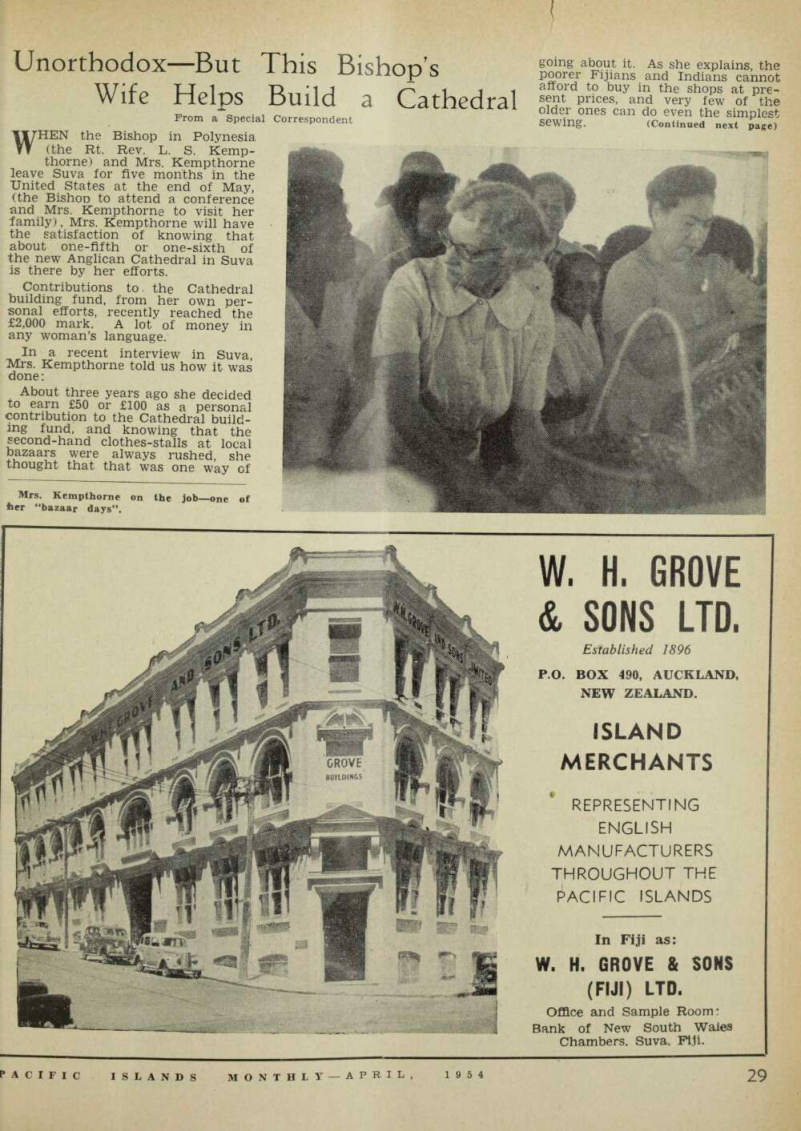
Mrs. Kempthorne on the job—one of her "bazaar days”.
To start the idea rolling, Mrs.
Kempthorne wrote first to Inends in Honolulu asking for old clothes suitable for re-sale, and got such a hearty response over a period of six months that she fetched out her address book and wrote every friend or relative or acquaintance in the United States, asking for donations of practically everything in the clothing line.
The Bishop in San Francisco offered to accept all parcels, and freight and crating was donated by the Women’s Auxiliary of the Cathedral Church there. This effort brought in half a ton of clothing.
“By this time,” says Mrs. Kemp thorne, “I had really got warmed up to the possibilities, so when I went to New Zealand just after the hurricane of January, 1952, I was able to collect nearly a ton of things with the understanding that pro ceeds were to go to the Cathedral fund. Since then I have been re ceiving regular shipments of sacks of old clothing from different sources in New Zealand and it has proved highly profitable despite freight, customs charges and pillage.
The Fijians who go down into the ships’ holds to unload here got to know about the contents of these sacks, and until we found out what was happening, helped themselves liberally.”
When the big new market was opened in Suva down near the wa t e r-front, Mrs. Kempthorne started selling there —just going along anytime she considered she had enough clothes for a “bazaar” and paying the usual hiring fee of one shilling a day for use of a piece of counter space.
About a year ago, however, the Town Council decided that only local products could be sold at this market; and that was the end of that.
Then Mr. A. Q. McGowan came to the rescue, and .each Friday and Saturday put up an enclosure next his store for Mrs. Kempthorne’s use. “A better place would be hard to find,” she says, “and I am cer tainly endebted to Mr. McGowan for his sustained interest and help given to my effort —I doubt whether I could have carried on otherwise.”
TO the query as to what were her most popular lines, the answer was, “Anything.” She has sold half a dozen fur coats (which must be the Fiji equivalent to selling re frigerators to Eskimos) and loads of heavy underwear.
Fijians buy the most, then Indians; with Chinese men doing the buying for their families. Fijians, says Mrs. Kempthorne, actually suffer from the cold in the cool months, and towards the end of the hot season she cannot get enough cardigans to sell to those preparing for the cold ahead. Style does not matter very much in any of the clothing, although with the better class of Fijian girl it does.
“They certainly have discriminating taste,” commented Mrs. Kemp thorne, “and figures to show off the dresses. Straight backs and no corsets or high-heeled shoes to throw them off balance, I suppose.”
Generally there are never enough children’s clothes to satisfy the de mand; and hundreds of men’s jacket coats and thousands of shirts could be sold —if they were available. All the women, of any race, want a “shortie” coat for the cooler months and will pay up to £2 for a good one. Generally the garments are sold from 3/6 to about 15/6 each —beyond that price these people are apt to regard clothes as being in the luxury range.
THE thing that amazes Mrs.
Kempthorne most about the whole business, is the way the Fijian women will never try on a dress in public. “They seem to think that that is undignified and you simply cannot make them slip it on, even over their clothes. They span the waistline of a dress with their outstretched hands, and if it is two spans and a bit, that is all they ask.
They never come back and ask to exchange something because of wrong size, so I imagine that they sell things or give them away if they don’t fit.”
Love of the Fijian female is a orassiere; and a first-hand, shop oought one is beyond their means.
Ihey will take them boned and strapless or take them plain, but they like them all. (It has been ■umoured that a factory will shortly oe starting in American Samoa to nanufacture these nether gar nents for the Islands trade. If so,
it should do extremely well). Select ing a bra for size is also done by guesswork, says Mrs. Kempthorne.
They would rather die than try one on.
About £l5O of the amount she has
raised for the Cathedral fund has been from the sale of Islands mats and baskets to tourists. These articles were collected for her by friends in Niue, Samoa and Tonga; and the manager of the Grand Pacific Hotel, in Suva, allowed her to have a table there where the goods could be displayed and sold.
It is not every Bishop’s wife who has raised a large sum of money by virtually setting herself up as an old-clothes merchant. But then, Mrs. Kempthorne does not strike one as being the typical Bishop’s wife. She does not say so, but she probably is not wildly enthusiastic
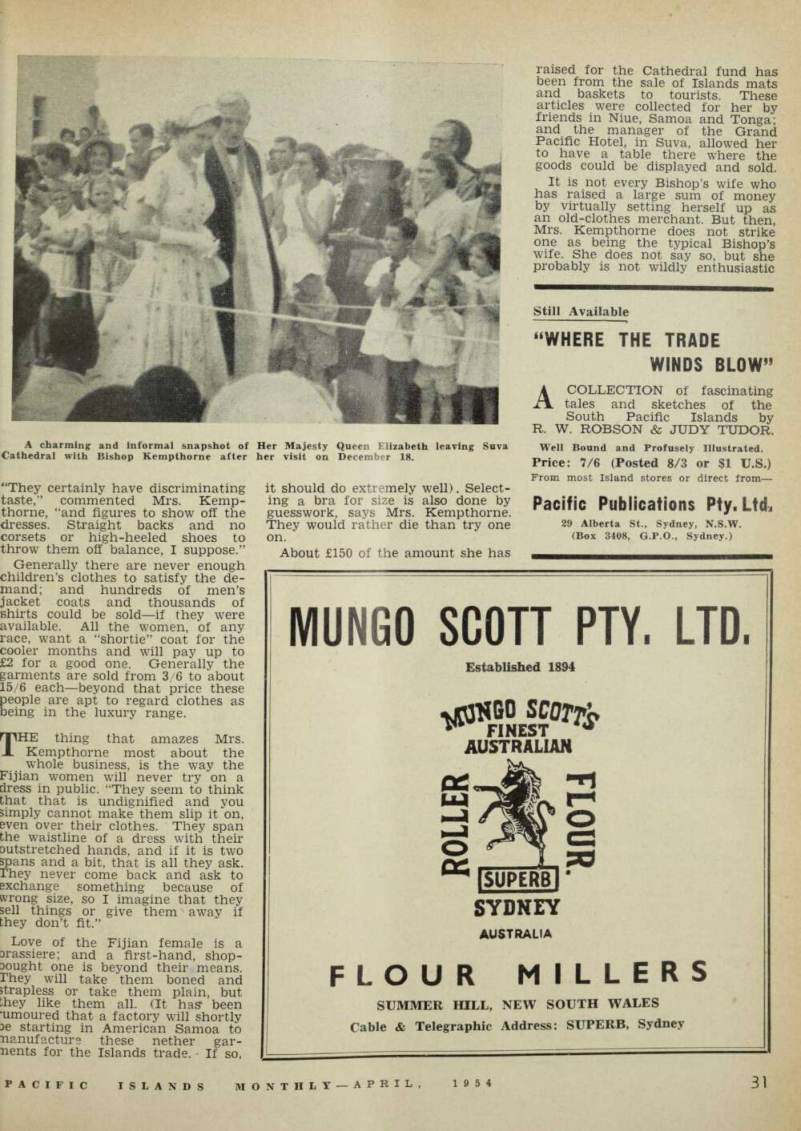
A charming: and informal snapshot of Her Majesty Queen Elizabeth leaving Suva Cathedral with Bishop Kempthorne after her visit on December 18.
about church teas, or sewing circles; yet in her own way, this charming American has got results. As she says herself, she works better when there is no one to impede her speed.
After Lord Nuffield and Dr. Beattie (who donated about £4,000 worth of pipe-organ to the new Cathedral) Mrs. Kempthorne is the third highest contributsr to the building fund. Nice work, America!