Territories Talk-Talk
pp. 25-28 · Read in the full issue
By Tolala
WITH all this talk about Fidgin- English it is not surprising that some of the old-timers, who accepted Pidgin for what it was ind never bothered about analysing its ultimate cultural effect, are showing interest. From one old resi dent of TNG comes the request for i copy of the Pidgin version of the harden of Eden, which many •eaders will remember. (This was published in PIM 20 years igo, and if space permits, we will re mblish it in May, Magazine Section.— Editor.) * * * Kenaf expert, J. Dempsey, made icme critical remarks about PNG’s Agricultural Dept, last month in :onnection with the Kenaf industry ind the Dept.’s alleged neglect in :arrying out recommendations he lad made on a previous visit. There vas the usual exchange of criticism )etween Dempsey and the Dept., vith the Minister backing up the Dept, (naturally).
This game of “goodies” and “bad lies” seems to be a popular pastime, md leaves the public up in the air.
Minister Hasluck did not seem to ippreciate Dempsey airing his views lublicly instead of behind the “iron urtain” of officialdom, whence it ould have possibly been mollified. ?hus arises again the question of he justice to the public of the iractice of censoring statements re arding alleged official delinquen ies.
One gets a bit tired of continu ity observing attempted demon trations of the adage: “The Ad linistration Can Do No Wrong!” ohn Citizen’s reaction now has
become that, whenever hush-hush tactics are adopted he thinks some thing must be wrong somewhere. * * * The second par. in the S.P. Post “Drum” of the 17th of March issue gives one to think. That is, the differentiation between the geo graphic and the political status of an area. It deals with Bougain ville, so often described as being a part of the BSI. Geographically, of course, it is included in the Solomon Island group and, during War 11., I believe it was usually referred to as such rather than as portion of TNG, where it belongs politically.
The old German Salomon Inseln, back in the nineties, consisted of Ysabel, Choiseul, Bougainville and Buka; and it was not until 1900 that international boundary line between British and German possessions was changed, and ex cluded Ysabel and Choiseul as the result of a treaty between Germany and Britain. Britain exchanged Heligoland (I think) to enlarge her holdings in the Solomons. (Also, Britain withdrew from Western Samoa, and Germany gave up her interest in Vavau, Tonga.—Ed.) It’s about time cartographers, hydrographers or whoever is re sponsible, got to work and did away with such possible confusion be tween political and geographical designations. * * * Drastic measures seem to have been taken by the P-NG Dept, of Health when it ordered the removal from a plantation in the Rabaul area of “Highland labour,” alleging the planter had taken insufficient
steps to suppress malaria amongst the labourers. I hate to think of the costs the planter has had to
bear, for Highland labour is an ex pensive item for the Lowland planter. Is does not appear that
such regimentation is conducive to the encouragement of the Terri tory’s agricultural development which Minister Hasluck has so often supported, although the PHD will get a pat on the back from UNO. Once again NG planters pay the UN price. * ❖ * In its much-lauded drive to eliminate malaria I wonder if the Dept, of Health still “kerosenes” the tames in closely-settled areas and also makes available, without charge, the larvae-eating gamhusia affinis? Are native villages penal ised if any mosquito - breeding grounds are found? * * * The recent complaints made at a meeting of the Rabaul Advisory Council concerning sub-standard buildings erected on main streets in Rabaul bring to mind the excep tionally fine standard of buildings erected when Rabaul’s first offices and residences went up in the Ger man time. They were in contrast, sad to relate, with those erected in later years, especially by the Ad ministration which, it is safe to say, showed no imagination what soever for architectural beauty and often lacked practical comfort for tropic conditions. You can count on the fingers of one hand the out standing buildings erected in Ra baul during our times—and none by the Administration.
For the most part, residences erected by the Administration were just houses—not homes; merely quarters to house officials who eventually made their homes in Australia, retiring to grow roses in some Sydney or Melbourne suburb.
That has been New Guinea’s han dicap down the years—the trans ciency of its white population. TNG has been a mere stepping-tone to superannuation and/or retirement; never a land of homes—only dwel lings. Few people become deep rooted in N.G.’s soil. Like coconuts, their roots are just under the soil. ❖ * Thus a correspondent: “You are consistently ticking off other people for errors in Pidgin, and their dis regard of old-time ethics, but what; about correctly spelling your own ‘Territories Tok-Tok,’ Mr. Tolala”' . . . Thanks; but the reason why I; do not adopt the phonetic spelling , is because I am writing for an j English-reading public and not for • Pidgin readers, and I can see no < useful purpose in using phonetic; spelling for people capable of read- ■ ing English. Why write “Astadei j mi lukim iu”? when it is far easier* to write (and to read) “yesterday me look ’im you”?
The unlovely phoenetic spelling •< only adds to the confusion of Pid- gin when read by the uninitiated..
Presumably, when the time comes * for teaching English to the native,, he will not be taught in the e
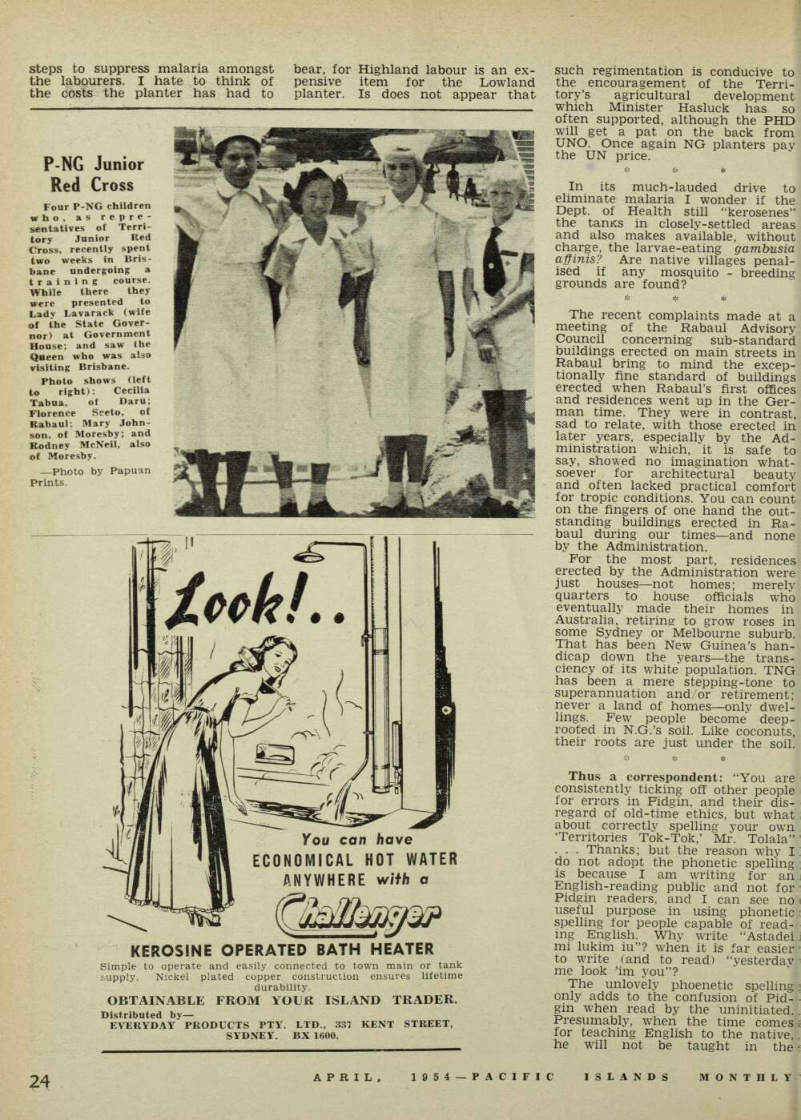
P-NG Junior
Red Cross
Four P-NG children who, as repre sentatives of Terri tory Junior Red Cross, recently spent two weeks in Bris bane undergoing a training course.
While there they were presented to Lady Lavarack (wife of the State Gover nor) at Government House; and saw the Qaeen who was also visiting Brisbane.
Photo shows (left to right): Cecilia Tabua, of Daru; Florence Seeto, of Rabaul; Mary John son, of Moresby; and Rodney McNeil, also of Moresby.
Photo by Papuan Prints.
phonetic spelling, and this means he must start from scratch again.
So far as I remember the phon etic spelling was only officially in troduced in the middle thirties, following the conference on native education held in Rabaul, when Pidgin received the imprimatur of tne Administration. * * * I can see a few eyebrows lifted by B 4 residents when perusing the list of the P-NG delegates to meet Her Majesty at Cairns. At least one or two delegates were anything but persona grata with the Powers That Be shortly before the last war and, in fact, caused quite a few headaches with their advanced ideas and defiance of current rule.
But their recognition as potential native leaders may pay a dividend.
We’ll hope so, at any rate. * * ♦ Sorry to hear that Harold Koch’s plantation on the South Coast of Slew Britain (PIM, March, p. 120) s infested with Promecotheca, a lest which has done a lot of damage ;o coconuts down that end of the sland, both on the Talasea and jasmata sides. Lindenhaven had i bad spell back in 1938 and the Dept, of Agriculture made a brave ittempt in that year to introduce a. parasite Pleurotropis parvulus, md good results were recorded.
Neglect during and after War 11. vas a heyday for coconut pests md diseases, as every planter mows.
H. W. Simmonds, from Fiji, was Drought over to have a look at jinga Linga estate down in Talasea n 1922-23, which was badly in ested. Some plantations had fair luccess in the war against Prome sotheca by encouraging the kura :um ant to attack the pest, bush ope being used to connect up the )alms, and fish used as bait, to ittract him into the palms. * * * A link with early drilling for oil n TNG snapped last month when V. D. Glanville died at Lae. He >ut down the first deep bore for iil at Matapau, in the Aitape dis rict, for the Mandated Develop ment Co. in 1924, using the old ashioned hit and miss type of )lant. After several unsuccessful ttempts there the drillers shifted ip the Sepik. A food cove was V. D. I should know. I was his •ff-sider for months —working the »ump, sharpening the bit and put ing down casing. * * No more “unfortunate incidents” •y UN delegates to P-NG is a iromise made by the Australian As ociation for UN, addressed to the Moresby committee of the local UN Lssociation branch, which com lained of rudeness and a lack of act on the part of the delegates’ eader. An effort, apparently, to npularise this organisation—and ecidedly an uphill job. (Over)
An interesting and a somewhat alarming change in plantation economics comes to light in a news Item in the S.P. Post (17/3/54) from Bougainville recording the arrival of 200 recruits from NG mainland for local plantations, costing about £5O a head, and tak ing the place of labour which in pre-war days was supplied locally.
Even with copra at its present high level, £5O a head makes a big item on the expense sheet.
In 1939, in that area, of the 2,897 indentured labour 2,783 were local natives, and 69 of the overseas workers came from the Sepik.
Now that some natives are grasp ing the fundamentals of economics <as, for instance, Raymon, who told the Duke at Cairns, he controlled co-operative societies turning over £200,000 a year) they might realise it would pay them to work locally and with the same vim as workers from other districts. No doubt the wage could be jacked up if em ployers could save the high costs of transport and equipment. But then, perhaps, the native economic sys tem envisages the elimination of native workers on plantations. * * * A crowd of NG natives, during the Queen’s visit in Sydney, sighted NG old identity, Jerry McDonald (to you, J. H. McDonald, DSO, MC, of 20th bn. in the First War and one-time DO in TNG) who has now retired. The lads gave him a
great welcome—and no wonder, for Jerry was one of the best DO’s up there, both for natives and Euro peans. I think his success in his job was that he had had experience as a plantation man in the Expro Board before he transferred to the Administration and worked up. He knew how to take it, as well as how to deal it out.