British Preference May
p. 17 · Read in the full issue
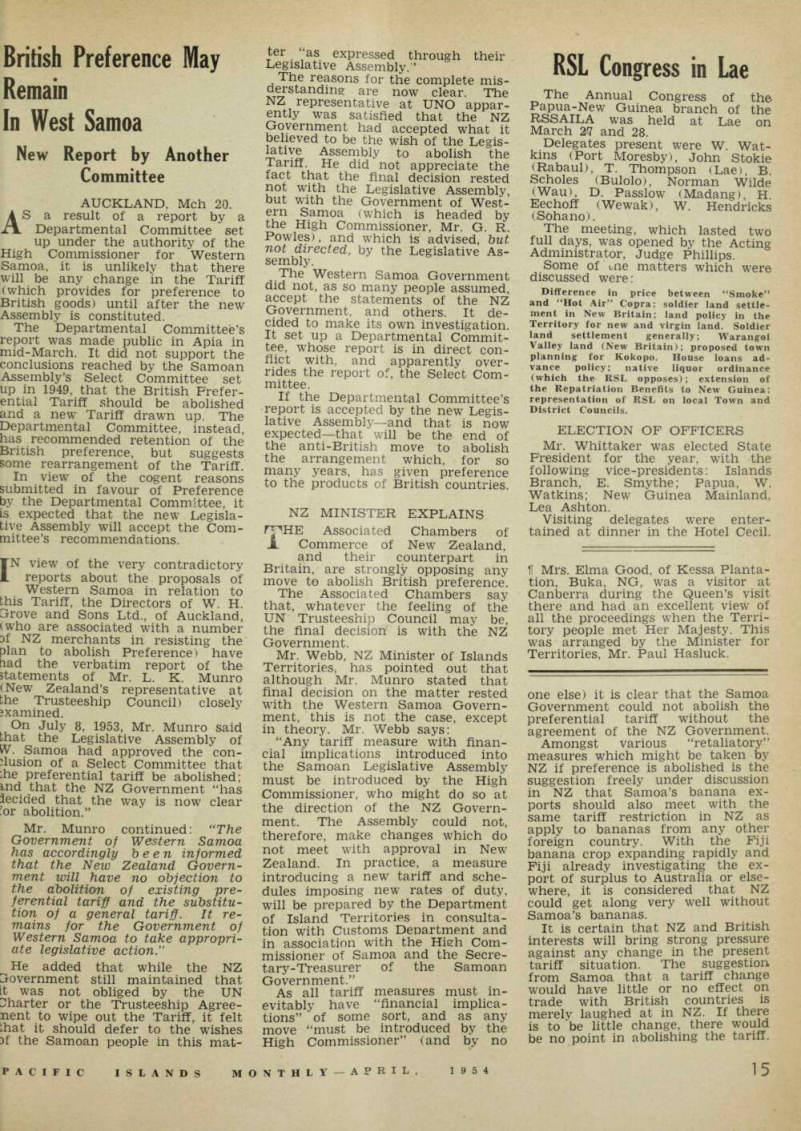
Remain In West Samoa New Report by Another Committee
Auckland, Mch 20.
AS a result of a report by a Departmental Committee set up under the authority of the High Commissioner for Western Samoa, it is unlikely that there will be any change in the Tariff (which provides for preference to British goods) until after the new Assembly is constituted.
The Departmental Committee’s report was made public in Apia in mid-March. It did not support the conclusions reached by the Samoan Assembly’s Select Committee set up in 1949, that the British Prefer ential Tariff should be abolished and a new Tariff drawn up. The Departmental Committee, instead, has recommended retention of the British preference, but suggests some rearrangement of the Tariff.
In view of the cogent reasons submitted in favour of Preference by the Departmental Committee, it is expected that the new Legisla tive Assembly will accept the Com mittee’s recommendations.
IN view of the very contradictory reports about the proposals of Western Samoa in relation to this Tariff, the Directors of W. H.
Drove and Sons Ltd., of Auckland, (who are associated with a number 3f NZ merchants in resisting the plan to abolish Preference) have bad the verbatim report of the statements of Mr. L. K. Munro (New Zealand’s representative at
the Trusteeship Council) closely
examined.
On July 8, 1953, Mr. Munro said that the Legislative Assembly of W. Samoa had approved the con clusion of a Select Committee that ;he preferential tariff be abolished; md that the NZ Government “has lecided that the way is now clear :or abolition.”
Mr. Munro continued: " The Government of Western Samoa has accordingly been informed that the New Zealand Govern ment will have no objection to the abolition of existing pre ferential tariff and the substitu tion of a general tariff. It re mains for the Government of Western Samoa to take appropri ate legislative action.”
He added that while the NZ Government still maintained that it was not obliged by the UN Charter or the Trusteeship Agree nent to wipe out the Tariff, it felt ihat it should defer to the wishes 3f the Samoan people in this mat
ter “as expressed through their
Legislative Assembly/’
The reasons for the complete mis derstandme are now clear. The NZ representative at UNO appar ently was satisfied that the NZ Government had accepted what it believed to be the wish of the Legis late Assembly to abolish the Tariff. He did not appreciate the fact that the final decision rested not with the Legislative Assembly, but with the Government of West ern Samoa (which is headed by the High Commissioner, Mr. G. R.
Powles), and which is advised, but not directed, by the Legislative As sembly.
The Western Samoa Government did not, as so many people assumed, accept the statements of the NZ Government, and others. It de cided to make its own investigation.
It set up a Departmental Commit tee, whose report is in direct con flict with, and apparently over rides the report of, the Select Com mittee.
If the Departmental Committee’s report is accepted by the new Legis lative Assembly—and that is now expected—that will be the end of the anti-British move to abolish the arrangement which, for so many years, has given preference to the products of British countries.
Nz Minister Explains
rpHE Associated Chambers of Jl Commerce of New Zealand, and their counterpart in Britain, are strongly opposing any move to abolish British preference.
The Associated Chambers say that, whatever the feeling of the UN Trusteeship Council may be, the final decision is with the NZ Government.
Mr. Webb, NZ Minister of Islands Territories, has pointed out that although Mr. Munro stated that final decision on the matter rested with the Western Samoa Govern ment, this is not the case, except in theory. Mr. Webb says: “Any tariff measure with finan cial implications introduced into the Samoan Legislative Assembly must be introduced by the High Commissioner, who might do so at the direction of the NZ Govern ment. The Assembly could not, therefore, make changes which do not meet with approval in New Zealand. In practice, a measure introducing a new tariff and sche dules imposing new rates of duty, will be prepared by the Department of Island Territories in consulta tion with Customs Department and in association with the High Com missioner of Samoa and the Secre tary-Treasurer of the Samoan Government.”
As all tariff measures must in evitably have “financial implica tions” of some sort, and as any move “must be introduced by the High Commissioner” (and by no
one else) it is clear that the Samoa Government could not abolish the preferential tariff without the agreement of the NZ Government.
Amongst various “retaliatory” measures which might be taken by NZ if preference is abolished is the suggestion freely under discussion in NZ that Samoa’s banana ex ports should also meet with the same tariff restriction in NZ as apply to bananas from any other foreign country. With the Fiji banana crop expanding rapidly and Fiji already investigating the ex port of surplus to Australia or else where, it is considered that NZ could get along very well without Samoa’s bananas.
It is certain that NZ and British interests will bring strong pressure against any change in the present tariff situation. The suggestion from Samoa that a tariff change would have little or no effect on trade with British countries is merely laughed at in NZ. If there is to be little change, there would be no point in abolishing the tariff.