Jumper”
pp. 143-144 · Read in the full issue
e Sailed in the “Hurricane Jumper”
[THEN Mr. J. D. Whitcombe, of f Auckland, loaned PIM some old photos associated with the Apia irricane disaster of March 18, 1889, told us of an Auckland resident 10m he believed to be the sole rviving crew member of HMS dliope, only vessel to escape from e harbour. Our Auckland repre itative went to see Mr. Richard ffers, the gentleman referred to; t we later learned that there was 11 living in London, at the, end 1953, another survivor, Rear- Imiral Cecil Fox, CB (retired), 10 was a midshipman on Calliope the time of the hurricane.
Vlr. Jeffers, now aged 82, recalls hurricane very clearly. In his inion, Calliope’s escape must be ;ributed not to the quality of the I coal in the bunkers, but to the e seamanship of her command : officer, Captain Coey Kane, RN. tfr. Jeffers, trained as a signaller, ned Calliope in 1889, in England; d Calliope went immediately erwards to Australian ports, and to Apia. a signaller, Mr. Jeffers was are that the other warships in ia harbour had ample warning
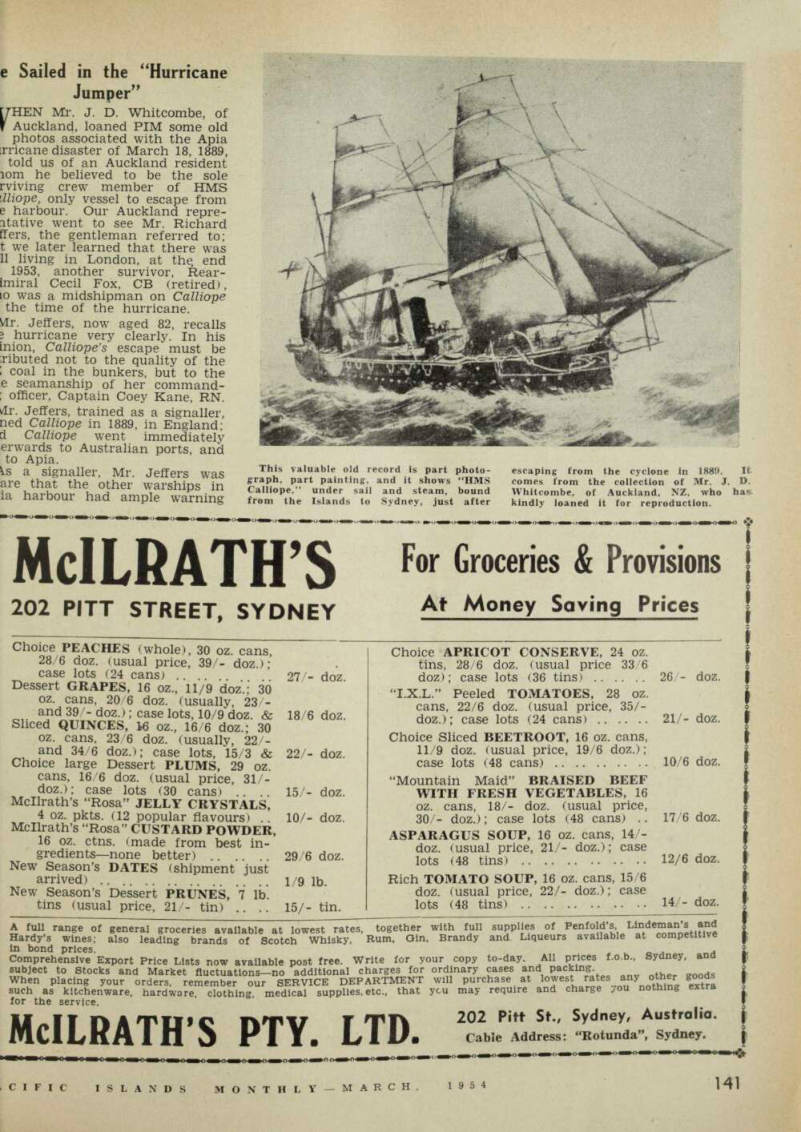
This valuable old record is part photo graph, part painting, and it shows “HMS Calliope,” under sail and steam, bound from the Islands to Sydney, just after
escaping from the cyclone in 1889, It comes from the collection of Mr. J. D.
Whitcombe, of Auckland, NZ, who has kindly loaned it for reproduction.
of the approaching hurricane. That they did not immediately get out of Apia was probably due to political reasons. Captain Kane, a good sea man, had due regard for the safety of his ship and company, and was ready to leave when conditions be came dangerous. The other six vessels were not ready.
Signalman Jeffers recalls that, when they got clear of the har bour, tears were streaming down Captain Kane’s face as he saw
what was happening to the other vessels.
Calliope was a composite barque— a wooden ship built on iron frames.
She was powered by a small hori zontal steam-engine driving a two bladed propeller, and depended largely upon her sails for motive power, setting fore and main royals, topsails, lower studding-sails and a spanker. She was one of six similar craft.
Following her spectacular escape from Apia, Calliope was ever after referred to in the Navy as the Hurri cane Jumper. She was broken up in 1951. She served for many years prior to that as a training ship moored at Jarrow-on-Tyne, Eng land. One of her company who was in the Apia hurricane was Midship man Hood, who, as an Admiral, went down with HMS Invincible in the Battle of Jutland, in World War I.
The Rev. Father E. M. de Klerk, a Dutch priest of the Catholic Mission in the BSIP, returned to his mission recently after 12 months holiday in Holland and America.
For his outstanding services to American servicemen in Guadal canal in the Pacific war, he was awarded the American Medal of Freedom and the Bronze Cross by the Netherlands Government. Dur ing his recent visit to America, Fa ther de Klerk met many of the men he had assisted during the war.
Queens to Meet Again?
ACCORDING to the London Dai: Mail of February 14, Quee Salote of Tonga may soon ps another visit to London —possib in the middle of this year—and, so, would stay at Buckingha; Palace at the invitation of Quee Elizabeth.
Agents for Tonga in New Zealar said that they knew nothing aboi it.
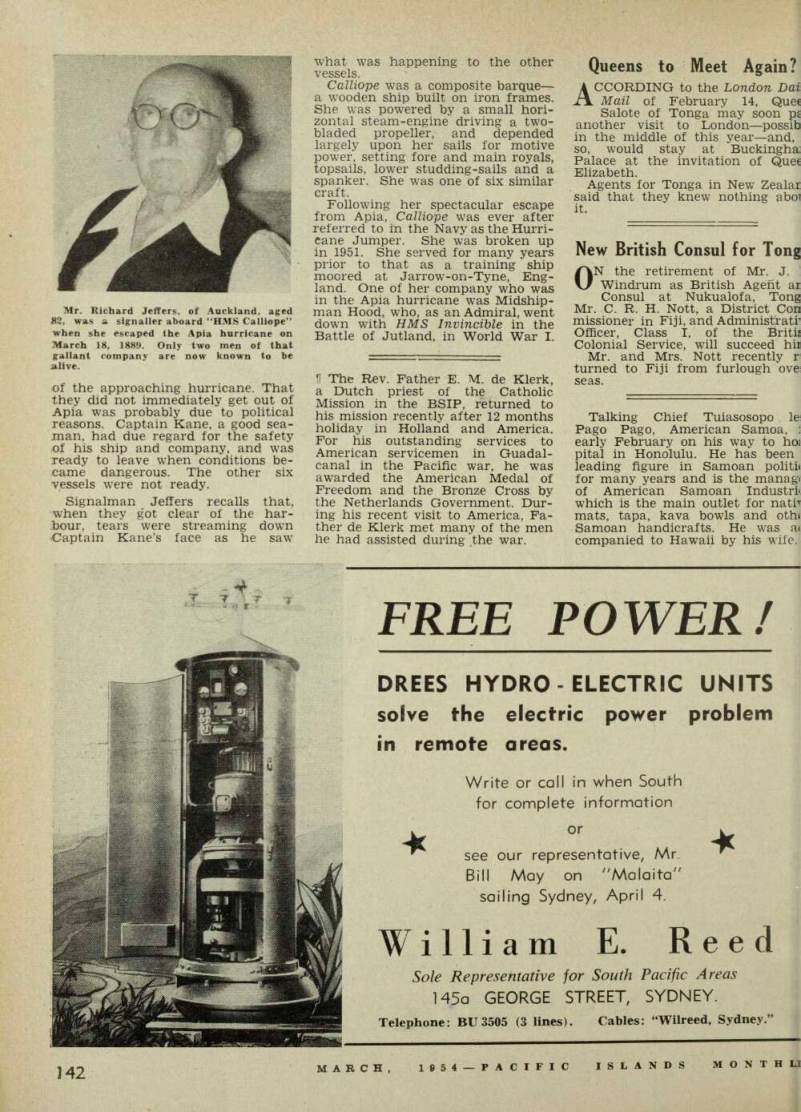
Mr. Richard Jeffers, of Auckland, aged 82, was a signaller aboard “HMS Calliope” when she escaped the Apia hurricane on March 18, 1889. Only two men of that gallant company are now known to be alive.