P G oTL men^hiH?Sv n 3 r S
p. 93 · Read in the full issue
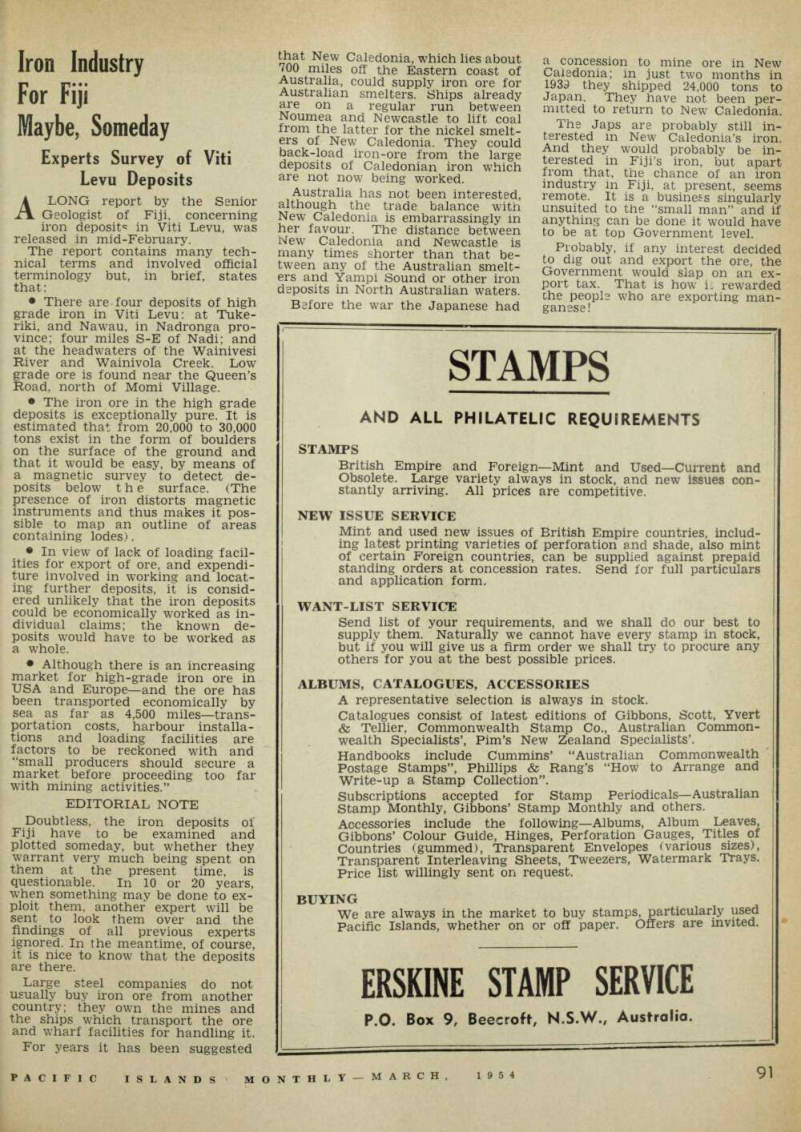
Iron Industry For Fiji Maybe, Someday Experts Survey of Viti Levu Deposits
ALONG report by the Senior Geologist of Fiji, concerning iron deposit* in Viti Levu, was released in mid-February.
The report contains many tech nical terms and involved official terminology but, in brief, states that; • There are four deposits of high grade iron in Viti Levu: at Tuke riki, and Nawau, in Nadronga pro vince; four miles S-E of Nadi; and at the headwaters of the Wainivesi River and Wainivola Creek. Low grade ore is found near the Queen’s Road, north of Momi Village. • The iron ore in the high grade deposits is exceptionally pure. It is estimated that from 20,000 to 30,000 tons exist in the form of boulders on the surface of the ground and that it would be easy, by means of a magnetic survey to detect de posits below the surface. (The presence of iron distorts magnetic instruments and thus makes it pos sible to map an outline of areas containing lodes). • In view of lack of loading facil ities for export of ore, and expendi ture involved in working and locat ing further deposits, it is consid ered unlikely that the iron deposits could be economically worked as in dividual claims; the known de posits would have to be worked as a whole. • Although there is an increasing market for high-grade iron ore in USA and Europe—and the ore has been transported economically by sea as far as 4,500 miles —transportation costs, harbour installa tions and loading facilities are factors to be reckoned with and “small producers should secure a market before proceeding too far with mining activities.”
Editorial Note
Doubtless, the iron deposits of Fiji have to be examined and plotted someday, but whether they warrant very much being spent on them at the present time, is questionable. In 10 or 20 years, when something may be done to ex ploit them, another expert will be sent to look them over and the findings of all previous experts ignored. In the meantime, of course, it is nice to know that the deposits are there.
Large steel companies do not usually buy iron ore from another country; they own the mines and the ships which transport the ore and wharf facilities for handling it.
For years it has been suggested
(Caledonia, which iies about aSiSh? 2® ,9“ Ea ftern coast of Australia, could supply iron ore for Australian smelters. Ships already ° n a regular run between from the latte^or“MrihLSS Eg deposits of Caledonian iron which anot now hpinp' wnrkpH . worked.
Austraha has not been interested, although the trade balance with New Caledonia is embarrassingly in her favour The distance between many C t&Sar£ d thTnThl’tV depcsila in North Australian waters.
Before the war the Japanese had
a concession to mine ore in New Caledonia; in just two months in 1939 they shipped 24 000 tons to Japan. They have not been per muted to return to New Caledonia.
teSted‘ff New »
“ f «« probab| be i°n-‘
from^thaf 11 n f Ut a P art iiom tiißt, tine chance of an iron industry in Fiji, at present, seems remote. It is a business singularly unsuited to the “small man” and if anything can be done it would have to be at top Government level. d “ id * d P G oTL men^hiH?Sv n 3 r S
fhe people Iho a?e exporting man
ganese!