Tropicalities
pp. 79-80 · Read in the full issue
Magazine Section
Gobbledegook
FIJI manganese miners, following the issue of an Order-in-Coun cil dated February 9, know that the Fiji Government will, in future, collect a royalty on all manganese exported.
But do they know how much? The Order-in-Council says: “(i) Where the yield expressed as a percentage of the annual sale value does not exceed 20 per centum, royalty shall be at the rate of 3/40 of 1 per centum of the annual sale value for each 1 per centum of yield expressed as such percent age. (ii) Where the yield expressed as a percentage of the annual sale value exceeds 20 per centum, royalty shall be at the rate of seven and one-half per centum of the yield, together with an additional 1/8 of 1 per centum of the yield for each 1 per centum by which the yield expressed as such percentage ex ceeds 20 per centum.
“ ‘Yield’ means the difference be tween annual expenditure and annual sale value. Annual ex penditure is defined in the Order.”
Fiji Offends Again
GRANNY, of the Sydney Morning Herald’s Eighth Column, runs a single-handed war against coined words, bad English and officialese.
He (we presume that Granny makes history by being the only masculine granny in the world) re cently took exception to an adver tisement for a health inspector for Fiji.
Snapped Granny; His duties, states the advertise ment, include “deratisationand “ disinsectisation” of aircraft and
shipping.
f suppose they talk that way to impress the natives.
Hard Living
A MAN dropped into PlM’s Auck land office the other day, burst ing with information about the Pago Pago fishing industry.
“Yes, we passed the Jap fishing boats at work the other day,” he said. “Funny thing, there were flocks of seagulls round them, fly ing on one wing.”
“What! Been injured, or some thing?”
“Oh, no. Just carrying their lunch under the other wing. Jap fishing-boats, you know!”
A Neon-Lighted Valley Of
Amazons
THAT story which we reported in December PIM (about the valley of Amazons in some unspecified place in New Guinea, where the men are kept in caves and only allowed out for purposes of repro duction) is still going the rounds.
An American reader, serving in
Korea, sends us a clipping from a Chicago negro paper called Jet which repeats the story—with some embellishments.
Our American friend also served in New Guinea, and asks somewhat urgently if there can be any truth in the story; he evidently feels that he missed out somewhere during his stay in the Territory.
According to Jet the story was first told at a London conference on street lighting, by a delegate called C. S. Downey. The Amazonian valley is put somewhere near Mt, Wilhelmina, in Dutch NG, and it is said that the women light their village with “weird neon-like moons ... a system of perfected artificial illumination equal, if not superior, to the gaseous tubes of the civilised 20th century.” The moons are de scribed as stone balls about 12 feet
in diameter and mounted on high columns.
We have never heard of Mi’.
Downey; and neither has anyone else .whom we have asked. But he deserves top marks for ingenuity and —as the politicians would say— “without fear of contradiction” in troduced, at what was probably a very dull conference, something best calculated to arouse the interest of street-lighting experts—and others.
Mr. Downey’s trouble was that his story was too tasty a morsel to be reserved exclusively for electrical engineers. It has been served up in every newspaper from Chicago to Port Moresby, and beyond. Our original story came via South Africa.
And An Island Of Beautiful
Virgins
DURING his recent Queen-seeing visit, we told the story to Mr.
Paul Mason, of Bougainville, who was suitably amused. His be lief is that many of these fantastic furphys emanate from the natives themselves who frequently indulge in wishful-thinking about erotic de lights that are supposed to exist beyond the reef or over the moun tains.
He said that one group of Solo mons natives had told him of an island of beautiful virgins which they had never seen but knew all about.
Only slightly less fantastic —and this time true —was one of Mr.
Mason’s own experiences when on the run on a Coastwatching job be hind the Jap lines in Bougainville during the war. In the high moun tains they came upon natives who lived entirely without water. The large party which was with Mi’.
Mason had perforce to do the same, and managed for some weeks with out too much discomfort —so long as they kept to native foods and ate no meat or salt.
Drinking water was obtained from a growing bamboo for a native who was suffering from malaria; but the rest of them got sufficient for their requirements from native foods and from endless chewing of sugar-cane.
Sent Back Home
FROM Sydney Daily Telegraph: “We hear that the Burns Philp ship Mangola loaded in Lae a couple of weeks ago—2,ooo dozen bottles of Australian beer which the locals wouldn’t buy, apparently pre ferring the Moresby-made South Pacific draught beer.
“By an extraordinary coincidence, mainland breweries sent greatly in creased supplies of bottled beer to New Guinea about the same time as the South Pacific brewery opened in Port Moresby.”
Actually, Mrs. Flo Stewart shipped 2,200 dozen beer to her Sydney agents. We understand the ship ment comprises West Australian and Victorian brands, which the Morobe
folk simply refuse to drink when they can get the Moresby brew.
Noumea Beer In New
Channels
ON the subject of Pacific Islands beers, it is interesting to learn that the bottled product of the Noumea brewery, to which reference was made in PIM not long ago, has now virtually disappeared from the European market in New Caledonia.
The lawmakers of New Caledonia, in pursuance of their policy of liberty, equality and fraternity, de cided to legalise beer-drinking by persons of native status; and, with in a month, supplies of the Noumea beer, which sells at a price decidedly less than the imported article, had been diverted to native markets.
Noumea Europeans report sourly that, as only imported brands are available to them, they now must either drink less or pay more.
Dogura’S New Bible Cost
£l2O/15/- WHEN the well-known merchant of Samarai and Lae, Mr. R. F. (Bob) Bunting, returned from England to P-NG at the end of January, he brought with him as a gift for the Anglican Mission, Dogura, Papua, a Coronation Bible which cost him 115 guineas—Sterl ing guineas, we imagine.
Only a very few of these Bibles were printed and 11 of them were for sale, the rest going into museums.
The Bibles were hand printed and hand sewn and one of them was used by Queen Elizabeth at her Coronation.
Mr. Bunting has presented the Bible to the Dogura Cathedral in memory of the late Rev. Dennis Taylor, who lost his life at Higatura during the Mt. Lamington eruption in 1951.—H.
Us Travel Agents Learn
About Hurricanes
SURELY the most amusing aspect of the January near-hurricane in Fiji must have been the un happily timed efforts of Mr. Bob Hewlett, head of Fiji Visitors’
Bureau, Mr. Harvey Hunt, of Hunt’s Travel Agency, and Mr. Paul Harrick?, Pan American’s District Traffic Manager, in attempting to display the travel virtues of Fiji to a party of United States and Can adian travel agents at the. height of the blow.
The main blast happily missed Viti Levu, but there was still a great deal of wind and rain, and the travel agents arrived just prior to the start of it all. But look-around plans went ahead, regardless.
Just why Fiji should be spending large sums of money bringing groups of travel agents to Fiji—even in good weather —when the Colony is incapable of housing even the routine travellers and business people from overseas, has never been clearly explained.
There is one school of thought which considers that encouraging
American tourists to Fiji, at this stage, is likely to damage the trade in the long run. This is especially true in regard to Suva, where there is certainly no sign of any tourist accommodation becoming available in the forseeable future.
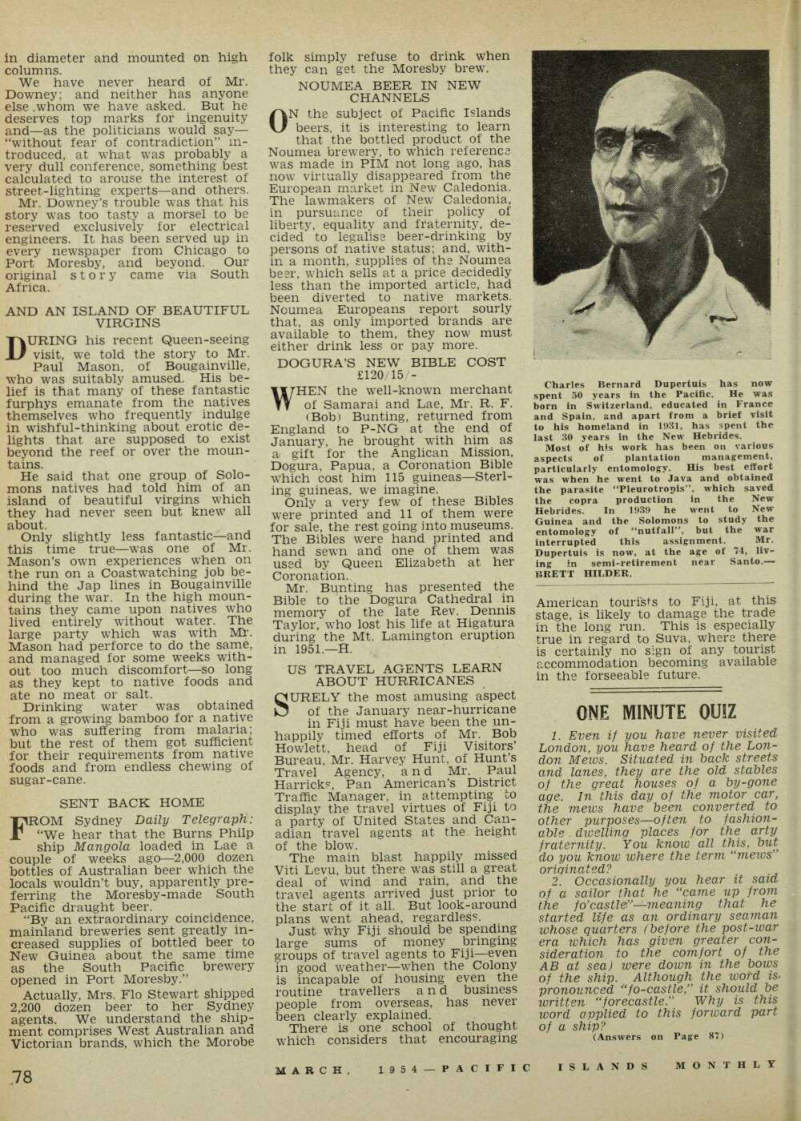
Charles Bernard Dupertuis has now spent 50 years in the Pacific. He was born in Switzerland, educated in France and Spain, and apart from a brief visit to his homeland in 1931, has spent the last 30 years in the New Hebrides.
Most of his work has been on various aspects of plantation management, particularly entomology. His best effort was when he went to Java and obtained the parasite “Pleurotropis”, which saved the copra production in the New Hebrides. In 1939 he went to New Guinea and the Solomons to study the entomology of “nutfall”, but the war interrupted this assignment. Mr.
Dupertuis is now, at the age of 74, liv ing in semi-retirement near Santo.—