Pago Pago Has An Embarrassment
pp. 69-71 · Read in the full issue


Embarrassment of Fish
Cannery Now in Full
Operation
THE six Japanese long-line fish ing vessels which are employed by Tokio Marine Products Cor poration, and are fishing on a poundage basis for Van Camp Sea
Food Inc. off Pago Pago, American Samoa, are proving beyond a shadow of a doubt that there are plenty of tuna in the South Pacific and that the Japanese know how to catch them.
The fish cannery at Pago is now in action and canning 48,000 tins of tuna a day—wlrch is the capacity of the plant at present.
The former Byrd Antarctic ex ploration ship, the 1,642-tons NorJi Star, has been converted to a freezer ship and now lies off the cannery storing 900 tons of fish at a time, and producing 20 tons of ice per day for the fishing boats.
Van Camp are reported to be paying the Japanese 162 dollars per ton for tuna and slightly higher for albacore, the only fish being canned.
The rest is being sold locally through the local Government, and Western Samoa is being offered as much as it likes of cleaned fish at
14 cents a pound ex Apia wharf.
It is believed that the Japs are anxious to supply Fiji if Matua or Tofua will lift it as freezer cargo.
No doubt the Japs would be happy to provide other fishing craft to give Fiji—or any other Pacific territory —fresh fish at a low price.
Although the islanders’ diet is traditionally fish and coconuts, there is no fishing industry worth the name in any of the Pacific islands. Fish is scarcer and dearer there than in any of the cold countries. A great deal of money has been spent by individual Pacific governments and by the South Pacific Commission on fishery sur veys, but none of them have so far produced any fish. The smart thing would be to employ the Japanese to provide the Islanders with this cheap food. They have both the know-how and the ships.
Governments are not given to
doing smart things, however. They believe that it is better to have Pacific Islanders managing their non-existent fishing industries than it is to employ foreigners to actu ally produce the goods.
Teaching The Samoans
It has been suggested that it is not the plan of the American Samoan Government to allow the Japanese permanently to fish off that Territory to supply the local cannery. It is believed that the Japanese are to fish there just until the Samoans learn how it is done.
The Japanese are not given to teaching anybody anything; and the Polynesians are not given to putting into fishing, or anything else, the sustained effort that is producing the sort of results the Japs are get ting around Samoan waters. If the Americans have any of their good Yankee common sense left they will not attempt to exchange high theory
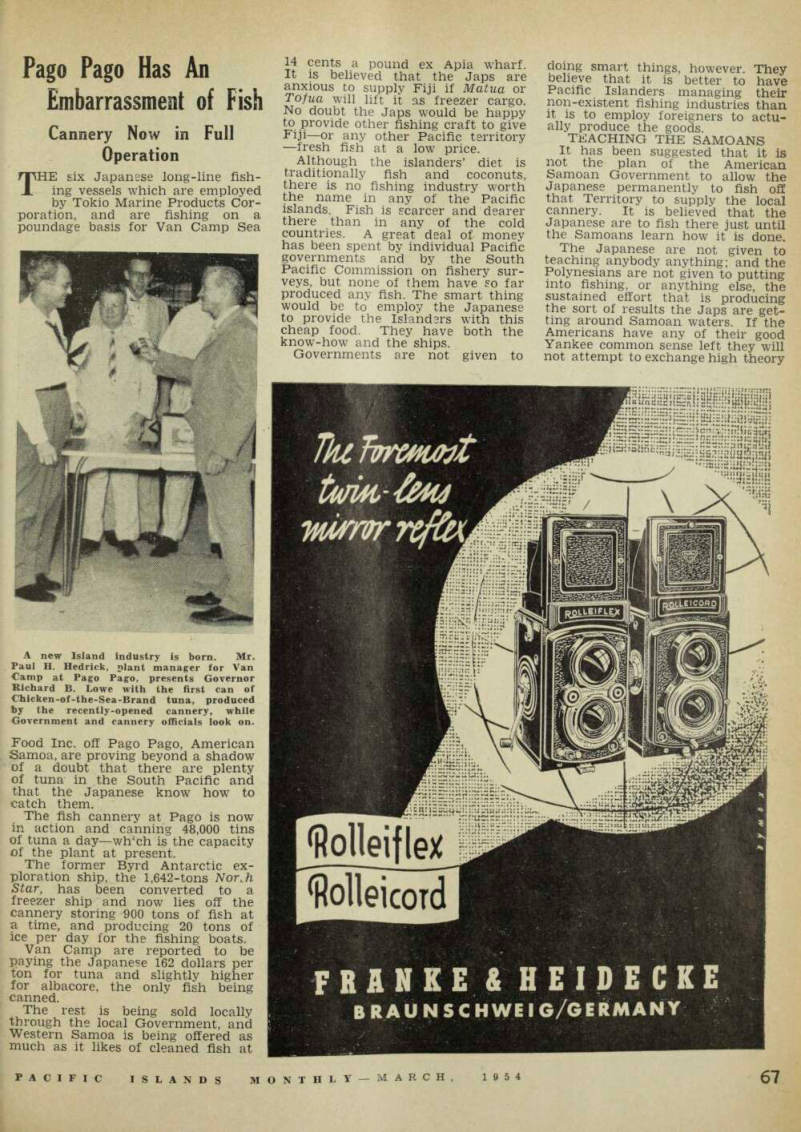
A new Island industry is born. Mr.
Paul H. Hedrick, plant manager for Van Camp at Pago Pago, presents Governor Richard B. Lowe with the first can of Chicken-of-the-Sea-Brand tuna, produced by the recently-opened cannery, while Government and cannery officials look on.
for the actual fish that are keep ing their cannery going at the pre sent time.
The charter of the present fleet of Jap fishing, vessels expires in April. Presumably they will be re placed by others from Japan.
Pago Pago Tuna Cannery
In Operation
The Van Camp Sea Food Com pany formally opened up its plant on February 11 in a ceremony wherein Governor Richard Barrett Lowe received the first can of tuna prepared by the Company, and also the first case, containing 48 more tins. The fish was presented to the Governor by plant manager, Mr.
Paul Hedrick.
The plant actually went into pro duction on February 8. First day’s output amounted to 90 cases, but a daily output of ten tons oT 48,000 tins will shortly become routine.
Cannery men are said to be pleased with the quality of the canned tuna, which equals or betters that being canned in California. It was feared that the larger tuna be ing caught off Samoa might not be ef high quality. This fear has proved groundless.
The firm will shortly make canned tuna available for local sale through Pago Pago merchants, but the bulk of the output will probably be shipped at intervals to the States aboard President Line vessels re
turning from Manila. These ship ping arrangements have still to be made.
By mid-February the industry was employing 56 male and 52 female local Samoan employees.
Fiji Fish—But Buyer-
Resistance!
WHILE the Japanese pull enorm ous quantities of tuna and other fish from the sea off Samoa, in Fiji, Mr. Harold Gatty’s small and worthy fishing venture, relaunched six months ago with the small launch Marau is meeting more than its share of troubles.
No great quantity of fish has so far been produced, and several hundredweights recently offered in the Suva market met with unusual buyer-resistance.
It seems that in Fiji a cleaned and gutted fish is looked on as a fish that is not fresh—although the
very reason that these were gutted was to make sure that they would still be quite fresh on delivery at the market. Without gutting they cannot be brought from any great distance.
It is understood that a small cannery is now being considered— and to blazes with the fresh fish trade!
There was an exodus of sports men from Fiji in January includ ing 15 representatives of a cricket team to play a series of matches in New Zealand; five Fijian athletes for engagements in the South Island and nine yachtsmen who represented Fiji in the 18footer world yachting champion ships which were this year held in Auckland. In addition to the sports men, there were 23 Fijian firewalk ers and two Indian dancers for the Auckland birthday carnival.