Other Ways
pp. 64-65 · Read in the full issue
Other Days and Other Ways Of Making Money
IN view of Tonga’s investigation into Vanilla planting (see else where this issue), it is interest ing to read a report on trade in the Islands made by Mr. C. D.
Whitcombe, of Auckland, in August, 1885. The report followed a survey voyage by Janet Nicoll, as a result of which a regular shipping service from New Zealand to Polynesia was established.
The report shows that in 1883 Tonga exported 40 tons of Arabian coffee, and, believe it or not, 120 bales of wool. Both those com modities would be valuable to the Kingdom to-day. The coffee came mainly from a plantation on Tonga tabu owned by the Deutschen Handels und Plantagen Gesellschaft; and the wool from 15,000 sheep established on Eua, just south of Tongatabu, by the Parker brothers.
But even in 1885 the sheep flock was declining, due to a serious in festation of scab, for which, at that time, there seemed to be no known cure.
Across in the Cooks the value of exports for 1884 exceeded the value of imports (£24,000) by £4,000, and the Territory was self-supporting.
Mr. Henry Nicholas exported 1,500 bales of cotton (450 lbs per bale) in
1885 from Rarotonga, as well as large quantities of good-quality coffee and arrowroot. There was no legal currency and the Chilian dollar was much in vogue until Chief Te Pou, journeying to Auck land. discovered that the Cook Islands traders were on a good thing in currency-trafficking at various rates of exchange.
It is interesting to note that in
regard to Apia, Mr. Whitcombe re ported: “There is a large consump tion of lager beer, as many as 4,000' cases being consumed annually in.
Apia alone. The wholesale price is. £2/8/- per case of 4 dozen reputed quarts, and it Is retailed at 2/- per bottle.” Presumably without a per mit!
Elsewhere the report says: “New (Continued Col. 2, page 63.)
(Continued from Page 62.) Zealand meats, here as elsewhere, will speedily drive others out of the market, but beef alone is saleable to the natives; if mutton reaches the traders’ hands the sheep pic tured on the tin is rubbed off and the contents sold as beef.”
The Fiji Forestry Department last year planted 90 acres of mahogany and kaucula trees in the Colo-i- Suva area and surveyed and enum erated the timber resources of 50,000 acres of Viti Levu island. This year a further 200 acres will be planted up in the Colo-i-Suva area. The kauvula timber will eventually be used for fruit cases.
A Commerce & Industries Office has been established in Suva, Fiji, as a branch of the Secretariat fol lowing the recommendations of the Economic Review Committee last year. The Office will act as a liaison between Commerce and the Government and should be of value to overseas business firms seeking information about the colony. The Office has also taken over existing import control and allocation of foreign currency, will include local price control in its functions and gather statistics which later will be published in a periodical bulletin.
A Fijian Grammar, compiled by Mr. G. H. Milner for the Fiji Gov ernment, will soon be printed in Suva.
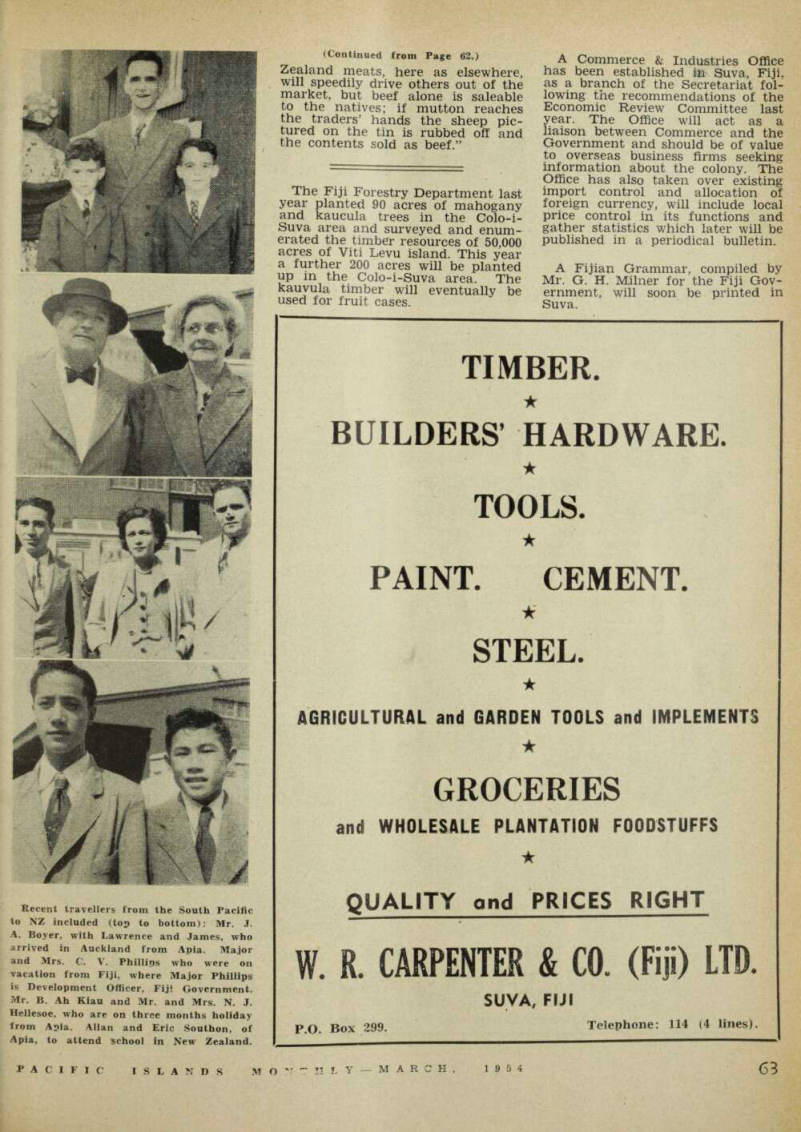
Recent travellers from the South Pacific to NZ included (top to bottom): Mr. J.
A. Boyer, with Lawrence and James, who arrived in Auckland from Apia. Major and Mrs. C. V. Phillips who were on vacation from Fiji, where Major Phillips is Development Officer, Fiji Government.
Mr. B. Ah Kiau and Mr. and Mrs. N. J.
Hellesoe, who are on three months holiday from Apia. Allan and Eric Southon, of Apia, to attend school In New Zealand.