Britain And
pp. 25-27 · Read in the full issue

New Hebrides
3 Alternatives; and Why a Change is Needed
From a Special Correspondent
Noumea, Feb. 27.
IT was to be expected that high officialdom would deny all the reports that Britain contem plates the abandonment of .her share in the New Hebrides, owing to the economic hopelessness of the British outlook in the Condominium, and the cost of maintaining her ad ministration there.
Probably, no decisions have yet been reached; probably, no recom mendation yet has been made to the British Colonial Office; but I can tell you, quite definitely, that the new High Commissioner for the Western Pacific, Sir Robert Stanley, has had the whole matter under review, and that he will not allow the set-up to drift along purpose lessly as it has done for 30 or 40 years. I understand that the fol lowing are the three alternatives which are being considered by the British, and these alternatives are bound up, in some degree, with the Anglo-French conference to take place in Honiara within a few days: • Britain shall give up her share of the New Hebrides Condominium, in return for some territorial con cession elsewhere. • Britain’s share in the New Hebrides shall be taken over by Australia. (This is regarded by the British as a logical development, but the Australian Government has re fused to show any interest in the proposal.) • The Condominium Government
at Por t Vila shall be streamlined, and made to function more effici ently. There still would be two Re sident Commissioners: but, instead of each nation having separate de partments dealing with the same thing, there would be a joint staff, half of the officials British and half French.
The last alternative, I believe, is the one likely to receive close dis cussion in the Honiara conference.
At present, each national office in Honiara has its own Public Works official, as well as there being a Condominium Public Works De partment—a costly set-up.
There also is acute dissatisfac tion with the Joint Court. When the two judges (one British and one French) cannot agree, there is no decision. The Condominium agree-' ment provides that there shall be a chief judge or President (neither British nor French) who shall give a casting vote in such cases; but there has been no President for at least ten years.
There is need, also, for some sort of Supreme Court to which appeal can be made against the decisions of the Resident Commissioners.
The latter (subject only to tneir respective High Commissioners) have dictatorial powers, and re sidents in the new Hebrides cite some cases of glaring injustice, as a result of it. Notably, there have been pro-French decisions by the French RC, and pro-British verdicts by the British RC, based on funda mentally opposite ideas of colonial policy.
I learn here that, in addition to the two High Commissioners and two Resident Commissioners, the Honiara Conference also will be at tended by Mr. Peebles, a British Administration official from Port Vila, and Mr. Banner, an inspector of French Colonies, from France,
who happens to be here at present.
There is current here an interesting, but completely unofficial, report that the United States is taking a keen interest in possible future developments here in New Caledonia and in the New Hebrides.
Could be.
Dumb Comnlarpnrv of
P . .
note AL Australia !
IT truly is an astonishing thing that while Australia is prepared to spend millions upon idealistic conceptions like an Antarctic Expedition and the Colombo Plan, she
declines to show any interest what ever in the present condition and probable future of the New Hebrides and Solomons archipelagoes, which are her very near neighbours in the northeast.
Maybe, as the conspicuously unimaginative gentlemen who run the Australian Government from Canberra insist, Australia already has all the administrative and financial problems she wants in the Islands groups of New Guinea and the Bismarck Archipelago; and that it is hard, practical commonsense to leave the other groups to their present reluctant masters. But if it is wise to try to placate Asia with
a Colombo Plan, how much wiser is it to keep some sort of control over New Hebrides and Solomons!
It is not so long ago that Asians seized and occupied the Solomons, within easy flying distance of the Australian coastline.
Fifty years ago, Australia might have sat complacently at home, and ignored the implications of an enemy’s presence in New Hebrides and Solomons. To-day, with aviation and radio and guided missiles in their present stage of development, such complacency is sheer lunacy.
Our correspondent reports that United States may be interested in what is going on around the South west Pacific. That would not be surprising. The Americans are far more realistic and enterprising than the Australians.
Visit by a High Official
THE President of the French Overseas Territories Commis sion, Senator Henri Lafleur, has arrived in the South Pacific, on an official inspection of conditions in French Oceania, New Caledonia and the New Hebrides. He is giving particular attention to industries, health and education.
It may be merely a coincidence that Senator Lafleur has arrived in the South Pacific while the leading officials of the British and French High Commissions for the Western Pacific (responsible for Solomon Islands, New Caledonia, New Hebrides, Gilbert and Ellice, etc.) are meeting formally at Honiara, in the Solomons.
Senator Lafleur will return to Paris at the end of April.
Honours for M. Angamarre
P. MORESBY, March 1.
THE French High Commissioner in the Western Pacific, M, Raoul Angamarre, Governor of New Cale donia, en route from Noumea to Honiara for a conference, was accorded special honours when passing through Papua and New Guinea. The Deputy Administrator, Judge Phillips, met him at Jack sons Airfield, here; and there was a guard of honour for him at every airfield on his way through to Rabaul.
Poor Transport Service
Editorial No'e\ The bankruptcy of the Australian-controlled trans port system in the Northwest Pacific Territories of New Caledonia, New Hebrides and Solomons is illustrated in the case of the Governor of New Caledonia, and the Resident Com missioners in the New Hebrides, who were due to attend a conference in Honiara (in the Solomons, along side New Hebrides). To get there, these high officials flew south to Sydney; thence flew by another air service to Lae, in New Guinea; thence by another air service from
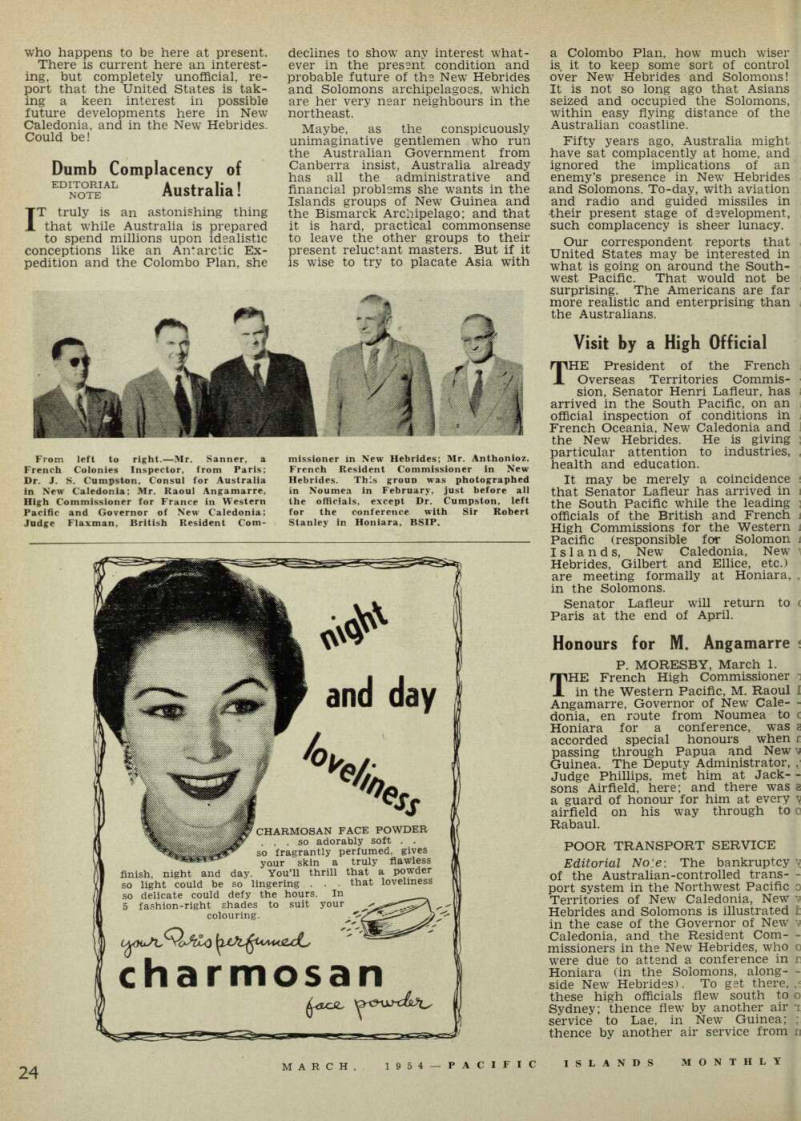
From left to right.—Mr. Sanner, a French Colonies Inspector, from Paris; Dr. J. S. Cumpston, Consul for Australia in New’ Caledonia; Mr. Raoul Angamarre, High Commissioner for France in Western Pacific and Governor of New Caledonia; Judge Flaxman, British Resident Com-
missioner in New Hebrides; Mr. Anthonioz, French Resident Commissioner in New Hebrides. This group was photographed in Noumea in February, just before all the officials, except Dr. Cumpston, left for the conference with Sir Robert Stanley in Honiara, BSIP.
Lae, via Rabaul, to the Solomons.
Flying time from Vila to Honiara, direct, is about 3 hours.