A Story
p. 151 · Read in the full issue
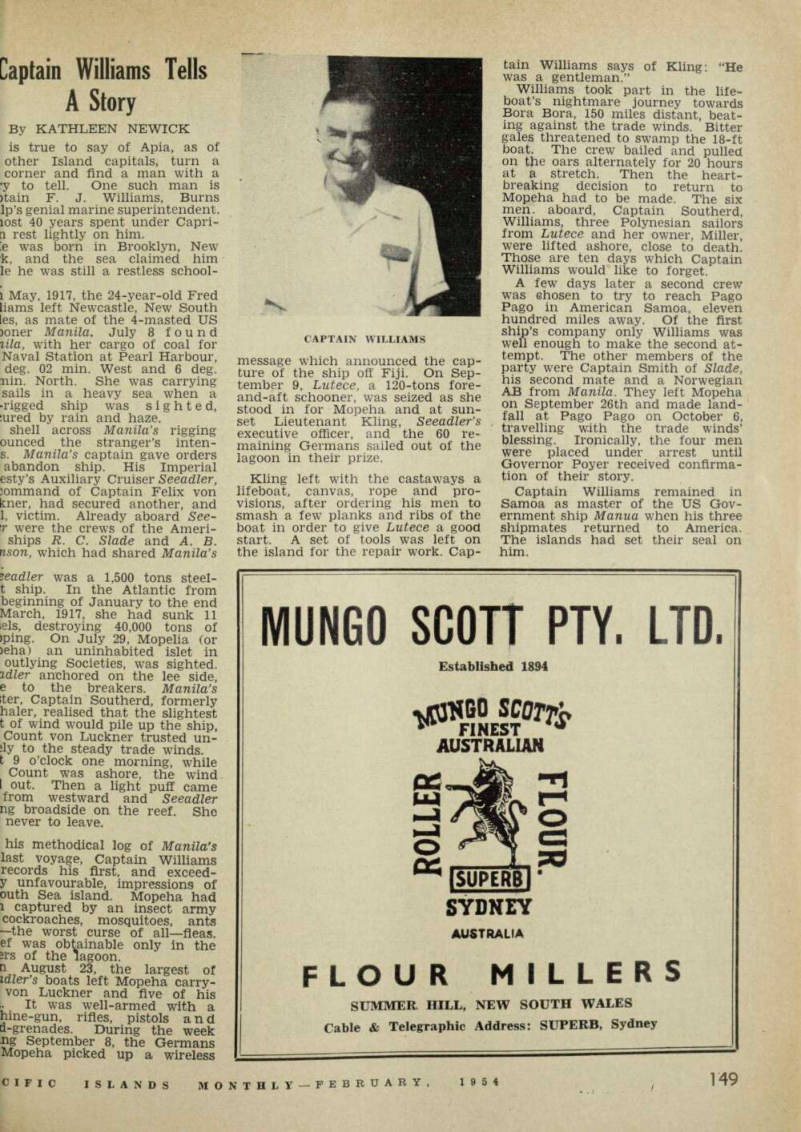
Captain Williams Tells A Story
By Kathleen Newick
is true to say of Apia, as of other Island capitals, turn a corner and find a man with a •y to tell. One such man is )tain F. J. Williams, Burns Ip’s genial marine superintendent, lost 40 years spent under Capri ti rest lightly on him.
'.e was born in Brooklyn, New k, and the sea claimed him le he was still a restless school i May, 1917, the 24-year-old Fred liams left Newcastle, New South les, as mate of the 4-masted US loner Manila. July 8 found lila, with her cargo of coal for Naval Station at Pearl Harbour, deg. 02 min. West and 6 deg. nin. North. She was carrying sails in a heavy sea when a ■rigged ship was sighted, jured by rain and haze. shell across Manila’s rigging ounced the stranger’s inten s. Manila’s captain gave orders abandon ship. His Imperial esty’s Auxiliary Cruiser Seeadler, command of Captain Felix von kner, had secured another, and l, victim. Already aboard See r were the crews of the Ameri ships R. C. Slade and A. B. nson, which had shared Manila’s readier was a 1,500 tons steel t ship. In the Atlantic from beginning of January to the end March, 1917, she had sunk 11 lels, destroying 40,000 tons of >ping. On July 29, Mopeha (or >eha) an uninhabited islet in outlying Societies, was sighted. idler anchored on the lee side, e to the breakers. Manila’s iter, Captain Southerd, formerly haler, realised that the slightest t of wind would pile up the ship, Count von Luckner trusted un *ly to the steady trade winds, t 9 o’clock one morning, while Count was ashore, the wind 1 out. Then a light puff came from westward and Seeadler ng broadside on the reef. She never to leave. his methodical log of Manila’s last voyage, Captain Williams records his first, and exceed y unfavourable, impressions of outh Sea island. Mopeha had i captured by an insect army cockroaches, mosquitoes, ants —the worst curse of all—fleas, ef was obtainable only in the ;rs of the lagoon, n August 23, the largest of idler’s boats left Mopeha carry von Luckner and five of his It was well-armed with a nine-gun, rifles, pistols and d-grenades. During the week ng September 8, the Germans Mopeha picked up a wireless
message which announced the cap ture of the ship off Fiji. On Sep tember 9, Lutece, a 120-tons fore and-aft schooner, was seized as she stood in for Mopeha and at sun set Lieutenant Kling, Seeadler’s executive officer, and the 60 re maining Germans sailed out of the lagoon in their prize.
Kling left with the castaways a lifeboat, canvas, rope and pro visions, after ordering his men to smash a few planks and ribs of the boat in order to give Lutece a good start. A set of tools was left on the island for the repair work. Cap
tain Williams says of Kling: “He was a gentleman.”
Williams took part in the life boat’s nightmare journey towards Bora Bora, 150 miles distant, beat ing against the trade winds. Bitter gales threatened to swamp the 18-ft boat. The crew bailed and pulled on the oars alternately for 20 hours at a stretch. Then the heart breaking decision to return to Mopeha had to be made. The six men. aboard, Captain Southerd, Williams, three Polynesian sailors from Lutece and her owner, Miller, were lifted ashore, close to death.
Those are ten days which Captain Williams would like to forget.
A few days later a second crew was chosen to try to reach Pago Pago in American Samoa, eleven hundred miles away. Of the first ship’s company only Williams was well enough to make the second at tempt. The other members of the party were Captain Smith of Slade, his second mate and a Norwegian AB from Manila. They left Mopeha on September 26th and made land fall at Pago Pago on October 6, travelling with the trade winds’ blessing. Ironically, the four men were placed under arrest until Governor Poyer received confirma tion of their story.
Captain Williams remained in Samoa as master of the US Gov ernment ship Manua when his three shipmates returned to America.
The islands had set their seal on him.