Rabaul First To See
pp. 88-89 · Read in the full issue
“Long Line” Methods
IT is obvious that the Jap long line method does get results, even with Tuna. There is nothing particularly secret about their methods. Anyone in doubt
should apply for the court records of the trial of Captain Kimio Ohyama, his crew and his ship, Sumiyoshi Mam, at Rabaul last April. During the trial the captain explained fully the methods they used in fishing with long lines.
This Jap ship which was caught fishing illegally i n Territorial waters was a seven-days’ wonder in New Guinea and Australia. How
ever far from being resentful of tne Japs who were held some time m custody in Rabaul, local people (who, heaven knows, suffered more at the hands of the Japs during the war than almost anyone else) were intrigued at their ship and their methods.
Over 20 men lived aboard the small ship in the most primitive and uncomfortable conditions, but
the ship’s large refrigerator space was full of fish.
Briefly, their method was to use literally miles of line suspended on glass floats; smaller lines carrying baited hooks trailed from the mam line. When arrested, it had taken 14 h hours for the crew to wind in the main line. „ . . .
It was freely said in Rabaul, at that time, that the Japs should not be fined but asked to stay around to catch fish for the local market.
It was said also, that more had been learned about successful fish catching methods from the evid ence given by the Captain and crew, than from the expensive fish eries survey that had been con ducted by the Australian Govern ment some time previously—and which, to our knowledge, has not put one more fish into New Guinea larders to this day.
THERE were more red faces in North Australia this year when Jap pearl shell fishers, working again with small ships and a large mother ship, collected more shell in a month than Torres Strait crews had done in the whole of the previ ous season. This Jap enterprise led to Australia declaring jurisdiction over the whole Continental shelf. (See “Australia and the Jap Pearl ing War” elsewhere).
Fish in Australia is a luxury food.
It might be a very good thing if some Japanese fishing boats were invited to supply the local rharket; or if some tie-up were arranged be tween Australian capital and Jap industry on the lines of the Van Camp enterprise in Pago.
But the mere suggestion would, of course, bring screams of anguish from every fisherman in the Com monwealth —just as there were screams of anguish a few years ago when one of the South Seas Marine Products’ clippers fished experi mentally in NSW waters for a few months.
They were, we were assured on that occasion, taking the bread and butter out of the mouths of long suffering Australians, and making fat profits for American million aires*
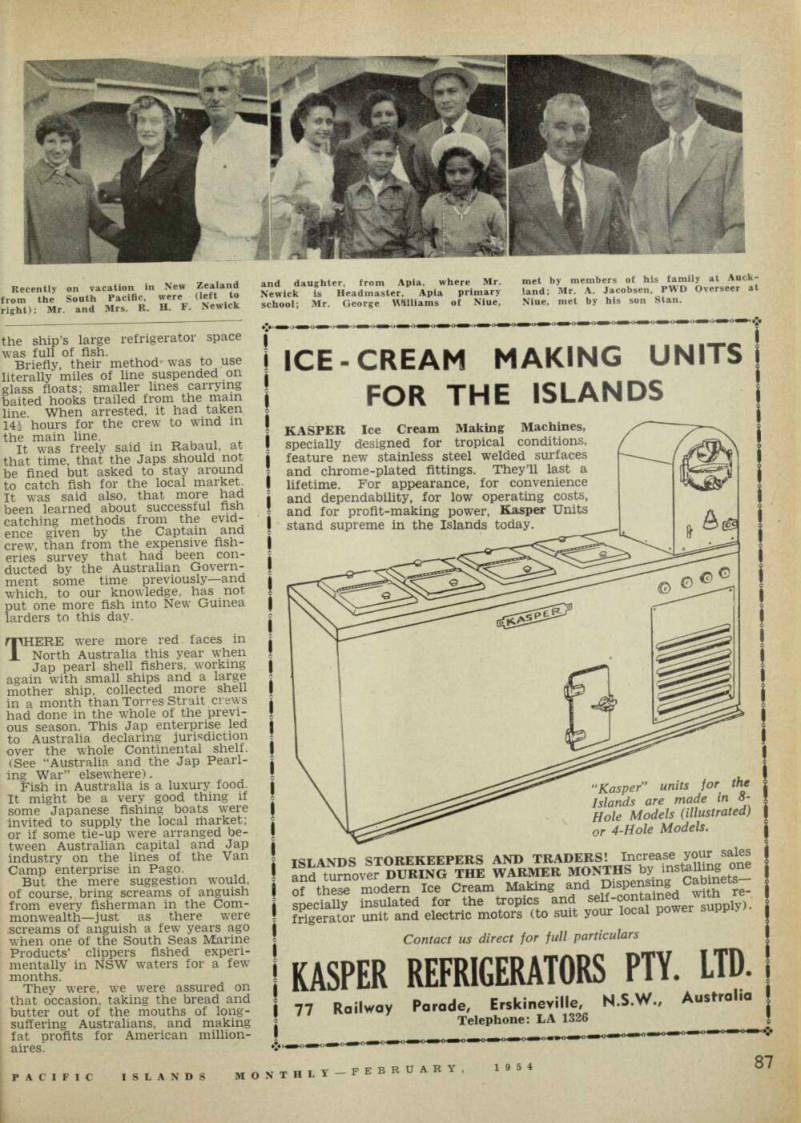
Recently on vacation in New Zealand from the South Pacific, were (left to right): Mr. and Mrs. R. H. F. Newtek
and daughter, from Apia, where Mr.
Newick is Headmaster, Apia primary school; Mr. George Williams of Niue,
met by members of his family at Auck land: Mr. A. Jacobsen, PWD Overseer at Niue, met by his son Stan.