of Dakuwangga
pp. 78-79 · Read in the full issue
The Queen Came to the Realm of Dakuwangga
By Frank Exon.
WHEN Gothic picked up the leading marks that guided her safely through the reef passage into Suva harbour, she passed into the realm of Daku wangga who, in the words of Her Britannic Majesty’s own passport, “afforded her every assistance and protection of which she may stand in need.”
A mile to port, perched -on the reef, sits the rusted skeleton of an old sailing ship which had come from the ocean bed especially to see the Queen. Two months previously, this wreck somehow contrived to have herself violently erupted from the depths where she had lain for years. Once free, she travelled shorewards in style, on the back of the giant wave that swept all before it after Fiji’s recent earthquake.
The experts are still arguing as to the origin of that earthquake; but none of their theories explains satisfactorily the macabre emer gence from the sea-bed of this barnacled old ship; or her triumphant ride to the reef from which chosen eminence no power, neither God nor man, -is likely to dislodge her until the end of time.
So, realising it was all beyond the ken of the scientists, I went to the people who have known the land and the sea and its mysteries the longest—to the unscientific, un lettered Fijians. They told me about the Shark God Dakuwangga, and their theory is the most satisfying yet.
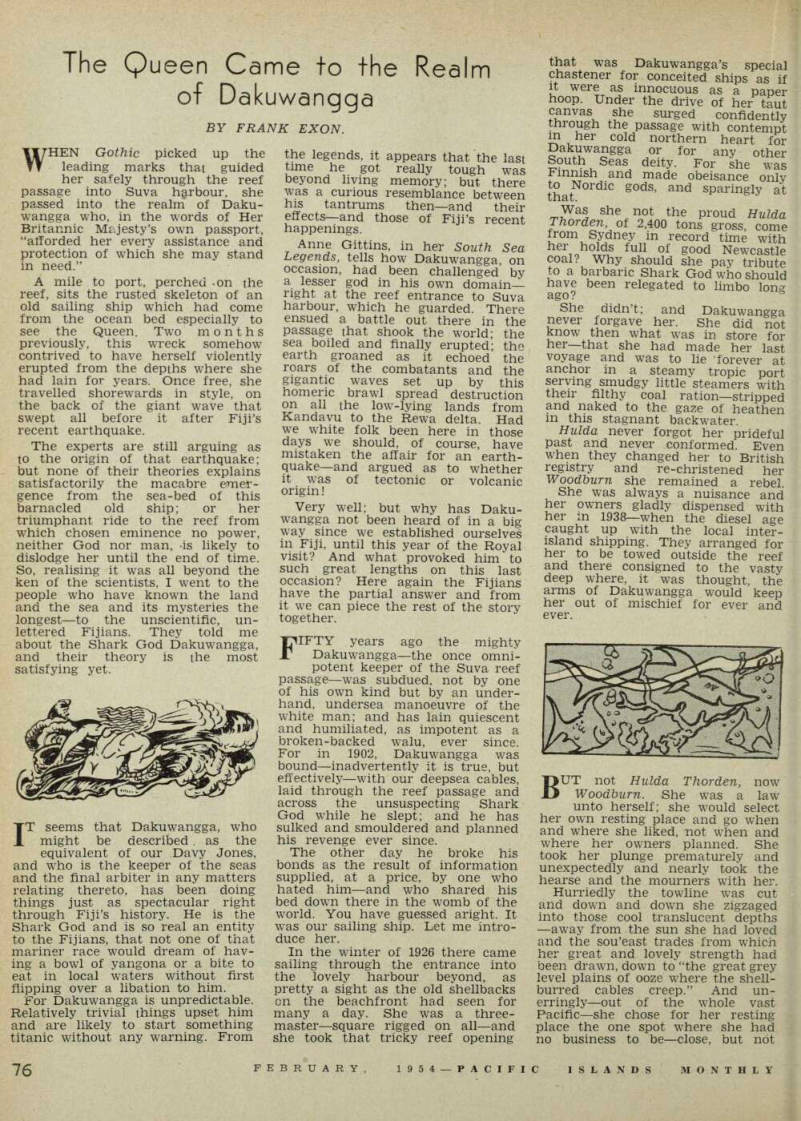
IT seems that Dakuwangga, who might be described . as the equivalent of our Davy Jones, and who is the keeper of the seas and the final arbiter in any matters relating thereto, has been doing things just as spectacular right through Fiji’s history. He is the Shark God and is so real an entity to the Fijians, that not one of that mariner race would dream of hav ing a bowl of yangona or a bite to eat in local waters without first flipping over a libation to him.
For Dakuwangga is unpredictable.
Relatively trivial things upset him and are likely to start something titanic without any warning. From
the legends, it appears that the last time he got really tough was beyond living memory; but there was a curious resemblance between his tantrums then—and their effects—and those of Fiji’s recent
happenings.
Anne Gittins, in her South Sea Legends, tells how Dakuwangga, on occasion, had been challenged by a lesser god in his own domain right at the reef entrance to Suva harbour, which he guarded. There ensued a battle out there in the passage that shook the world; the sea boiled and finally erupted; the earth groaned as it echoed the roars of the combatants and the gigantic waves set up by this homeric brawl spread destruction on all the low-lying lands from Kandavu to the Rewa delta. Had we white folk been here in those days we should, of course, have mistaken the affair for an earth quake—and argued as to whether it was of tectonic or volcanic origin!
Very well; but why has Daku wangga not been heard of in a big way since we established ourselves in Fiji, until this year of the Royal visit? And what provoked him to such great lengths on this last occasion? Here again the Fijians have the partial answer and from it we can piece the rest of the story together.
FIFTY years ago the mighty Dakuwangga—the once omni potent keeper of the Suva reef passage—was subdued, not by one of his own kind but by an under hand, undersea manoeuvre of the white man; and has lain quiescent and humiliated, as impotent as a broken-backed walu, ever since.
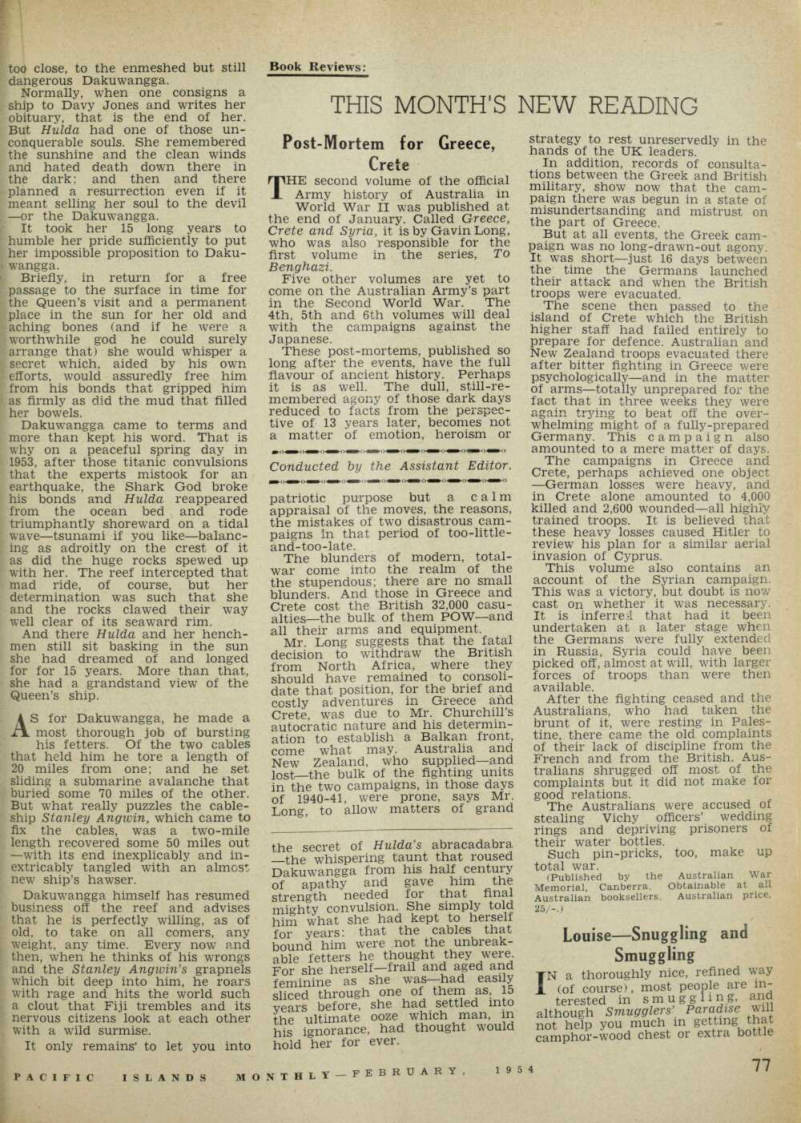
For in 1902, Dakuwangga was bound—inadvertently it is true, but effectively—with our deepsea cables, laid through the reef passage and across the unsuspecting Shark God while he slept; and he has sulked and smouldered and planned his revenge ever since.
The other day he broke his bonds as the result of information supplied, at a price, by one who hated him —and who shared his bed down there in the womb of the world. You have guessed aright. It was our sailing ship. Let me intro duce her.
In the winter of 1926 there came sailing through the entrance into the lovely harbour beyond, as pretty a sight as the old shellbacks on the beachfront had seen for many a day. She was a three master —square rigged on all —and she took that tricky reef opening
that was Dakuwangga’s special chastener for conceited ships as if it were as innocuous as a paper hoop. Under the drive of her taut canvas she surged confidently through the passage with contempt m her cold northern heart for Sf.Si Wa o gga " for a ny other South Seas deity. For she was Finnish and made obeisance only to Nordic gods, and sparingly at trlclL.
Was she not the proud Hulda Thorden of 2,400 tons gross, come from Sydney in record time with her holds full of good Newcastle coal? Why should she pay tribute to a barbaric Shark God who should have been relegated to limbo long ago?
She didn’t; and Dakuwangga never forgave her. She did not know then what was in store for her—that she had made her last voyage and was to lie forever at anchor in a steamy tropic port serving smudgy little steamers with their filthy coal ration—stripped and naked to the gaze of heathen in this stagnant backwater.
Hulda never forgot her prideful past and never conformed. Even when they changed her to British registry and re-christened her Woodhurn she remained a rebel.
She was always a nuisance and her owners gladly dispensed with her in 1938—when the diesel age caught up with the local inter island shipping. They arranged for her to be towed outside the reef and there consigned to the vasty deep where, it was thought, the arms of Dakuwangga would keep her out of mischief for ever and ever.
BUT not Hulda Thorden, now Woodhurn. She was a law unto herself; she would select her own resting place and go when and where she liked, not when and where her owners planned. She took her plunge prematurely and unexpectedly and nearly took the hearse and the mourners with her.
Hurriedly the towline was cut and down and down she zigzaged into those cool translucent depths —away from the sun she had loved and the sou’east trades from which her great and lovely strength had been drawn, down to “the great grey level plains of ooze where the shell burred cables creep.” And un erringly—out of the whole vast Pacific —she chose for her resting place the one spot where she had no business to be —close, but not
too close, to the enmeshed but still dangerous Dakuwangga.
Normally, when one consigns a ship to Davy Jones and writes her obituary, that is the end of her.
But Hulda had one of those un conquerable souls. She remembered the sunshine and the clean winds and hated death down there in the dark: and then and there planned a resurrection even if it meant selling her soul to the devil —or the Dakuwangga.
It took her 15 long years to humble her pride sufficiently to put her impossible proposition to Daku wangga.
Briefly, in return for a free passage to the surface in time for the Queen’s visit and a permanent place in the sun for her old and aching bones (and if he were a worthwhile god he could surely arrange that) she would whisper a secret which, aided by his own efforts, would assuredly free him from his bonds that gripped him as firmly as did the mud that filled her bowels.
Dakuwangga came to terms and more than kept his word. That is why on a peaceful spring day in 1953, after those titanic convulsions that the experts mistook for an earthquake, the Shark God broke his bonds and Hulda reappeared from the ocean bed and rode triumphantly shoreward on a tidal wave—tsunami if you like —balancing as adroitly on the crest of it as did the huge rocks spewed up with her. The reef intercepted that mad ride, of course, but her determination was such that she and the rocks clawed their way well clear of its seaward rim.
And there Hulda and her hench men still sit basking in the sun she had dreamed of and longed for for 15 years. More than that, she had a grandstand view of the Queen’s ship.
AS for Dakuwangga, he made a most thorough job of bursting his fetters. Of the two cables that held him he tore a length of 20 miles from one; and he set sliding a submarine avalanche that buried some 70 miles of the other.
But what really puzzles the cable ship Stanley Angwin, which came to fix the cables, was a two-mile length recovered some 50 miles out —with its end inexplicably and in extricably tangled with an almost new ship’s hawser.
Dakuwangga himself has resumed business off the reef and advises that he is perfectly willing, as of old, to take on all comers, any weight, any time. Every now and then, when he thinks of his wrongs and the Stanley Angwin’s grapnels which bit deep into him, he roars with rage and hits the world such a clout that Fiji trembles and its nervous citizens look at each other with a wild surmise.
It only remains' to let you into
the secret of Hulda’s abracadabra the whispering taunt that roused Dakuwangga from his half century of apathy and gave him the strength needed for that final mighty convulsion. She simply told him what she had kept to herself for years- that the cables that bound him were not the unbreak able fetters he thought they were.
For she herself—frail and aged and feminine as she was—had easily sliced through one of them as 15 vears before, she had settled into the ultimate ooze which man, in his ignorance, had thought would hold her for ever.