Tropocalities
pp. 75-76 · Read in the full issue
Magazine Section
Presenting The South Seas
To The World
THE BBC feature, ‘This is Fiji, and Tonga,” broadcast during the Queen’s visit to the Pacific, was written and narrated by Phillip Snow, a former administrative officer in Fiji. Heard in the session were Ratu Sir Lala Sukuna, Secre tary for Fijian Affairs, Sir Harry Luke, former Governor of Fiji, and Corporal N. Lalabalavu, a member of the Fijian Force in Malaya.
The second part of the pro gramme, dealing with Tonga, in cluded an extract from Queen Salote’s message to her people, broadcast while she was in London, and descriptions of her palace at Nukualofa. J. S. Neill, one-time British Agent and Consul in Tonga, spoke of its government, and a New Zealand anthropologist ex plained Fijian and Tongan racial origins. Music from both countries was heard, ending with the Tongan national anthem. — H.E.L.P.
Cheaper By The Hundred
EDWIN GOLD, of Mangaia, re ports that Cook Islands ship owners who quote a special cheap rate to organised tere parties, who are forever on the move from island to island, are being diddled.
They’re finding that whenever a tere party comes aboard there are no regular-rate passengers. The full-rate passengers are slipping in as members of the tere party, which is allowed up to 100 persons at the contract rate.
How to tell a legitimate fere tripper from full-rate customer is just one more of the Cook Islands ship-owners’ many worries.
Fijians Firewalk In
Auckland
CHIEF attraction of Auckland’s annual Birthday Carnival this January-February was three performances by a party of 20 Fijian firewalkers from the little island of Beqa.
Due to a succession of mis fortunes, the firewalkers almost found themselves without their specially imported stones to walk on. First the January hurricane scare caused the launch bound for Suva with the rocks to put back to Beqa. Then the USS Co. ship Karamu, for the same reason, fled from Suva before her normal load ing was completed—leaving the stones behind. They were loaded on the next available ship, which went
first to Lyttelton. There they were duly trans-shipped to a ferry steamer for Wellington to be railed on to Auckland by an express train instead of the normal goods train.
Here an unexpected snag was met in the form of a Watersiders’ picnic —but by special appeal they were discharged and despatched to Auckland with no time to spare.
Finally the two tons of stones were loaded on a motor truck for despatch to the Fair ground—and the truck broke down en route, finally being towed there by another truck just in time to heat them up for the first performance.
And there was no doubt about the stones being very, very red hot when the Beqa men, who arrived by specially .chartered TEAL aircraft, eventually stepped onto them.
So hot in fact that the public round the fire-pit were glad to try the free bowls of kava dispensed by Paula Tabaki, a (male) member of TEAL’S Suva office staff, nearby.
Gill Hemming Again
WHEN Captain Dibbern arrived in Auckland late January with his yacht Te Rapunga to enter the Auckland-Hobart race, PIM’S Auckland correspondent went down to make the acquaintance of the
skipper who has done considerable cruising in the Eastern Pacific.
Down in the cabin, a young woman with pencil and notebook, busily cross-examining Dibbern and his attractive all-girl crew, pricked up her ears when PIM was men tioned —and with good reason. She was Gill Hemming—Mrs. Maurice Shadbolt since last November 21— who lived with her parents at Kolube Plantation, New Ireland, until the Japs drove her and her mother out. Her father was one of that little band of New Ireland planters whose fate was never clearly established.
Gill is now a special writer on the staff of the Auckland Weekly News —having graduated to Auck land some time ago from the Syd new Sun staff. Her husband is an Auckland journalist. Her mother, well-known to pre-war New Guinea people, now lives at Pine Street, Manly.
For a while in pre-war days PlM’s Auckland man served in New Guinea coasters which ran. amongst other places, to Kolube.
Grimble’S G & E Story
For Films
ANOTHER film may be shot in Fiji shortly. At the end of January, two men from Strato Films, of London, which is in Sir Henry Korda’s group, visited the Colony on a preliminary survey for making a film based on Sir Arthur Grimble’s book Pattern of Islands.
Sir Arthur’s book was interesting reading but old residents of the Gilbert and Ellice Islands consid ered it a much exaggerated account of the life of a young Colonial Ser vice official in that Colony—and of the Colony itself. (Oven
Even as written, however, it will probably not be as exciting and “glamorous” as the film men will like. One may therefore expect a few cases of apoplexy amongst re tired members of the Colonial Ser vice if and when the film version of Pattern of Islands is made and released sometime in the future.
The Low Down On Germs
“T ORD LISTER was not a very ±J important person at first. He was a Englishman.” This alarming statement was made by Alisi, a young Fijian schoolgirl from a remote village, in a social studies examination paper at the end of the year. But Alisi’s trouble was largely with the vagaries of the English language. She had both Lord Lister and Louis Pasteur very well summed up.
“One day,” she wrote, “Lord Lister heard that Louis Pasteur has found out the germs and how to cure them.
Louis Pasteur said by heating and cooling those germs can’t stand it.
And thought of boiling everything for operation. He boiled them. The first person operate alive. By that time Lord Lister was in a very high standard.”
Which was perfectly true, and the small Alisi netted 42 marks out of a possible 50 for the whole paper.—S.
Printer’S World Record?
WE nominate the printer and publisher of the Papua and New Guinea Government Gazette for unusual behaviour. The issue dated Port Moresby, January 28, was in our hands before Feb ruary was two days old.
Publishers of Gazettes through out the world are notorious for de lay in production of their compila tions—probably the result of dilatory methods in Government Depart ments. There are one or two Ad ministrations in the Pacific Islands whose Gazette usually appears 2 years behind the official date of publication. Even in Sydney and Canberra, the depressing little official newspapers are generally three or four weeks late.
But the Port Moresby printer for some reason (which probably will be found in Government House methods) has gradually shortened the gap until to-day there is no de lay at all. Probably a world record.
Stand Back, Archangelsky!
OUR Tahiti correspondent thought he was on safe ground when in July PIM (p. 70) he described Alexandre Archangelsky as “believed to be the oldest European resident of Tahiti to-day.”
Seeing this recently, another Tahiti veteran, Monsieur Henri Grand, after comparing notes with Archangelsky stepped smartly into our correspondent’s office and let it be known that not only was he senior to the old Alaskan, but, at 83, is still actively engaged in man
aging his own Papeete business.
Monsieur Grand, indeed, having arrived in Papeete in 1885, sounds like a man who could tell a tale or two. Before World War I he was manager for Societe Commercial de 1 Oceanic, French Oceania affiliate of the famous Deutsch Handels Plantagen Gasselschaft which con trolled the lion’s share of Pacific business in those days.
City Limits
PALMYRA Island might be the last place that possible future tourists would expect to find a Honolulu cop pacing his beat.
Yet Otto Hornung, retired Honolulu commercial photographer, who looks after the atoll for the Fullard Leo family is just that—and not by accident.
For Palmyra, 900 miles south of the Hawaiian capital—together with the Pearl and Hermes Reefs, 1,100 miles to the north-west—is, admin istratively, an integral part of Hono lulu city, under the direct control of Mayor Wilson and subject to the city bylaws. Hornung is an offici ally appointed reserve policeman, fully empowered to arrest the non existent population and control the island’s non-existent traffic.
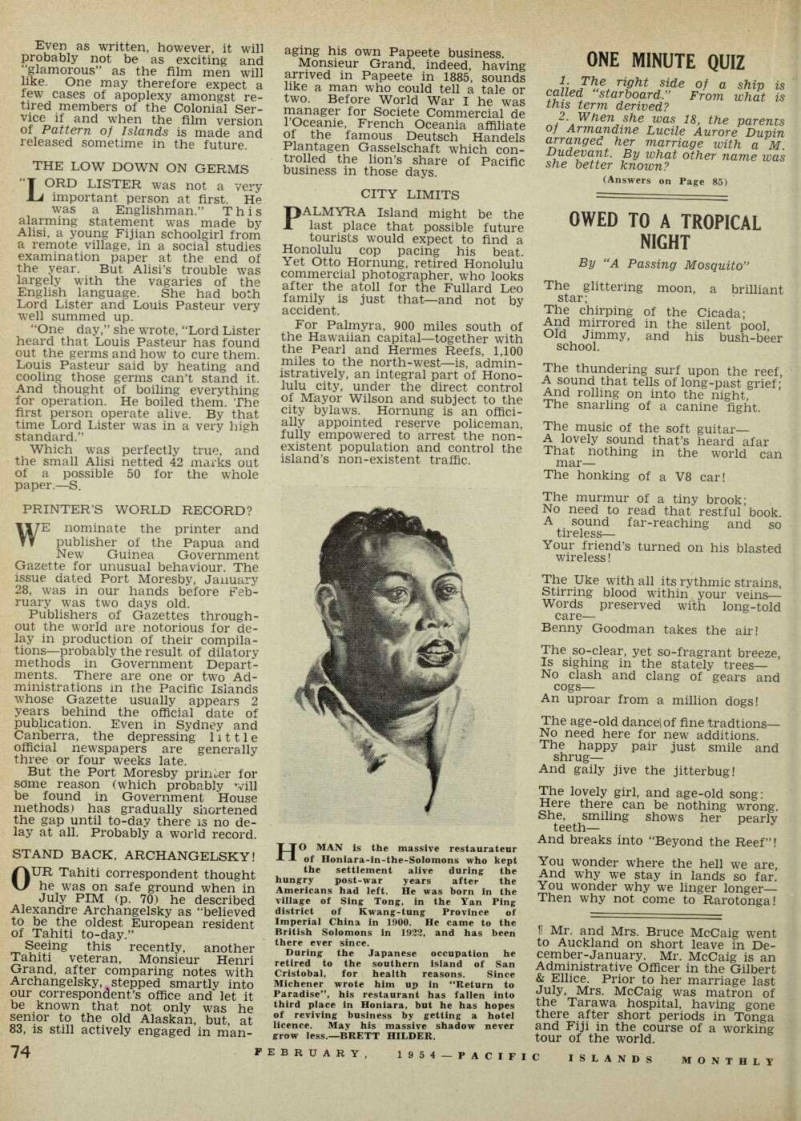
HO MAN is the massive restaurateur of Honiara-in-the-Solomons who kept the settlement alive during the hungry post-war years after the Americans had left. He was born in the village of Sing Tong, in the Yan Ping district of Kwang-tung Province of Imperial China in 1900. He came to the British Solomons in 1933, and has been there ever since.
During the Japanese occupation he retired to the southern island of San Cristobal, for health reasons. Since Michener wrote him up in “Return to Paradise”, his restaurant has fallen into third place in Honiara, but he has hopes of reviving business by getting a hotel licence. May his massive shadow never grow less,—BRETT HILDER.