Phenomenal Prices For
pp. 72-73 · Read in the full issue

NG Cocoa-beans But Buyers Still Say “Poor Quality”
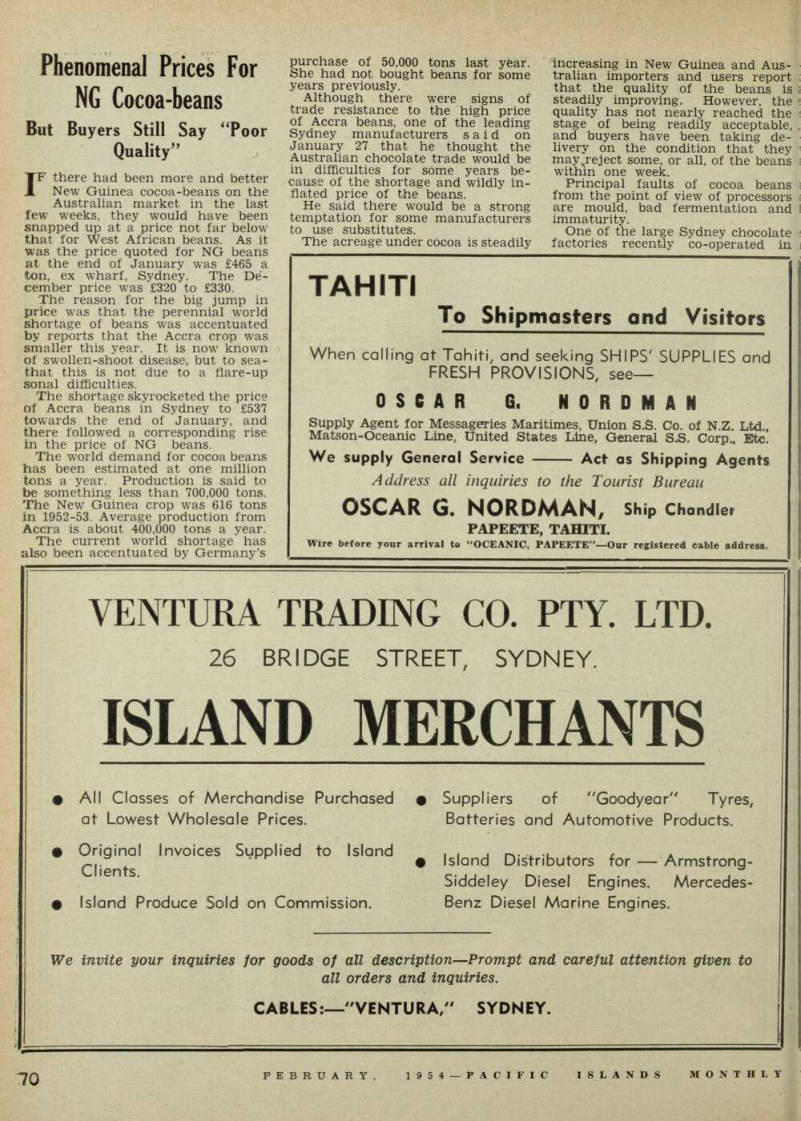
IF there had been more and better New Guinea cocoa-beans on the Australian market in the last few weeks, they would have been snapped up at a price not far below that for West African beans. As it was the price quoted for NG beans at the end of January was £465 a ton, ex wharf, Sydney. The De'cember price was £320 to £330.
The reason for the big jump in price was that the perennial world shortage of beans was accentuated by reports that the Accra crop was smaller this year. It is now known of swollen-shoot disease, but to sea that this is not due to a flare-up sonal difficulties.
The shortage skyrocketed the price of Accra beans in Sydney to £537 towards the end of January, and there followed a corresponding rise in the price of NG beans.
The world demand for cocoa beans has been estimated at one million tons a year. Production is said to be something less than 700,000 tons.
The New Guinea crop was 616 tons in 1952-53. Average production from Accra is about 400,000 tons a year.
The current world shortage has also been accentuated by Germany’s
purchase of 50,000 tons last y6ar.
She had not bought beans for some years previously.
Although there were signs of trade resistance to the high price of Accra beans, one of the leading Sydney manufacturers said on January 27 that he thought the Australian chocolate trade would be in difficulties for some years be cause of the shortage and wildly in flated price of the beans.
He said there would be a strong temptation for some manufacturers to use substitutes.
The acreage under cocoa is steadily
increasing in New Guinea and Aus tralian importers and users report that the quality of the beans is steadily improving. However, the quality has not nearly reached the stage of being readily acceptable, and buyers have been taking de livery on the condition that they may .reject some, or all, of the beans within one week.
Principal faults of cocoa beans from the point of view of processors are mould, bad fermentation and immaturity.
One of the large Sydney chocolate factories recently co-operated in
tests on a quantity of NG beans and reported that of nine lots, two were “good” and seven were “poor.”
One “good” lot was 5 per cent, unfermented and had a slight foreign aroma, probably from copra.
The other was 6, per cent, unfer mented and 3 per cent, mouldy.
The main fault in the poor lots was bad fermentation. One lot was reported to have 35 per cent, un fermented beans.
Doubts have been expressed at both the manufacturing and grow ing ends of the cocoa industry as to whether these phenomenal prices are a good thing. As cocoa and cocoa products are commodities which the average consumer takes or leaves according to the state of his finances, it is feared that high cost of raw materials will force manufacturers to price their goods out of a market.
Already the price of some choco late lines has risen in Australia.