Phenomenal Fish-Catching Off
pp. 65-67 · Read in the full issue
Samoa
Japs Show Us How- Pago Cannery In Operation
IN January, Pago Pago, American Samoa, had more fresh fish available for local consumption than ever before in its history. It retailed at 20 cents a pound, which is less than half the price charged . there for the cheapest fresh meat.
Even more imnortant, it seems cer tain now that the local cannery, -which was set up about five years " ago and has never canned a fish, will at last have some raw material to work on. , Reason for this change on the fisheries front is the arrival in Pago of a flotilla of half a dozen Japanese vessels and a mother-ship. They are owned by the American fishing , companv. Van Camp, but are operated on a pay-by-results basis, by Japanese who use a long-line fishing technique that gets results.
About 150 Samoans will be em ployed in the shore-based part of the industry; Mr. Paul J. Hendrick, with five other Americans, is already in Pago in charge of opera tions.
The mother ship is North Star; the fishing vessels Takuyo Maru, Daijin. Maru, Shinko Maru, Kiyo Maru, Kyuei Maru, and Kotoku Maru. Two of them fished on their wav south to Pago from Japan, and arrived in Eastern Samoa with lh tons of marlin and about eight tons of tuna. To show it was no acci dent, while waiting for serious operations to begin, the ships go out off American Samoa and regularly bring in large hauls of fish, includ
ing tuna.
The early success of Japanese methods in bringing in the elusive tuna is naturally causing broad grins in Pago, and all over the Eastern Pacific men are asking what it is the Japs have that the expensive South Seas Marine Pro ducts of Fiji did not.
The answer obviously is know how.
SSMP was set up with head quarters in Fiji, about 1948. It had
a solid backing of American capital, expensive American equipment, in cluding special tuna clippers, and a spotting plane. The cannery in Pago was part of the plan;—lt was to process for the American market, tuna caught by specially trained Fijians in the specially equipped tuna clippers. Earnings by the British end of the outfit were to help balance our dollar deficit.
South Seas Marine Products can not be blamed for what happened
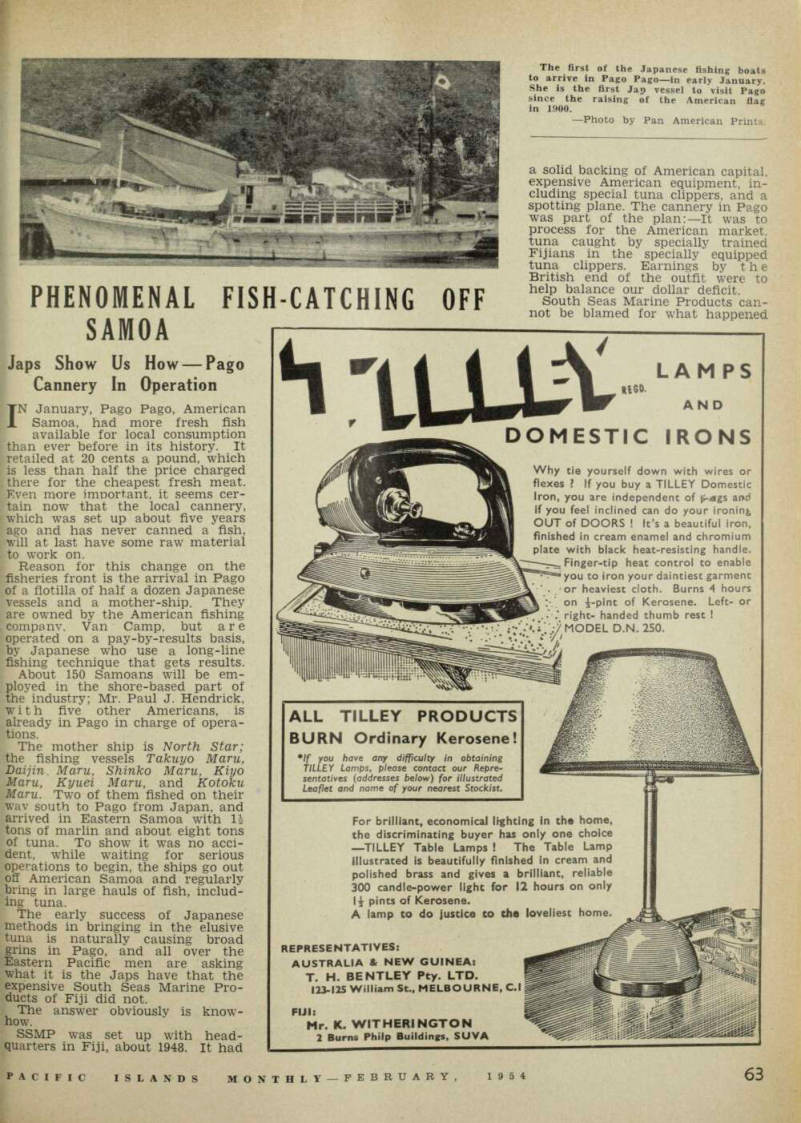
The first of the Japanese fishing boats to arrive in Pago Pago—in early January.
She is the first Jap vessel to visit Pago since the raising of the American flag in 1900. —Photo by Pan American Prints.
next. Apparently the tuna in those waters refused to fall for the methods adopted nearer the US mainland, and the specialised pole fishing from the clippers around
Fiji achieved precisely nothing. The cannery in Pago never got a tuna and finally the whole concern was wound up and the clippers and other equipment sold.