Ordained Priest
pp. 53-56 · Read in the full issue

Native Papuan
A New Era in P-NG
By Renata Cochrane
TO-DAY, in Mainohana village, Julian Efi became a priest, the first Papuan ever to be ordained in his own country.
Sixteen years before, he had left for St. Mary's Seminary, at Vuna pope Mission, near Rabaul. “At first, when I started, I didn’t understand what it was all about,” he said. “But as the years went on —well, things seemed to get clear. Botany and physics and history I found easy; but dogma and philosophy, they were hard; and I think we all had difficulty with Latin to begin with.”
Julian’s studies were interrupted by the Japanese invasion in 1942.
With his fellow-students, he was forced to labour side by side with Australian prisoners-of-war. Later, he was interned in company with all the members of Vunapope Mission.
By the end of the war, there was not a single building left at the
Mission. There was no question of re-opening the seminary. Then Bishop Wade, of the Solomon Islands, came to the rescue. He bought an Army camp at Torokina, in his own diocese, and founded a new seminary, where Julian was able to finish his studies. Then he returned to Papua to report to his superior, Bishop Andre Sorin, MSC, of the Catholic Mission, Yule Island. Broad shouldered and self assured, quiet and with a ready smile, he held himself in readiness for his great day.
“I don’t know where the Bishop will send me,” he said. “All the Fathers here are Missionaries of the Sacred Heart, but the Pope prefers that the clergy of a country should be taken from its own people. So if I wish to remain a secular priest, I can do so.” He spoke decisively, well knowing that he represented the beginning of the Church in Papua.
FOR this reason, the Bishop had decided that the ordination should take place at the village of Mainohana, the natural meeting-place of the Mekeo, Roro and Waima people, inhabiting the coastal plain across from Yule Island. Julian
is a Mekeo, like the only other Papuan priest, Father Louis Vangeke, MBC; but Father Louis was ordained in Madagascar, and the Papuan people had never seen an ordination.
So, on this Sunday morning, Julian’s people got up long before drawn to attend Mass and hurry along the paths through the kunal grass and along the creeks in their canoes, so that, for once in their unhurried lives, they might be in good time. Mothers carried their babies in net bags slung from their foreheads. Grave Mekeo men, their carefully-combed frizzy hair clipped like a round, full wig, walked with their heads held high. Some were
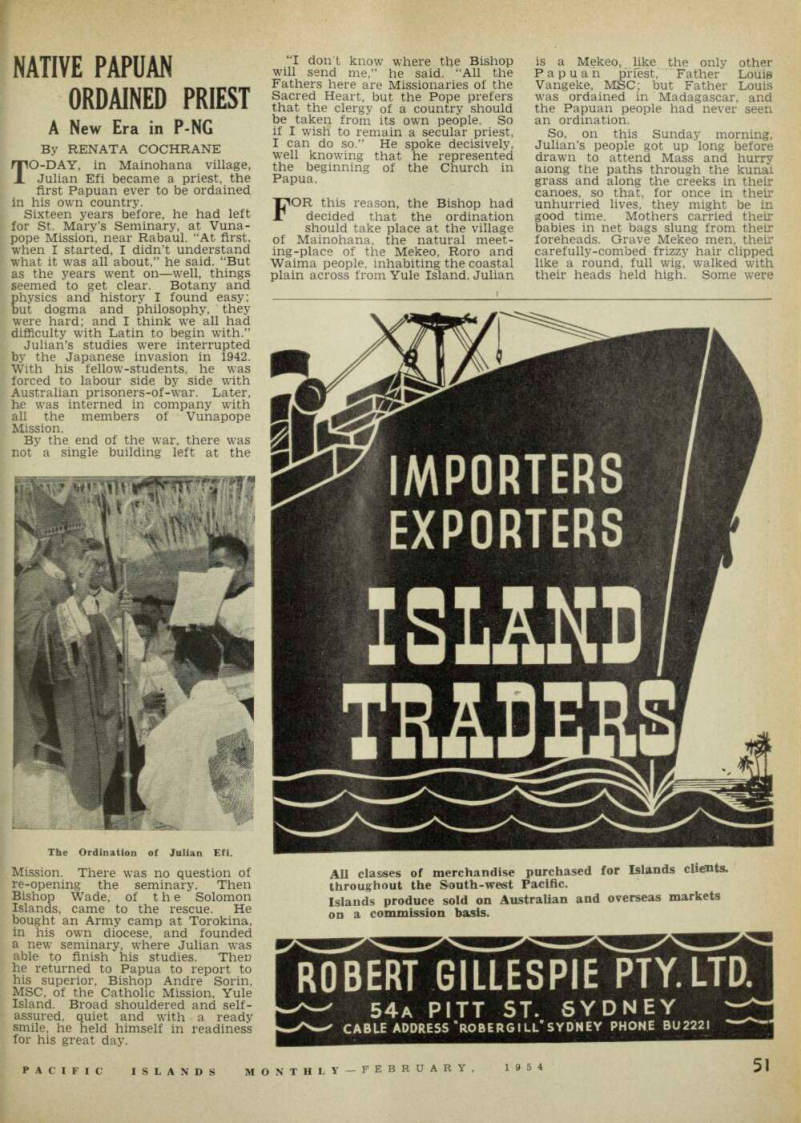
The Ordination of Julian Efi,
naked except for a breech clout and a collection of ornamental belts and armlets; but most came in shirts and blue or scarlet ramis.
Roro girls, tatooed from head to foot in delicate, sooty, geometric patterns swayed their hips and set their fine, yellow-dyed grass skirts swinging. Round their necks hung massive necklaces of dogs’ teeth, plaques of gold-lip pearl shell, finely-worked ornaments of tortoise shell —all their portable wealth for the prospective husbands to see and admire.
The crowd grew denser as they neared Mainohana Mission Station.
Schoolboys dressed uniformly in blue ramis marched in; a troop of Scouts; young men with their faces intricately painted all over in traditional designs of many colours; old women with shaven heads and no adornment, naked piccaninnies.
All the people—Julian’s people— came hurrying in for the ordination.
ABOUT 4,000 of them gathered in the open space near the newly erected Mission buildings. The unfinished church was too small to house them, so the village people had built a sanctuary out of doors, high up on a platform. They used the traditional design of a Papuan house, a pointed arch rising un interrupted from floor to roof tree.
Delicate young coconut fronds out lined the entrance, indicating a chief’s house. The walls were of local bamboo, tied with vines.
The front of the altar was hung with a native fishing net, the centre decorated with a design of flaming bird-of-paradise plumes. Grass skirts hung on the walls, and mats woven by the women from dried sago leaves carpeted the floor.
It was the Bishop’s wish that this should be a feast for Julian’s people, that they should under stand that this was the beginning of the Church in Papua. Even the embroidery on Julian’s new white chasuble caught the theme—a bird of-paradise escaping from a broken net, with taro leaves in the back ground to symbolise the Mekeb countryside.
“Laqueus contritus est et nos liberati sumus.” —“Our soul was freed as a bird from the snare of the trappers: the snare was broken and we were delivered.”
PRESENTLY the procession came walking under the arches of swaying coconut fronds. The brown-skinned schoolchildren led the way, followed by the Sisters in their white habits and pale blue veils. Then came the Papuan Little Sisters in grey, with a demure white collar: then the laymen, builders, boatmen and farmers of the Mission; the Brothers, European and Papuan, dressed alike in black soutanes and starched white lace; and lastly the Fathers —all those who could pos sibly leave their stations for a little while.
From the steps of the sanctuary,
the Bishop in his robes spoke to the people in the Roro language: “God, who is all powerful, created man. Man, by sin, cut himself off from God. God sent His Son, Jesus Christ, to stand between Himself and man. He is therefore the only true priest. But, just before He died, Jesus Christ gave to the Apostles the power to stand before
God as priests. And though we are only men, we who are ordained are priests in Jesus Christ. And so, by His power, Julian also will become a priest.”
The Bishop asked the people if they knew of anything which might prevent Julian from becoming a priest. No one spoke. He turned to Julian, reminded him of the duties he will have to undertake.
Beautifully and meticulously, the ceremony continued. Julian prostrated himself before the altar, while the Waima, Roro and Mekeo people, accustomed to Latin, took up the responses of the Litany of the Saints. Julian rose and knelt before the Bishop. In silence, in the fierce hot sunlight of the tropic morning, the Bishop laid his hands on Julian’s head, asking the Holy Spirit to come down on him and make him a priest forever.
Sweat ran down the faces of the attentive native people. No one stirred. In the front row, a woman with a shaven head wept quietly.
She is one of Julian’s sisters. * * * The crowd jostles and pushes round the Mission House. The sun beats down on eager, painted faces.
From shining brown skins comes a smell of coconut oil, slightly rancid in the hot sun. The red and yellow
flowers around the top-knots of the young women begin to wilt. Suddenly, there is silence. Father Julian in his white chasuble, the bird-of-paradise escaping from the broken net of paganism, comes out to his people to give them his first
blessing.
The Under Secretary of State for the Colonies, Lord Munster, who at tended the Finance Ministers’ Con ference in Sydney, had brief in formal talks with the Governor of Fiji when he passed through Nadi, on his return to the UK via America, in late January.