The Genius Of The Late
pp. 41-46 · Read in the full issue
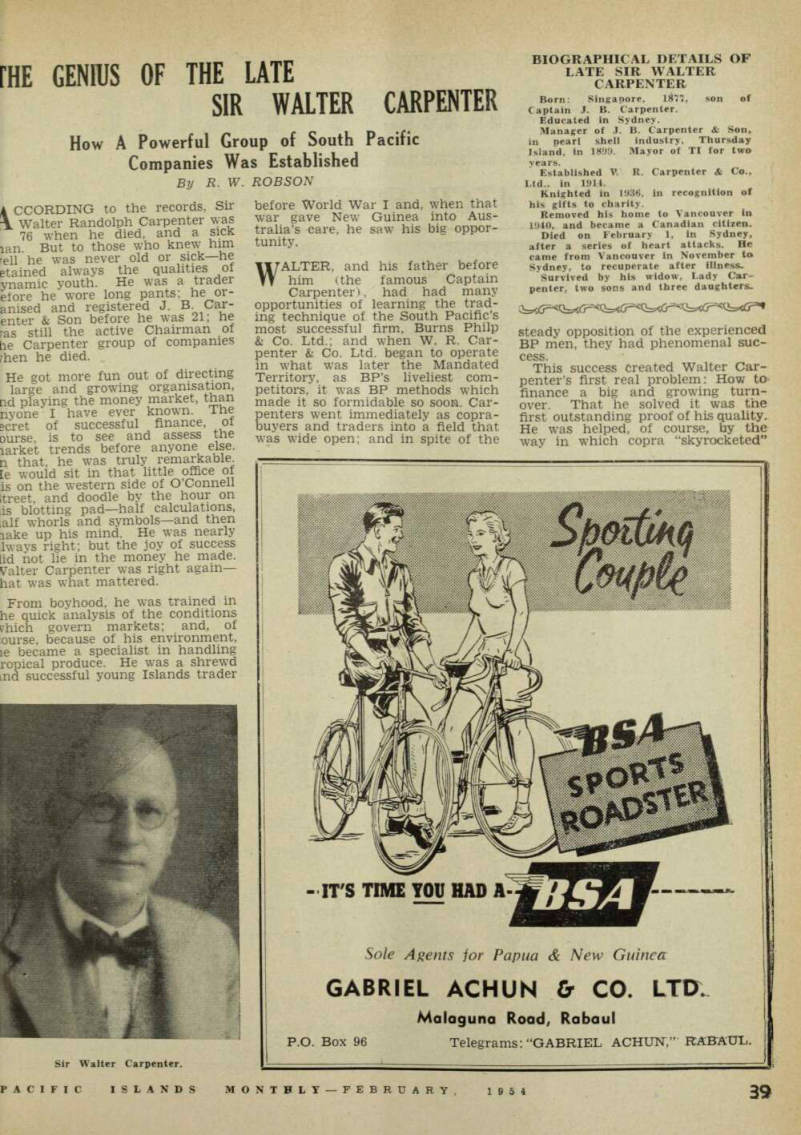
Sir Walter Carpenter
How A Powerful Group of South Pacific Companies Was Established
By R. W. Robson
A CCORDING to the records, Sn* \ Walter Randolph Carpenter was 76 when he died, and a sick lan But to those who knew him rell he was never old or sick —he etained always the qualities of ynamic youth. He was a trader efore he wore long pants; he or anised and registered J. B. Car enter & Son before he was 21; he ras still the active Chairman of tie Carpenter group of companies rhen he died.
He got more fun out of directing large and growing organisation, nd playing the money market, than nyone I have ever known. The scret of successful finance, of ourse, is to see and assess the larket trends before anyone else, n that, he was truly remarkable [e would sit in that little office of is on the western side of O’Connell itreet, and doodle by the hour on is blotting pad—half calculations, alf whorls and symbols—and then lake up his mind. He was nearly Iways right; but the joy of success [id not lie in the money he made.
Valter Carpenter was right again— hat was what mattered.
From boyhood, he was trained in he quick analysis of the conditions yhich govern markets; and, of ourse, because of his environment, le became a specialist in handling ropical produce. He was a shrewd md successful young Islands trader
before World War I and, when that war gave New Guinea into Aus tralia’s care, he saw his big oppor tunity.
WALTER, and his father before him (the famous Captain Carpenter). had had many opportunities of learning the trad ing technique of the South Pacific’s most successful firm, Burns Philp & Co. Ltd.; and when W. R. Car penter & Co. Ltd. began to operate in what was later the Mandated Territory, as BP’s liveliest com petitors, it was BP methods which made it so formidable so soon. Car penters went immediately as copra buyers and traders into a field that was wide open; and in spite of the
steady opposition of the experienced BP men, they had phenomenal sue-
Coss.
This success created Walter Car penter’s first real problem: How to finance a big and growing turn over. That he solved it was the first outstanding proof of his quality.
He was helped, of course, by the way in which copra “skyrocketed”
Sir Walter Carpenter.
i the ’Twenties. He easily could ave been ruined by what happened l 1929-30, for in those early days 5 must have been carrying a lot : borrowed money. ■Rnt tv-ip cwinfT-hnrk from the S? of the ’Twenties bringing the ep?ession he and 6 starVaUon'Ticel .r copra had been foreseen by The oss - he had his anchors down in rm 'ground, and he rode out the orm without damage. In fact, he -ofited by it. Many properties, ading and planting concerns, colpsed financially, and Carpenters ithered them into the WRC organation.
N the beginning with capital small, thfCarp B ente W r trade con- « S l S h e ere of on” P co y uW y at 6 f profit t u P nassed and P more mital became available Walter’s a P n became^lear—nameiv control
industries andlinking them to-
‘ther so tLrone fed the omer The trading stores bought the irvrrT and sold essentiaf goods ck to the d nlanter Profit on copra ? nrofiton goods'for the Co Then le Co beean to get control antations—sometimes by purchase, metimes by financing the planter. here were now three profits—on te copra, on the goods supplied, on ie operation of the plantation. He tablished his own insurance commy and got a fourth profit.
Once the Depression was past,
Walter’s tireless mind turned to transport. Every activity of his Co. had to pay for sea-carriage, in some form or other. The next logical step, therefore, was to own and operate ships. The Co. ran its own small boats along the New Guinea coasts, but by 1934 it had acquired two elderly motor-ships which it named the Salamaua and the Rabaul, for carrying its copra over seas, and bringing back the goods for its Islands stores. That was the beginning of the Carpenter line ot modern motor-ships, now known in most Pacific ports, Ships could not carry goods and passengers between the sea and the Morobe goldfield, however—that was °« of
“tors ?hem suddenly
appeared in New Guinea a couple of little to run between Lae and Wau in the Carpenter interests.
So was established Mandated Air ways, stm operating in New Guinea.
A few yew* later > Carpenter air ways interests tendered for and captured from Guinea Airways the contract for running the air-mails between Sydney and New Guinea; 1 wit^nDanta^ 86^6^17 merged with Qantas.
A ND so it went on—copra buying and selling, plantations, trade stores, ships, air services, and various subsidiaries, all linked to gether, each feeding the other, and
constantly growing; Carpenters were an increasing force in Islands trade.
Walter’s brothers—Jack and Bill, notably—became associated with the Co. early in its history, and the Co. also was (and still is) magnific ently served by managers like Bert Perriman and Jack Sedgers. Two of Walter’s sons, R.B. (“Ranji”) and C.H. (“Wick”), grew up beside him as his loyal and exceedingly com petent lieutenants. To-day they are the men in charge.
“The Boss” was rarely seen in public or in the Islands; but he was always there in his little room, scribbling figures on his tortured pad and planning each develop mental step. In the beginning, there were croakers a-plenty, who fore saw Walter’s downfall; but when the Depression only brought him greater strength, and the Carpenter dividend continued and grew, Car penter shares slowly and steadily entered the gilt-edged field.
Of course, the Co. had its critics and its implacable enemies—success in a highly competitive field usually produces a crop. The Carpenters were tough traders, and there was no coddling of staff in the Islands.
Those who stuck it mostly went on to reap solid rewards; but many found the going too hard, and dropped out, to become vociferous Carpenterphobes. Walter himself, like most folk with a quick brain and dominating character, was not easy to live with, at headquarters.
But the staff men who survived
never had reason to complain of lack of kindness or generosity.
AN important development was seen before World War 11. Car penters now were getting the production profit, the trading profit, and the transport profit. But still Walter was not happy. Why could they not share in the end profit
m^ ufacturin S and distribution?' The first step was taken at Pond New Britain. By the middf Thirties, a Carpenter mill the was producing desiccated cocom from Carpenter plantations’ copr On my last visit there, in 1940, be fore the place was torn to piece by the Japs, some new and ingeni ous appliances were working c
oconut husks, and bales of coir fibre ly beside the sacks of desiccated oconut, awaiting shipment.
Walter, sometime, had noticea hat. although Canada consumed oconut oil and meal, there was no opra mill in Canada. So oefore 7orld War II broke out, Walter was i Vancouver at the official opening f a crushing mill, for the establish lent of which he was personally re ponsible. .
The story of the mills is a long tory— but to-day, in Suva and in Labaul, there are large crushing lills, producing coconut oil and leal in bulk, both owned and perated by Carpenter interests.
Carpenters thus get some of the nd profit on their copra; and, by stablishing these secondary indus ries they have enriched the conomy of both Territories. r SAW this immense organisation, L and all these inter-locking in dustries, come into existence ver the last 30 years. Enormous apital, of course, was needed —and t was provided, and still the Car tenter family retained control. How jas it done? Only God and Walter Carpenter knew. I never ceased to .dmire the man’s financial genius, le never failed his colleagues, and Lis backers. . , , . , Naturally, with his knowledge of tig finance, Walter Carpenter was ntensely interested in government, t was through that that I fi r st met iim 24 years ago. He believed that he solution of Australia’s then Lnancial troubles lay in the depre iation of the Australian £. Most leople shuddered in horror at the dea that there should be any dif erence between the Australian £ md Sterling. His understanding f international finance, and his ogic, convinced me, and I helped iim many times in the compilation >f newspaper articles, advocating [evaluation. As everyone knows, it ame in 1933.
LONG before World War 11, WRC foresaw the effect of Socialist trends on Aus ralian economy trends that ,re so apparent now. He believed hat, if anything ever happens to listurb the oversea markets for Australia’s chief products, there will ie a grave collapse in Australian conomy, and that Socialist pol ticians then will ruthlessly despoil ich men and rich companies.
So, little by little, all of the Car >enter interests which could be re lieved from Australia, were widely tased overseas —the newer enter >rises were never even brought to Australia. The parent company, mce so big and flourishing and pro itable, remains in Australia, of ;ourse, but it now is little more han a holding Company; a good leal of its original capital has been eturned to the shareholders. That vas Walter Carpenter’s last big job; md it represents the comment of lis financial genius upon the future )f Australia.
Walter Carpenter belongs, as of right, to a remarkable company o outstanding British men whose genius, foresight and industry established great trading and industrial organisations in the South Pacific.
They are the late Sir James Burns (founder of the Burns Philp group) : ‘he late Sir Carpenter (founder Of the Carpenter group), the late Sir Maynard Hedfitrom (founder of Morris Hedstrom Ltd.) ; Captain A. S. Fitch (founder of Steamships Trading Co. Ltd., of Pnmia’l thp IntP O F Nelson.
ESSIfpV nf O F Lsnn & Co Ltd founder of O F. Nelson & co. Lta., of Western Samoa, directors of the Grove and Donald companies of New Zealand, which have established branches throughout Polynesia.
end of its gold bearing country, went inteJ partnership with the Australian Govern -t ment in a very large timber industry* based on the famous Bulolo pines. NGG£ Ltd., also have established a large timbeie plant; but the authorities seem deter-mined that NGG, Ltd., shall not get any substantial share of the available forests —they are reserved for BGD. NGG, Ltd., appears to have no future in New Guineas timber.
However, while the gold lasts, an* under the present competent, cautious) and conservative management, it is likeljr] that NGG, Ltd., will be a small but steady dividend payer for some years.