Territories Talk-Talk
pp. 23-26 · Read in the full issue
By Tolala
F reports in Sydney evening papers can be taken as correct, it seems odds-on that “forced labour” in -NG will be a political platform lank of the ALP in the forthcom ig Federal elections. And so, once gain, poor old P-NG becomes a elitical chopping-block.
The press reports that the NSW entral Executive of the Federal xecutive of the ALP appointed a act-finding” committee on “allega ons of forced labour on govern ent projects in P-NG.” One of le Central Executive is a Mr. G. ’Donnell, one-time ADO, “who re gned in 1952 after 15 years in the ;rvice after clashing with the Ad inistration on treatment of itives.” The Committee is “con rring with former Territories inister Ward, Australian Board of ifsions and other missionary )dies.”
So there is every indication of isty hustings in the offing which ill do the Territory no good and ily increase the sectional antagon n up there. * * * Amongst the many and various
government hand-outs coming over the air from the ABC recently (on the twelfth anniversary of the Fall of Rabaul, to be exact) was the announcement of a week-end tour of Minister Hasluck to P-NG for the purpose (so it stated) of speed ing up the production of beef cattle and rice for the consumption of the local native population and then, incidentally, reference was made of the Minister attending the opening of the big ply-mill at Buloio on January 26.
Presumably the listening public, following such an announcement, is to visualise the Minister person ally hastening the breeding of stock and the planting of rice in order to make P-NG self-supporting and so justify the week-end jaunt, which would become a charge to Native Affairs account. The Speed Age must have added many thousands of pounds to Administration Travel ling Expenses. * * * “The Hill,” not far from Rabaul, has been the centre of considerable controversy, conflict and court action, ending in “calaboose” for one party and a nolle prosequi for another. But, from what an old timer tells me (and he keeps his ear well to the ground) the matter is not ended yet.
The Hill, by the way, translated into the Blanche Bay dialect, is Raluana. There have been several features of the Raluana incident
that need clarifying. Iron curtain tactics in such matters only lead to serious misunderstandings.
Latest development, according to the SP Post, tells that Administrator Cleland has adopted strong-arm tactics with the Raluana folk and told them it was his job to put them in the Council, “like it or not.”
Somehow, I don’t think they will like it. * * * American anthropologist Margaret Mead figured in Sydney newspapers last month when she reviewed pre sent conditions with those existing 25 years ago, when gathering material for her Growing Up In- New Guinea, a book which has be come a classic of its kind.
Many people in Australia, read ing her remarks about the speed with which the Manus folk have progressed, according to Western standards, are liable to apply her remarks to New Guinea natives as a whole and raise their eyebrows at recent incidents in the Telefomin and Kukukuku countries. Manus, of course, was one of the most sophisticated areas of T-NG even 25 years ago, so little wonder at the “speed” they have shown after having made contact with Yanks, Jap prisoners, Service personnel and the gentleman known as Paliau.
I would like to see Beatrice Blackwood, Oxford anthropologist, who studied the Kukukuku tribe back in the early thirties, make a return trip and give us her com parative observations. * * * Sea communication with P-NG, Australia and the East seems to be on the increase, and a welcome step, too. Australia does not want to neglect this trade route. It would not surprise me if the NDL steam ers are ploughing through these seas in the not-distant future. * * * The general outcry against Jap anese being included in the ANZUS survey of NG was only natural, and for a few days public feeling ran high on the subject. I don’t think the Japs have very much left to learn about the coastlines of New Guinea or New Britain, and par ticularly the Manus area. Japanese hydrographers were by no means idle during the 3 h years of the Nippon occupation of our Territory and for many years before the war Japanese nationals, engaged in shell-fishing, Recruiting and ordinary freighting, in territorial waters, were always acknowledged as being well versed on their inter-island voyages.
What the late Captain Komine didn’t know about NG waters was nobody’s business. His own planta tion at Pipitalai, which afterwards became the property of Nagahama, formed a part of the famous Manus base.
The greatest danger, in my opinion, of carrying out the sugges tion would have been the impression made upon the natives when they
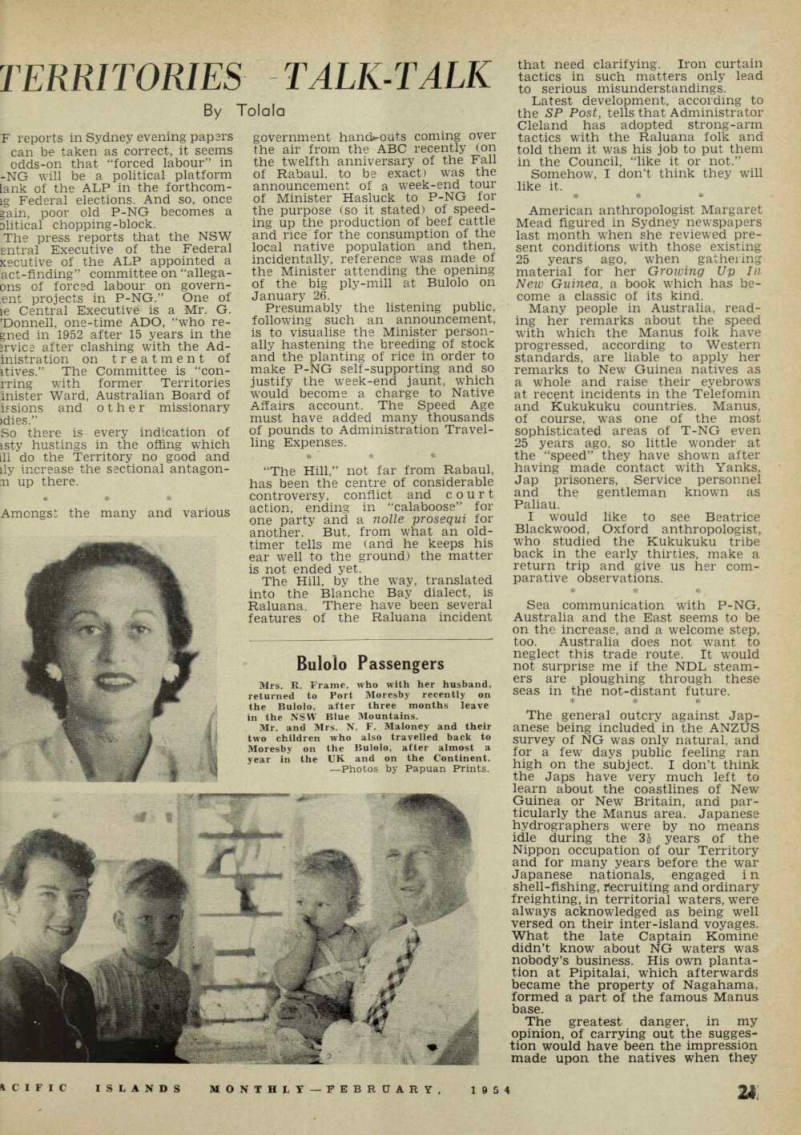
Buloio Passengers
Mrs. R. Frame, who with her husband, returned to Port Moresby recently on the Buloio, after three months leave in the NSW Blue Mountains.
Mr. and Mrs. N. F. Maloney and their two children who also travelled back to Moresby on the Buloio, after almost a year in the UK and on the Continent. —Photos by Papuan Prints.
iw Japanese engaged in this work, de by side with ANZUS personnel, he “turning the other cheek”
Dlicy is not readily understood by rown Brother and, before we knew here we were, the rumour could isily have been started by some iterprising agitator that Japan as making a check-up before iquiring a new property! * * * “Twenty Kanaka police bands .en from Port Moresby arrived in /dney. . . .” Thus the SMH on its ont page one day last month. Tut, it! Scarcely a tactful appellation t fellow-students in our Aus alian Secondary Schools, even tough it may be etymologically ►rrect! * * * And, while on the important sub ct of secondary education for NG itives: Don Barrett, MLC for NG lands, seems to have a justifiable mplaint that the Administration ithheld a UN Trustee Council port dealing with this subject. It >pears that Mr. J. H. Jones (NG ecial representative and one ne DDS), in answer to a ques- Dn by the Syrian representative, id NG indigenous children had )t yet reached the stage for condary education; and, when ady, it would be provided in the ‘rritory. Mr. Barrett believes the lange of policy was the result of trong representation by mission ies from the Kwato Mission.”
Ee should have described the rep sentation as Abel, not Strong.) To me, this proposed colour co ucation scheme is a very risky isiness, from the sociological pect. Time will tell; but the inion of the Australian parents those attending schools with NG idents should be obtained. * * * It was only natural that P-NG id native welfare should come up r discussion at the congress of the istralian and New Zealand Assn, r the Advancement of Science.
Professor of Geography O. H. K.
Spate plugged for the extension of European plantations and native geared economy in the Territory.
“Forced European development,” he envisaged as “leading to a Second Kenya.” . . . Anthropologist Stanner criticised mission teaching as sub ordinating native cultures; and Prof.
Elkin thought many years would elapse before full-bloods of NT be came assimilated, adding: “If we are honest we may have to admit that we are not sure whether we want them to be assimilated.” And the Professor has got something there which could apply to P-NG “if we are honest,” and not pro pounding policies for the edifica tion of the UN critics. * * . * A new film star arising in Lon don is Diane Cilento, daughter of T-NG’s one-time PMO, Sir Raphael Cilento. Press blurbs say she was born in NG, but as she is only 21 now that would mean 1932 as her birth year. If my memory serves me aright, Sir Raphael and Dr.
Phyllis (his so-capable wife who is well remembered especially in Rabaul Chinatown, for her child welfare work) left the Territory circa 1928. Still, if Diane wants to claim NG as her birth-place, I don’t suppose anyone will have objection. * * * ■ Critics criticised section; UN Trusteeship Council delegates, who visited P-NG last year and were free with criticism of local condi tions, have themselves come in for some outspoken criticism from the Moresby branch of the Australian Ass’c’n. for UN, which complains of rudeness, and lack of tact on the part of delegates. Special exception is taken to the remarks of the Dominican member.
I am not at all surprised—it is time P-NG locals stood up for them selves. For years, planters and commercial enterprises have been accused by L of N and UNO of be ing tyrants and exploiters of natives, and Government officials of not
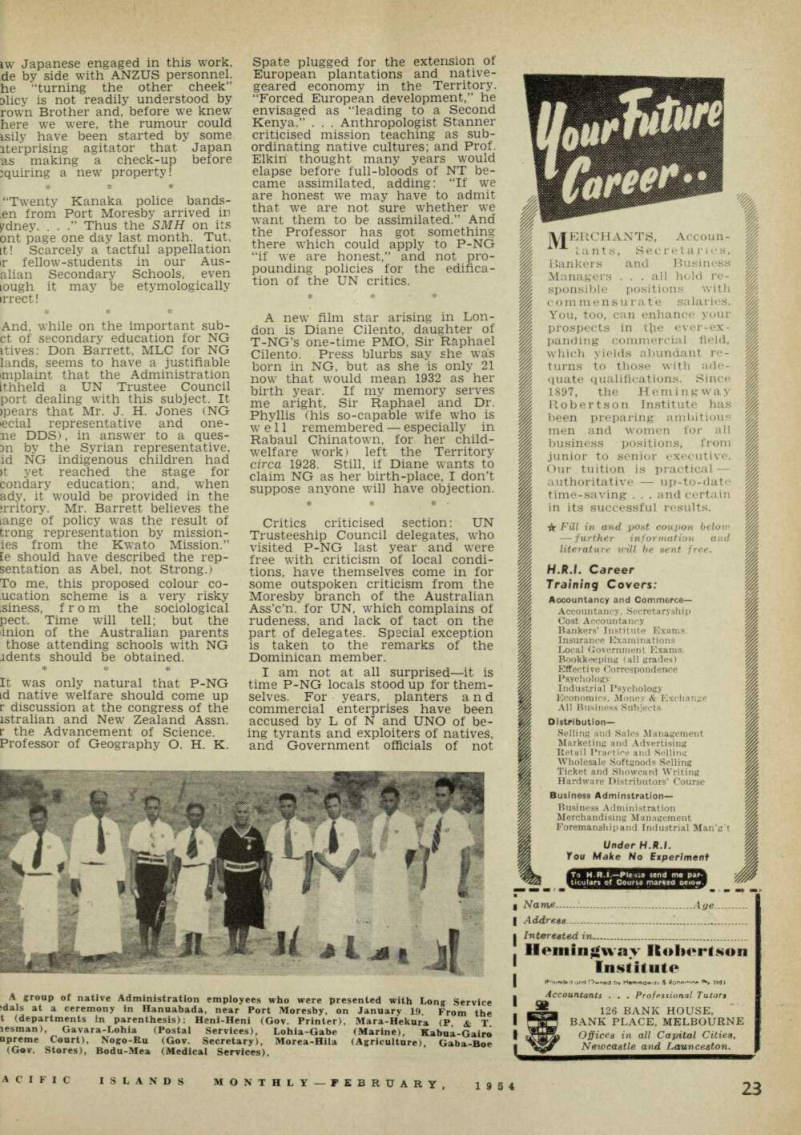
A group of native Administration employees who were presented with Long Service [?]dals at a ceremony in Hanuabada. near Port Moresby, on January 19. From the [?]t (departments in parenthesis); Heni-Heni (Gov. Printer), Mara-Hekura (P & T. [?]lesman), Gavara-Lohia (Postal Services), Lohia-Gabe (Marine), Kabua-Gairo [?]upreme Court), Nogo-Ru (Gov. Secretary), Morea-Hila (Agriculture), Gaba-Boe (Gov. Stores), Bodu-Mea (Medical Services).
adequately safeguarding native in terests.
Administration officials always re main mute and tactful (an attitude, no doubt, prescribed by Canberra) but non-officials certainly do the Territory good by challenging UN representatives’ attitude towards dwellers in Trust territories.
For years, now, I have wanted to tell these unqualified critics of NG to jump into the Lakes —first Geneva and now Success —and until more people do this Australia will always be bounced by these folk who are handing out pompous criticisms in order to hold their jobs. * * ♦ Lae is anxious that the RPC parade ground at Malahang should be resumed as an historical site.
Another site, with greater historical interest, is Proclamation Square in Rabaul, where the ceremony of tak ing over German New Guinea by the Australians in September, 1914, was carried out. It was also the scene of the public flogging admin istered to the German civilians in volved in the flogging and ill-treat ment of the Australian missionary, Rev. W. H. Cox, during the first days of War I. It is block 21 on the current Rabaul town plan. * * * Bits and Pieces: Old-time T-NG resident Willy Dupain and his charming wife were in Sydney last month at the Australia—he now is
BP Manager at Cairns. . . , Edwina Hordern, of Bowral, is engaged to marry Peter Bailleu, of Victoria. He is a step-son of Harold (3LO) Cold ham, a popular T-NG old-timer. . ..
Hon Camilla Wedgwood, of the SOPA, has been elected a member of the Social Scientific Research Council of Australia the only woman member. . . . Passed to his rest in Moresby is Lionel P. B.
Armitt, one of Papua’s oldest and best-known residents. By his mag azine articles in US and Britain he put Papua on the map. He arrived in Papua about 1898. . . .
U Mr. R. M. Taylor, for m e r ly, Financial Secretary in the Gov ernment of Fiji, who was trans ferred to Northern Rhodesia in 1952, has been seconded to the post of] Secretary of Transport in the new Central African Federal Govern ment.
Mr. A. L. Baker, Establishment Officer in the Fiji Secretariat,* accompanied by his wife and family, left Suva in late January on over seas leave. During his leave Mr.
Baker will attend a conference ofl Establishment at the Colonial Office in London.