£5 Million-A-Year
p. 19 · Read in the full issue
Industry
CNGT Mill Opened at Bulolo
[THE plyw r ood factory at Bulolo, L owned jointly by Bulolo Gold Dredging, Ltd., and the Aus alian Government, was officially lened, on January 26, by the [mister for Territories, Mr. Paul asluck.
The mill is now in production id it is expected that the first lipment of ply will be made tp te United States in March. Daily itput of the mill will be about i tons of 3 16 in. plywood in four fferent sizes. It will add £5 illion, to the annual overseas [ports of the Territory.
American experts say that the ywood is better than any pro iced in America and Canada (cause it has the minimum of lots in the wood, very little grain id the logs are of even cylindrical easurement —the trees that pro de them going up 90 feet before ,ey branch.
For these reasons Bulolo will oduce a high grade ply with the inimum of wastage.
Everyone is pleased with the ilolo mill—except a few dis untled Australian manufacturers plywood and some Labour liticians who imagine that it is threat to Australian industry.
Provision is made for a certain lount of Bulolo’s production to made available to Australia if juired, but the bulk of production to go to North America where it 11 earn dollars.
Here are some facts and figures out the new undertaking; ► The mill was built at a total cost £1,340,000.
I The company, Commonwealth-New inea Timbers, Limited, has an horised canital of £2,000,000, and led capital of £1,500,000. Half the res, plus one, are held by the Com awealth Government, and the other f, less one, by Bulolo Gold Dredging, lited. i Board of Directors: Mr. F. H. vitt, Mr. G. Gummow (Commonwealth rt.), Mr. A. W. Austin, Mr. L. W. gstrand (BGD, Ltd.), i Chairman of the Board of Directors, L. W. Austin; General Manager of company, Mr. L. W. Bergstrand. (Mr. gstrand, who is also General Manager Bulolo Gold Dredging, Limited, joined staff of that company in 1931 and i been associated with it ever since), i The mill, covering an area of four es, was designed by an American firm Engineers and Contractors, In porated. of Tacoma—who have built 25 wood plants. As a result the mill has ry proved and known device for chanisation of plywood processing, is, it is hoped, will offset the high our costs in the Territory.
Although plywood production is expected to occupy the mill for the present, it is probable that in the future wall-board and wood-pulp for high grade writing paper will also be manufactured.
The new undertaking has given the Bulolo valley a new lease of life. Five senior technical men sent from BGD to the United States last year to study the latest production methods are key per sonnel now the mill is in produc tion. Gradually, as the gold-mining part of BGD’s activities diminish, men will be transfered to plywood production.
Although pioneering and develop ment in Papua New Guinea has largely been left to the “small man” to whom most public sympathy goes large-scale de velopment of the type undertaken by CNGT is the only method likely to get quick results and in our time. It is the answer to the thousands who are wont to say that “They should do something about developing New Guinea.” Reduced to £SD it means an outlay of millions instead of hundreds or thousands.
Mumeng Bridge Opened,
Too
During his visit to Morobe for the opening of the plywood mill, Mr. Hasluck also opened a bridge across the Mumeng Creek on the Lae-Wau road. The bridging of the Mumeng is a vital link in the success of the plywood venture. All ply is to be freighted out by road in a fleet of 7-ton trucks to ware houses at Lae on the coast.
Mumeng crossing has been a nightmare to drivers on the Wau- Labu road for years. It is a swiftly running mountain torrent that crosses the road just below the
Mumeng Hotel; it is dangerous at any time and a death-trap after I dill.
• The plant will be operating 24 hours a day, five days a week, with 155 Euro peans and a similar number of native assistants. • CNGT has a timber permit over 40,000 acres compris ing mainly hoop and klinki pine, and expects to use 12,000,000 superfeet of logs a year for its plywood operations.
This will clear about 500 acres yearly. • A perpetual forest is to be estab lished through re-
planting of logged-out areas by the Ad ministration Forestry Department thus establishing a 50-years cycle.
First postwar plantings by the Forestry Department have already reached a height of 20 feet in three years, and pines in a small pre-war test plot have grown to 80 feet in 11 years. (This compares with an average growth of a little over a foot a year in cold climate pine forests).
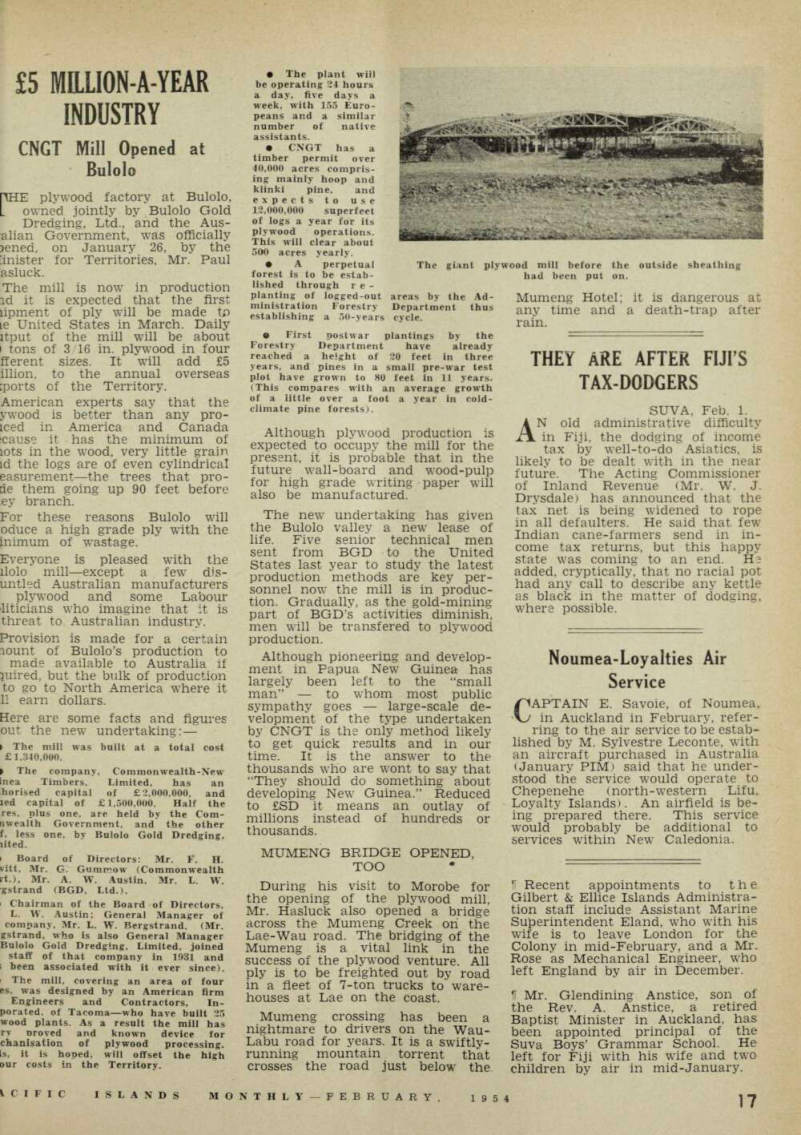
The giant plywood mill before the outside sheathing had been put on.