What Not To Eat In The
pp. 86-89 · Read in the full issue

Pacific
(Extracts from talk broadcast from
ZJV by the Nutrition Section of the
South Pacific Health Service ).
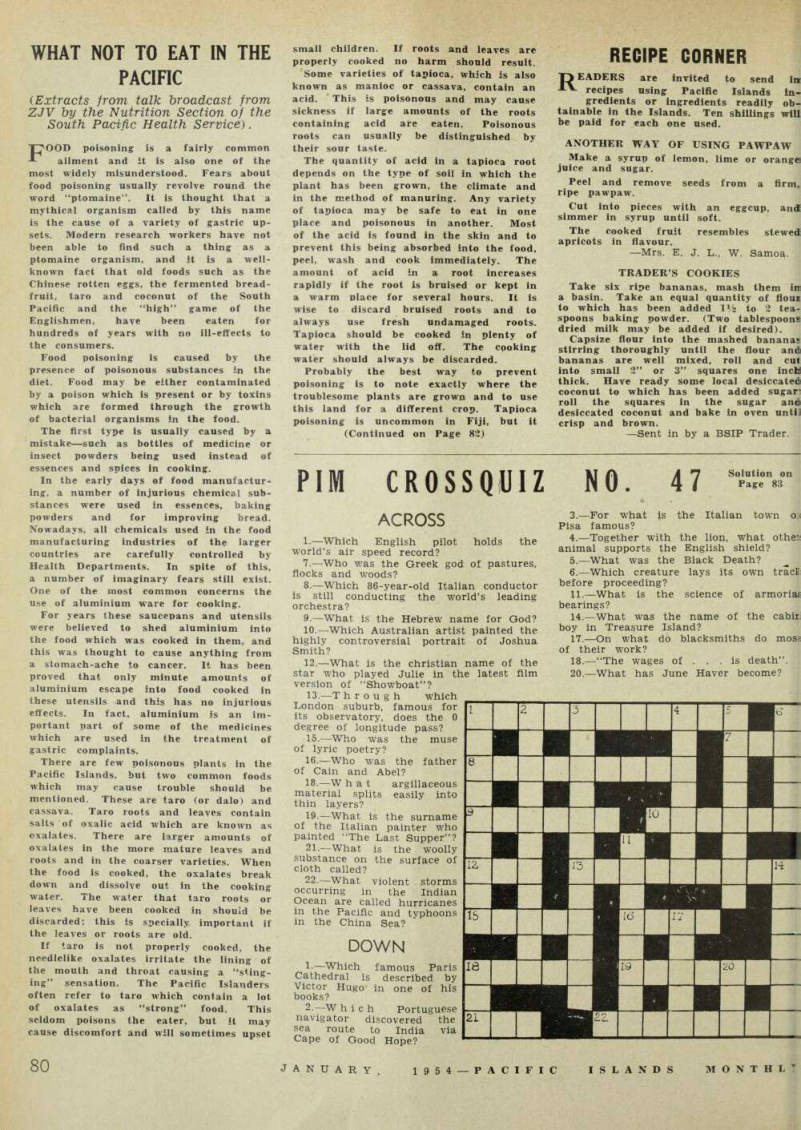
FOOD poisoning is a fairly common ailment and it is also one of the most widely misunderstood. Fears about food poisoning usually revolve round the word “ptomaine”. It is thought that a mythical organism called by this name is the cause of a variety of gastric up sets. Modern research workers have not been able to find such a thing as a ptomaine organism, and it is a well known fact that old foods such as the Chinese rotten eggs, the fermented bread fruit, taro and coconut of the South Pacific and the “high” game of the Englishmen, have been eaten for hundreds of years with no ill-effects to the consumers.
Food poisoning is caused by the presence of poisonous substances in the diet. Food may be either contaminated by a poison which is present or by toxins which are formed through the growth of bacterial organisms in the food.
The first type is usually caused by a mistake—such as bottles of medicine or insect powders being used instead of essences and spices in cooking.
In the early days of food manufactur ing, a number of injurious chemical sub stances were used in essences, baking powders and for improving bread.
Nowadays, all chemicals used in the food manufacturing industries of the larger countries are carefully controlled by Health Departments. In spite of this, a number of imaginary fears still exist.
One of the most common concerns the use of aluminium ware for cooking.
For years these saucepans and utensils were believed to shed aluminium into the food which was cooked in them, and this was thought to cause anything from a stomach-ache to cancer. It has been proved that only minute amounts of aluminium escape into food cooked in these utensils and this has no injurious effects. In fact, aluminium is an im portant part of some of the medicines which are used in the treatment of gastric complaints.
There are few poisonous plants in the Pacific Islands, but two common foods which may cause trouble should be mentioned. These are taro (or dalo) and cassava. Taro roots and leaves contain salts of oxalic acid which are known as oxalates. There are larger amounts of oxalates in the more mature leaves and roots and in the coarser varieties. When the food is cooked, the oxalates break down and dissolve out in the cooking water. The water that taro roots or leaves have been cooked in should be discarded; this is specially important if the leaves or roots are old.
If taro is not properly cooked, the needlelike oxalates irritate the lining of the mouth and throat causing a “sting ing” sensation. The Pacific Islanders often refer to taro which contain a lot of oxalates as “strong” food. This seldom poisons the eater, but it may cause discomfort and will sometimes upset
small children. If roots and leaves are properly cooked no harm should result.
Some varieties of tapioca, which is also known as manioc or cassava, contain an acid. This is poisonous and may cause sickness if large amounts of the roots containing acid are eaten. Poisonous roots can usually be distinguished by their sour taste.
The quantity of acid in a tapioca root depends on the type of soil in which the plant has been grown, the climate and in the method of manuring. Any variety of tapioca may be safe to eat in one place and poisonous in another. Most of the acid is found in the skin and to prevent this being absorbed into the food, peel, wash and cook immediately. The amount of acid in a root increases rapidly if the root is bruised or kept in a warm place for several hours. It is wise to discard bruised roots and to always use fresh undamaged roots.
Tapioca should be cooked in plenty of water with the lid off. The cooking water should always be discarded.
Probably the best way to prevent poisoning is to note exactly where the troublesome plants are grown and to use this land for a different crop. Tapioca poisoning is uncommon in Fiji, but it
(Continued on Page 82)
has been reported from the Tongan Islands.
Poisonous fish cause a considerable amount of trouble in the Pacific and it is thought that fish become poisonous after eating certain foods. In many parts, fish are poisonous during one season of the year, and edible during another. However, it is very important to find out about poisonous fish from local people as there have been many instances of the same type of fish being safe in one place and dangerous in another.
TJACTERIAL organisms are the most serious cause of food poisoning.
Certain types of disease-bearing bacteria grow and multiply rapidly in food and produce toxic substances which cause illness when the food containing them is eaten. Amongst the most serious food borne diseases are tuberculosis, typhoid fever, septic sore throats, diarrhoea, vomiting and botulism. Most of these can be prevented if the food is properly cooked and stored.
In warm, moist climates, bacteria grow more rapidly and it is therefore very important to take extra precautions.
This can be done if the following rules are followed carefully:— • Food should never be handled by anyone who is suffering from a sore throat, boils or septic cuts as bacteria may easily spread from the infected person to the food. • All prepared foods such as soups, sausage meats, cooked fish and meats, white sauce, salad dressing, cream, gelatine and milk puddings and ice creams should be kept in a cool place.
It is very important that foods are cooled quickly and kept covered when in the open. • All left-over foods such as soups, meats, fish and savouries made with white sauce should be heated to boiling point and cooked for 10-15 minutes or better still, heated in a pressure cooker, before serving. This is particularly im portant if the food has not been stored in the refrigerator. • Do not use foods made from milk, eggs, cream or gelatine if these have become warm in a defrosted refrigerator, and never re-freeze ice cream or any frozen milk food which has melted. • Make sure that any food which develops an unusual odour during storage is not used. • The following foods have a bad reputation for causing food poisoning if not properly cooked and stored, and should be watched carefully: Gelatine savouries and puddings; salad dressings made with eggs and milk; white sauce dishes; meat, fish or milk soups; potato salad or any salad mixed with mayonnaise and kept for another day; cream cakes; re-frozen ice cream.
Food poisoning should not occur in households where food is selected and
prepared with reasonable care. Any suspected case should be reported at once to a doctor. Try to remember exactly the foods which were eaten the previous day and make a note of them. This helps to trace the source of the trouble.
Bacteria do not grow in strong acid, salt or sweet foods. Because of this, acids such as vinegar and salt and sugar are used in the making of pickles, chutneys and jams. Some moulds will grow on the top of these foods if jars are not covered properly but moulds are harm less although they spoil the appearance and flavour of the preserve. npHE following chutney keeps well and is an excellent addition to cold dishes and curries.
Pineapple Chutney
1 medium sized pineapple. 2 cups seedless raisins.
IVz cups of vinegar. 1 tablespoon salt.
IVz lb sugar. 2 tablespoons finely chopped fresh or preserved ginger root. 1 clove garlic, chopped fine. 2 or 3 finely chopped small fresh red peppers—be sure to remove the seeds. 4 oz finely chopped almonds or nuts.
Peel pineapple, remove core and cut into small pieces. Add all ingredients except nuts. Cook slowly until pine apple is tender. Add nuts and cook until the mixture thickens to the desired con sistency. Stir frequently to prevent burning. Pour boiling hot chutney into hot sterilised jars and seal immediately.
Serve with meats and curried dishes.
U Sir Brian Freestone, KCMG, Secretary-General of the South Pacific Commission, will retire from that post at the end of 1954, and will take up his residence in Eng land. In 1952, when he retired from the British Colonial Service, Sir Brian was Governor of Fiji. Since then, he and Lady Freestone have been highly esteemed members of the British community in New Cale donia. Their daughters now are at school in England.
On their way to and from Ameri can Samoa, a USA Senate party, lead by Senators Guy Gordon and Milton R. Young, recently visited Western Samoa.