A Womens Mission
pp. 85-93 · Read in the full issue
By Charles Brown, Jr.
r[ERE was a time, in 1918, when the Society Islanders died from influenza faster than their bodies could be buried or burned.
From Tahiti to remote Maupiti— everywhere—the scourge smote the seven islands like the wrath of Revelation. Verily, wailed the brown islanders, God had commanded the seven angels: “Go your ways, and pour out the vials of the wrath of God upon the earth.”
Now, at that time, Outside Heaven, the native pastor of Maupiti, had voyaged with Raiata, his wife, to Uturoa, in Raiatea, which is the French Administrative seat of the Leeward Group of the Society Archipelago. He had gone to ask the Reverend Charles Vernier, director of the French Protestant Mission’s pastorate in this region of French Oceania, for a bronze bell to suspend from the patriarchal tree beside his church on Maupiti beach.
While this weighty matter was discussed, Raiata visited in her childhood home.
Two days after arriving, she was smitten with influenza. Her con dition rapidly worsened. On the fourth day she died.
The burial of Raiata accom plished, Outside Heaven hastened home to Maupiti. Here, in that Dhristmastide, he conducted 43 funerals.
Very forlorn now was the hill side parsonage. And deeply touched ve r e the Maupitians by their ninister’s melancholy impress of ?rief; they wished they could dis sipate it.
How slowly passed time as he nourned! As slowly as grew the emale coconut-palm he planted in ;he parsonage garden in Raiata’s nemory.
PASTOR Charles Vernier sat on the parsonage verandah, atop Mission House Hill, at Uturoa, lis short, white-clothed body in a dicker chair. Through the coconut •alms, he saw ascending the mission »ath four bare-foot, brown women Iressed in overfull, outmoded black :arments, their faces shaded from he mid-morning sun by wide rimmed hats made of plaited white •andanus strips.
Who could they be? he wondered.
Vhy were they coming?
Presently, he recognised them: laupitian church members. One, be fat woman climbing behind the thers, was Tiare Teatua, Flower of Jod: a deacon’s wife; the wizened [Oman, her mother, simply called 'lower of God’s mother, was a tible-class teacher. The two other romen, fairly young, were humble ibourers in the Lord’s coconut rove.
“I or ana otou! (Good day all.)” A smile lighted Monsieur Vernier’s earnest face and direct brown eyes as he greeted them on his verandah.
Flower of God, panting hard, said in Maupitian, “We have just—arrived in —t he H eliotr op e —to acquaint you—with the object—of our visit.”
Monsieur Vernier invited them into his chair-lined study. “Will you have something to eat?”
“Don’t bother —about us.”
Flower of God seated her self before his desk. “We had bread—and coffee —at Ah Sin’s shop. Our visit is —more important—t ha n food of the table. We seek —spiritual food.”
Whereat, Flower of God’s mother g r a y-h aired, copper-coloured, with quiet, serious face and wide-set dark eyes—stood before Monsieur Vernier, who sat with hands folded on the
desk. She said; “Savant of God, be saved forever. . .
This is the purpose of our visit: We seek a wife for our Min ister, and a mother for us all. You know Outside Heaven lost his wife three years ago, and that the Lord God has said: ‘lt is not good that man should live alone.’
“On Maupiti, we cannot find a suitable woman. But on Tahaa and Raiatea are two women who will do; and we were led here by the spirits to see if one of them will consent to marry our minister. He knows nothing about our reason for com ing here.
“The first woman is Itae—White Bird of the Sea; she lives on Tahaa.
She is a respectable widow —a church sister. She knows her Bible, and is capable of teaching the women and children’s classes.”
Flower of God’s mother sat down.
“I approve of your voyage.”
Monsieur Vernier praised them for coming. He stood up. “Go immedi ately and speak with Itae.” he added, with eager interest.
After praying for their under taking he showed them to the verandah, and watched them de scend to the beach.
“There are no men with you?” he called down the path.
“None, except our crew,” Flower of God cried back. “We are on a women’s mission; not to sell copra and arrowroot. If we don’t suc ceed, we’ll return and tell you the second woman’s name.”
“I’ll look for you to-morrow morning.”
BUT all the next day he looked without effect: all the lagoon lay becalmed. Not until the second morning did he see the women return.
“Did you succeed?” he shouted down the path.
“Oh, no!” they cried up to him.
In the study, Flower of God’s mother, her face reflecting chagrin, said: “We saw Itae. She gave us food, cushions, and sleeping-mats.
At supper and after supper, we talked of everything but our visit.
Not until near bedtime prayers did we ask her to let us tell why we had come. She listened, and cried.
“ ‘Aita e peapea —it does not matter,’ she said. But her way of speaking showed that it mattered very much. T will think it over.
Your visit pleases me. Remain for my answer. I will give it to-morrow morning.’
“Itae talked with us till mid night,” continued Flower of God’s mother, her brow scored with deep furrows of vexation. “Just before we fell asleep, we heard her go out to ask her relations for their opinion and advice. At daybreak, she brought her answer.
“ ‘Eiaha e peapea —don’t trouble yourselves,’ she said, crying. T can not accept; Outside Heaven and I are related through the marriage of a distant ancestor. Don’t feel bad.’
“But we knew Itae’s mind; Maupiti is a ghastly island —where our heathen ancestors’ ghosts cry at night. She has changed since
(Continued on Page 86)
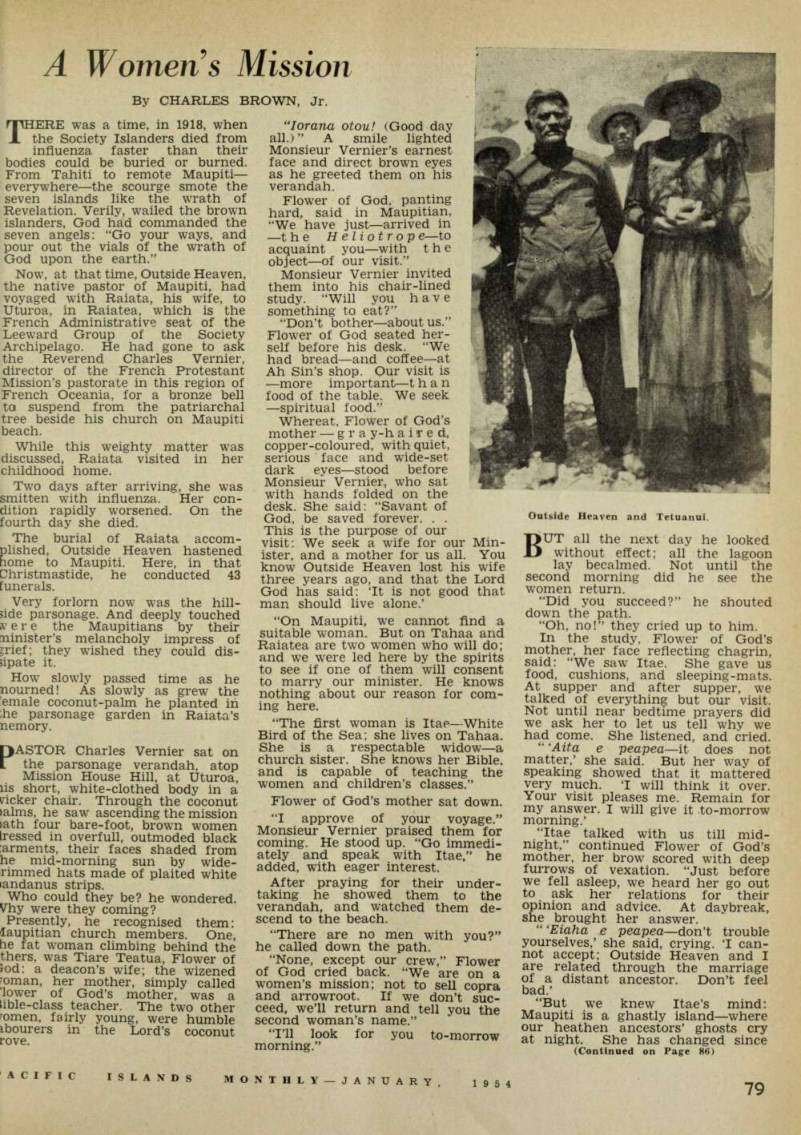
Outside Heaven and Tetuanui.
her husband died; and smokes con tinuously the cigarettes a China man gives her. She is not, we could see, a woman with an under standing heart.
" ‘Aita e pea-pea —all right,’ we said to her. ‘The spirits have not agreed with this proposal.’
“We have returned,” concluded Flower of God’s mother, “to tell you the second woman’s name.”
“We shall not look behind,” Mon sieur Vernier smiled encouragement; “We are still looking forward. We will make a new beginning; and God will provide for the ending.
Who is the second woman?”
Flower of God stood up. She answered; “Tetuanui —Praised Woman—the widow of the pastor at Avera—here on Raiatea. Her hus band died three years ago in the plague.”
“Tetuanui is well chosen; but she is from Rimatara, in the Austral Islands.” Monsieur Vernier was out spoken. “I know three things about her: she will not marry again; she intends to return to Rimatara, where she has children; and a deacon of Avera would marry her.”
“This will be difficult,” agreed Flower of God’s mother. “We put the matter in your hands.”
“Go, then, to Tahi Vahine on the beach; remain with her until I send for you. Say nothing about why you’ve come here.”
TWO evenings later, responding to Monsieur Vernier’s note, Tetuanui came to the parson age. Tall and queenly, her eyes deepest brown, she wore a black silk gown, with her braids of glossy blue-black hair hanging to the waist. Never before had Monsieur
Vernier seen her so lovely to look at.
After their dinner, Tetuanui fol lowed him into the study. When she heard why she had been sent for, she cried. Finally, she an swered: “You are our father. You know everything about us and what is
*ood foi us. If it is your wish for ne to go to Maupiti, well —I will jo. I must go; I have been asked hr a minister.”
Monsieur Vernier thanked her.
He dispatched his housemaid to fahi Vahine’s house.
Again, the black procession ntered the study, with heads bowed.
Greeting Monsieur Vernier and ?etuanui, the women sat down, and waited to hear him.
After looking solemnly at them, le snapped the tension. “Tetuanui ias consented to marry your min ster. She is happy that she will gain be a minister’s wife, with new lothers and children to guide.” ’hen, he asked God to be always ind to Tetuanui and Outside teaven.
The four women cried with great jy, embraced and kissed one an ther. When they kissed Tetuanui, ley affectionately stroked her arm, fter native custom.
“la haamaitai te Atua i ’a oe. ■od bless thee,” said Flower of rod’s mother. “Ever dear to our linister and us wilt thou be.” * * * Sunset was shooting red and gold :rows among the palmtops of !aupiti the following evening when, dling alongside the coral jetty ard by the white church with the id roof, the cutter Heliotrope opped anchor in the water reflect g the stained-glass sky. Immedi ;ely, her four passengers climbed to te thatched-roof, bamboo-walled irsonage, directly above the church.
The stocky, prematurely grey, sad ced pastor greeted them with an quiring gaze in his study. “You’ve 1 been to Raiatea? Was your visit iportant?”
“Yes—a women’s Mission.” Flower God’s voice was sweet as orange ossom honey.
“Was it favoured?” ‘‘Yes;the spirits have agreed with Whereat, Flower of God’s mother iscribed their mission. When she as finished, there was no sound in ie room, except Outside Heaven’s •eathing; anybody on the beach uld have heard that. He looked ; though he doubted his having ;ard correctly.
At length, he collected himself. l women’s mission it was indeed, know Tetuanui well. She’ll make e a faithful wife. And a good etua to you and your children.” ad, looking pensively out at the conut palm he had planted in aiata’s memory, he mused, laiata’s spirit will understand my arrying Tetuanui.”
Diane Cilento, daughter of Sir aphael Cilento, formerly medical ficer in New Guinea, was signed ) in London in January, to make <■ films for Sir Alexander Korda, le is very young—born in New uinea 21 years ago—but already e is a famous beauty and a suc ssful London actress.