This Adam is a kukukuku
pp. 82-84 · Read in the full issue
Book Reviews
WHEN Colin Simpson gave up most of his radio work —for which he was well known — and decided to make his living by writing books, there was no lack of local prophets to call the scheme crazy: Australia is a tough place in which to make a living from books. But if Simpson can keep up the standard of his first two Adams then there should not be too much trouble in doing just that.
The New Guinea Adam, like its Arnhem Land predecessor, has all the hallmarks of a best-seller.
Adam in Ochre, which appeared about two years ago (and concerns the Arnhem Land aborigines) has now been followed (October, 1953), by Adam with Arrows. The new book is produced to the same high standard that put Adam in Ochre well ahead of most Australian book productions; and it is illustrated with line drawings, and black-and white and coloured photographs (the latter financed by Sir Edward Hallstrom, to whom the book is dedicated).
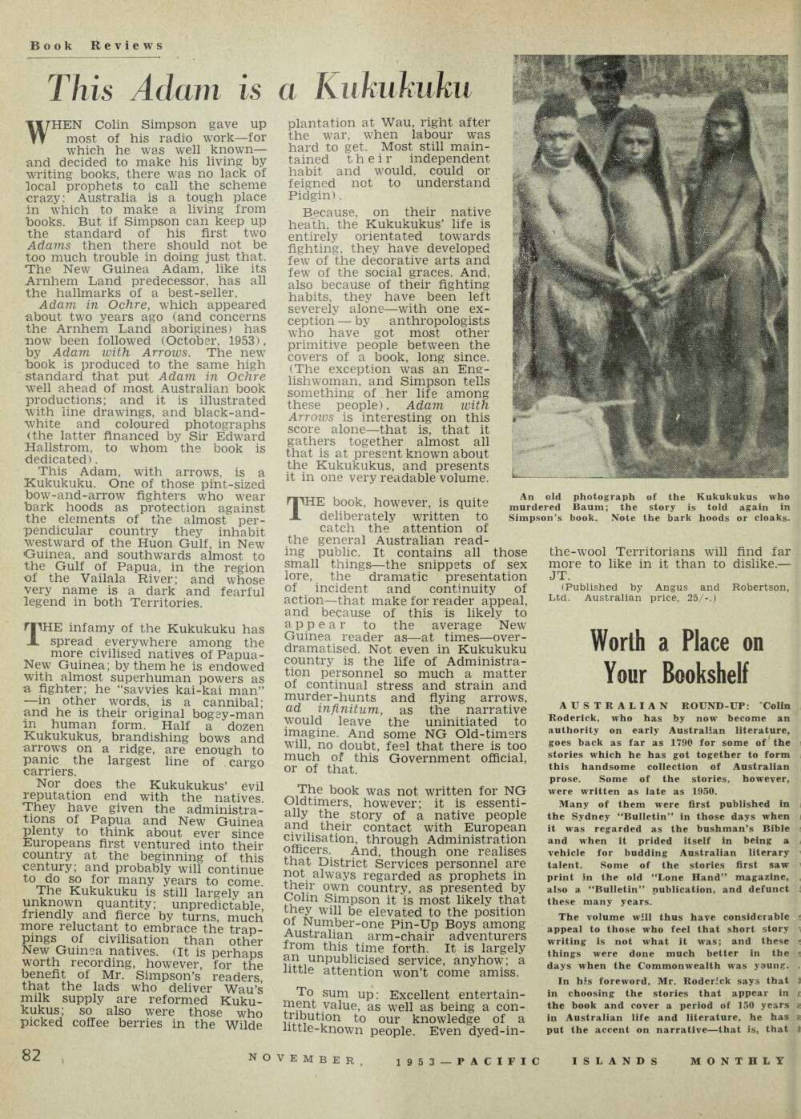
This Adam, with arrows, is a Kukukuku. One of those pint-sized bow-and-arrow fighters who wear bark hoods as protection against the elements of the almost per pendicular country they inhabit westward of the Huon Gulf, in New Guinea, and southwards almost to the Gulf of Papua, in the region cf the Vailala River; and whose very name is a dark and fearful legend in both Territories.
THE infamy of the Kukukuku has spread everywhere among the more civilised natives of Papua- New Guinea; by them he is endowed with almost superhuman powers as -a fighter; he “savvies kai-kai man” —in other words, is a cannibal; and he is their original bogey-man In human form. Half a dozen Kukukukus, brandishing bows and arrows on a ridge, are enough to panic the largest line of cargo carriers.
Nor does the Kukukukus’ evil reputation end with the natives.
They have given the administra tions of Papua and New Guinea plenty to think about ever since Europeans first ventured into their country at the beginning of this century; and probably will continue to do so for many years to come The Kukukuku is still largely an unknown quantity; unpredictable, friendly and fierce by turns, much more reluctant to embrace the trap pings of civilisation than other New Guinea natives. (It is perhaps worth recording, however, for the benefit of Mr. Simpson’s readers, that the lads who deliver Wau’s milk supply are reformed Kuku kukus; so also were those who picked coffee berries in the Wilde
plantation at Wau, right after the war, when labour was hard to get. Most still main tained their independent habit and would, could or feigned not to understand Pidgin).
Because, on their native heath, the Kukukukus’ life is entirely orientated towards fighting, they have developed few of the decorative arts and few of the social graces. And, also because of their fighting habits, they have been left severely alone—with one ex ception —by anthropologists who have got most other primitive people between the covers of a book, long since. (The exception was an Eng lishwoman, and Simpson tells something of her life among these people). Adam with Arrows is interesting on this score alone—that is, that it gathers together almost all that is at present known about the Kukukukus, and presents it in one very readable volume.
THE book, however, is quite deliberately written to catch the attention of
the general Australian read ing public. It contains all those small things—the snippets of sex lore, the dramatic presentation of incident and continuity of action—that make for reader appeal, and because of this is likely to appear to the average New Guinea reader as—at times —overdramatised. Not even in Kukukuku country is the life of Administra tion personnel so much a matter of continual stress and strain and murder-hunts and flying arrows, ad infinitum, as the narrative would leave the uninitiated to imagine. And some NG Old-timers will, no doubt, feel that there is too much of this Government official, or of that.
The book was not written for NG Oldtimers, however; it is essenti ally the story of a native people and their contact with European civilisation, through Administration officers. And, though one realises that District Services personnel are not always regarded as prophets in their own country, as presented by Colin Simpson it is most likely that they will be elevated to the position of Number-one Pin-Up Boys among Australian arm-chair adventurers from this time forth. It is largely unpublicised service, anyhow; a little attention won’t come amiss.
To sum up: Excellent entertain ment value. as well as being a con tribution to our knowledge of a nttle-known people. Even dyed-in-
the-wool Territorians will find far more to like in it than to dislike. — JT. (Published by Angus and Robertson, Ltd. Australian price, 25/-.)
Worth a Place on
Your Bookshelf
Australian Round-Up: Colin
Roderick, who has by now become an authority on early Australian literature, goes back as far as 1790 for some of the stories which he has got together to form this handsome collection of Australian prose. Some of the stories, however, were written as late as 1950, Many of them were first published in the Sydney “Bulletin” in those days when it was regarded as the bushman’s Bible and when it prided itself in being a vehicle for budding Australian literary talent. Some of the stories first saw print In the old “Lone Hand” magazine, also a “Bulletin” publication, and defunct these many years.
The volume will thus have considerable appeal to those who feel that short story writing is not what it was; and these things were done much better in the days when the Commonwealth was young.
In his foreword, Mr. Roderick says that in choosing the stories that appear in the book and cover a period of 150 years in Australian life and literature, he has put the accent on narrative—that is, that
An old photograph of the Kukukukus who murdered Baum; the story is told again in Simpson’s book. Note the bark hoods or cloaks.
each must have a story to tell and not be merely a sketch or a vig nette about a “mood a passing cloud, a flower or a mug of beer.”
Most people who have struggled through the s u r realist tripe that masquerades as the short story among Australian literary high - brows, will probably agree with him. The short story is the hardest literary medium of all, and judging by the manner in which borrowers or buyers of books spurn the volume of short-stories, the least popular.
It is a debatable point whether Aus tralia has yet produced any really great short-story writers—but they all seem to have one dominant characteristic (this is noticeable not only in Roderick’s col lection but in others) and that is their stress on the macabre, the bizarre; on violence or poverty or frustration. Even their humor is inclined to the sadistic.
This is a phenomenon that is hard to inderstand in a country which enjoys so nuch vaunted freedom, sunlight, open spaces, call of adventure and what-have rou. But to write about it is apparently •egarded as corn; it is much more artistic 0 write about misery in Woolloomooloo, r soul-destroying frustration in a small own, or drought and dead sheep in the fever-Never or murder in a bush humpy, n such things does Australia find its iterary expression; God knows why. lost Australians are unconcerned with □isery, drought, frustration and murder nd lead normal enough lives; an overseas eader, addicted to Australian literature, rould be excused for thinking otherwise, lowever.
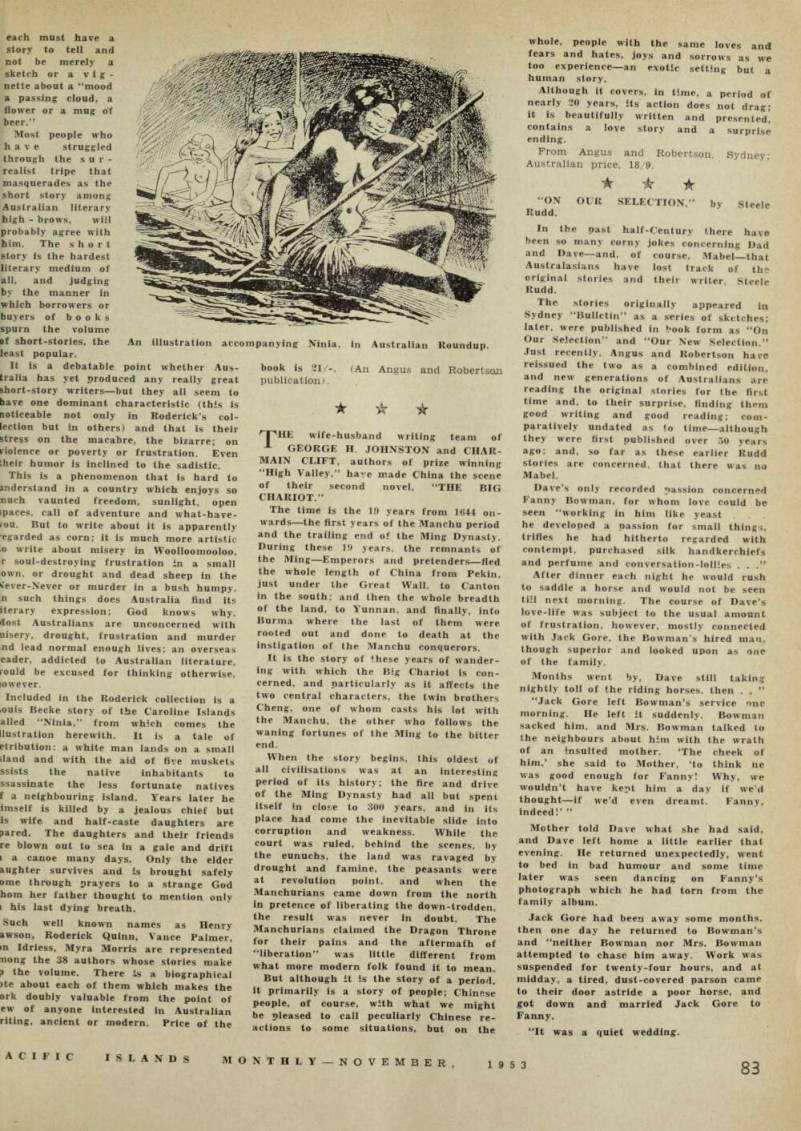
Included in the Roderick collection is a iOUis Becke story of the Caroline Islands ailed “Ninia,” from which comes the [lustration herewith. It is a tale of etribution; a white man lands on a small ■land and with the aid of five muskets ssists the native inhabitants to ssassinate the less fortunate natives f a neighbouring island. Years later he imself is killed by a jealous chief but is wife and half-caste daughters are Pared. The daughters and their friends re blown out to sea in a gale and drift 1 a canoe many days. Only the elder aughter survives and is brought safely “me through prayers to a strange God horn her father thought to mention only i his last dying breath.
Such well known names as Henry awson, Roderick Quinn, Vance Palmer, *n Idriess, Myra Morris are represented nong the 38 authors whose stories make P th « volume. There is a biographical >te about each of them which makes the ork doubly valuable from the point of ew of anyone interested in Australian riting, ancient or modern. Price of the
book is 21/-. (An Angus and Robertson publication!. ★ & ★ 'T'HE wife-husband writing team of
A George H. Johnston And Char
MAIN CLIFT, authors of prize winning “High Valley,” have made China the scene of their second novel, “THE BIG
Chariot.”
The time is the 19 years from 1644 on wards—the first years of the Manchu period and the trailing end of the Ming Dynasty.
During these 19 years, the remnants of the Ming—Emperors and pretenders—fled the whole length of China from Pekin, just under the Great Wall, to Canton in the south; and then the whole breadth of the land, to Yunnan, and finally, info Burma where the last of them were rooted out and done to death at the instigation of the Manchu conquerors.
It is the story of these years of wander ing with which the Big Chariot is con cerned, and particularly as it affects the two central characters, the twin brothers Cheng, one of whom casts his lot with the Manchu, the other who follows the waning fortunes of the Ming to the bitter end.
When the story begins, this oldest of all civilisations was at an interesting period of its history; the fire and drive of the Ming Dynasty had all but spent itself in close to 300 years, and in its place had come the inevitable slide into corruption and weakness. While the court was ruled, behind the scenes, by the eunuchs, the land was ravaged by drought and famine, the peasants were at revolution point, and when the Manchurians came down from the north in pretence of liberating the down-trodden, the result was never in doubt. The Manchurians claimed the Dragon Throne for their pains and the aftermath of “liberation” was little different from what more modern folk found it to mean.
But although it is the story of a period, it primarily is a story of people; Chinese people, of course, with what we might be pleased to call peculiarly Chinese re actions to some situations, but on the
whole, people with the same loves and fears and hates, joys and sorrows as we too experience—an exotic setting but a human story.
Although it covers, in time, a period of nearly 30 years, its action does not drag: it is beautifully written and presented, contains a love story and a surprise ending.
From Angus and Robertson, Sydney; Australian price, 18/9. ★ ★ ★ “ON OUR SELECTION.” by Steele Rudd.
In the past half-Century there have been so many corny jokes concerning Dad and Dave—and. of course, Mabel—that Australasians have lost track of the original stories and their writer, Steele Rudd.
The stories originally appeared in Sydney “Bulletin” as a series of sketches; later, were published in book form as “On Our Selection” and “Our New Selection.”
Just recently, Angus and Robertson have reissued the two as a combined edition, and new generations of Australians are reading the original stories for the first time and, to their surprise, finding them good writing and good reading; com paratively undated as to time—although they were first published over 50 years ago: and, so far as these earlier Rudd stories are concerned, that there was no Mabel.
Dave’s only recorded passion concerned Fanny Bowman, for whom love could be seen “working in him like yeast he developed a passion for small things, trifles he had hitherto regarded with contempt, purchased silk handkerchiefs and perfume and conversation-lollies . . .”
After dinner each night he would rush to saddle a horse and would not be seen till next morning. The course of Dave’s love-life was subject to the usual amount of frustration, how r ever, mostly connected with Jack Gore, the Bowman’s hired man, though superior and looked upon as one of the family.
Months went by, Dave still taking nightly toll of the riding horses, then . . ” ‘‘Jack Gore left Bowman’s service one morning. He left it suddenly. Bowman sacked him, and Mrs. Bowman talked to the neighbours about him with the wrath of an insulted mother. ‘The cheek of him,’ she said to Mother, ‘to think lie was good enough for Fanny! Why, we wouldn’t have kept him a day if we’d thought—if we’d even dreamt. Fanny, indeed!’ ”
Mother told Dave what she had said, and Dave left home a little earlier that evening. He returned unexpectedly, went to bed in bad humour and some time later was seen dancing on Fanny’s photograph which he had torn from the family album.
Jack Gore had been away some months, then one day he returned to Bowman’s and “neither Bowman nor Mrs. Bowman attempted to chase him away. Work was suspended for twenty-four hours, and at midday, a tired, dust-covered parson came to their door astride a poor horse, and got down and married Jack Gore to Fanny.
“It was a quiet wedding.
An illustration accompanying Ninia, in Australian Roundup.
“When they heard of it Mother and Sarah whispered things to one another and Dad thought of Dave. ‘Thank God.’ he said, ‘The horses’ll have a chance t’ get fat now’.”
Our Selection was on the Darling Downs in Southern Queensland where Rudd him self, the eighth child in a family of 13, had lived much the same sort of life as he portrayed in his stories. Those were the toughest days of Australian “cocky farming,” when farm life seemed to con sist mainly of a slab house and a water hole; droughts, and corn and wheat that brought a shilling or two a bushel; of patched pants and no shoes for the kids and a diet of bread and treacle and spuds and pumpkin and mutton, sometimes; more often, kangaroo-tail. But Rudd saw homour where most other Australian writers would have been pleased to see tragedy and in penning his stories gave an imperishable record of Australia be fore pioneering became a spent force.
If you can forget the tenth-rate movies and the radio serials that have cheapened it, you will find Rudd’s “Our Selection” something of a classic. (Australian price, 15/-).